


Notes From The Beauty Contest is a new investment blog that views current market dynamics through Keynes' newspaper beauty contest analogy. At NFTBC we will share deep dives on stocks, emphasizing a philosophy of "faithfulness" rather than trying to play the game.
Welcome to Deep Dive number three - Bruker Corporation ($BRKR). Also a warm welcome to new subscribers who have joined us since the last post a few weeks ago.
Despite previously announced intentions, it became increasingly clear in recent weeks/days that BRKR could be emerging as a nearer term opportunity so I decided to bring it forward in my agenda. To be honest, I had been putting off writing about BRKR. The company has a complex history and sells an intimidatingly large number of esoteric products - how does one write about a business like this and do it justice? My approach is to do it through my own lens, much like with REGN. We’re not going to go line-by-line through the products and neither will we tear apart the financials in painstaking detail. Rather than minutiae, we’re going to focus a bit more on the general to try to get to the bottom of questions such as - what makes BRKR special? My ambition here is to be able to take a motivated reader with little knowledge of BRKR up to a good level of understanding over the course of 45 minutes or so - please let me know if I succeed or fail.
For newcomers to NFTBC, please check out my intro piece here to learn about this blog and what the approach is. I’m publishing this deep dive mere days into a constantly fluctuating new tariff-based world order and BRKR shares have been falling like a stone. Regulars will know I don’t try to play the beauty contest guessing game as to where things are headed in the short-term. Please reach out if you think I’m wrong about something or have something to share. Let’s get going.
2026 Note: for all my BRKR updates since I originally published this post, please visit this link.
[Usual disclaimer - this isn’t intended as advice. Please do your own research. I currently own shares in Bruker.]
Introduction
If you’re not already familiar, BRKR is a producer of high-end scientific instruments, listed on NASDAQ and based in Billerica, Massachusetts. Despite its legal domicile, the company is as much German as it is American, if not more so. It has strong Swiss roots too. BRKR’s biggest end market is in the life sciences, but, as we shall see, it does an awful lot more than that. In simple terms, the principal feature that BRKR’s products share is the ability to see things that are really hard to see - to enable customers to “to explore life and materials at microscopic, molecular and cellular levels”. The applications are broad: from making discoveries in the world of medicine to helping in the manufacture of the latest nanoscale semiconductors.
In February 2008 all of the various Bruker businesses existing at that time were reunited under a single entity, and I consider this to be the effective IPO date - we’ll get into that later. From 2008 to 2024 BRKR compounded its EPS by 10% p.a., revenue by close to 7% p.a. and averaged ~5.5% in organic revenue growth. Notably, it wasn’t until around 2014 that the earnings story really got going with >12% EPS CAGR from 2014-2024. The reason I find BRKR so compelling today is because the earnings growth story is far from over - it’s got a decade or more left to run most likely. Yet the shares are down >50% from their early 2024 highs and trade today at <15x consensus earnings, which I would argue is much too low for a double digit secular growth story.
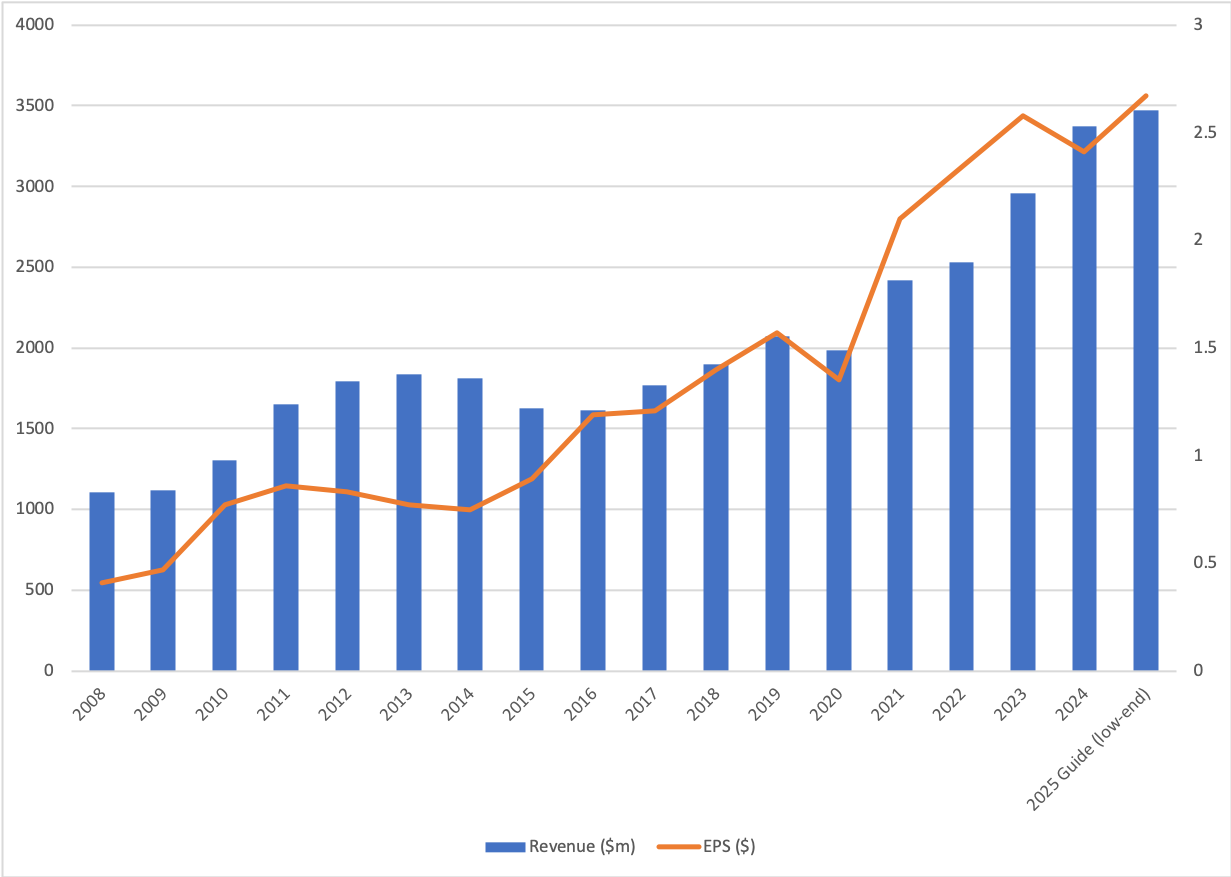
So why the pessimism? BRKR made a couple of strategic but loss-making acquisitions - one in late 2023 and one in mid 2024. Both are guided to be EPS dilutive out to 2026, at which point they’ll turn neutral and then accretive. The fact that BRKR is able to turnaround such perennial loss-makers is a demonstration of the “Bruker Management System” at work. Be that as it may, the company is now well off the medium term earnings trajectory it set at the 2023 Investor Day. BRKR has traded shorter term pain for longer term gain, and the reason they can get away with it is because they have a controlling shareholder-CEO. But beyond this consideration, there are two principal bogeymen on the scene, as I write. The first is announced cuts in grants awarded by the NIH and questions around what happens to the NIH’s budget from here. With higher than average exposure to academic and government end markets, BRKR has long been a popular punching bag for short sellers when questions around the NIH arise - I won’t deny it’s a strategy that works. The second is the implementation of wide-ranging border tariffs in the US and the threat of reciprocation. My intention is to address these concerns much later on - my ambition with this note is that it will hopefully still be relevant to someone picking it up in three or four years and neither do I wish to send my readers to sleep so early on. Clearly the volatile emergence of a new US regime is going to shake things up a bit, so perhaps there’s further still for the shares to fall. I just don’t know. And perhaps BRKR will have to revise down or pull their guidance for the year (although Q1 preliminary revenue came in stronger than expected). But I do believe that this extraordinary business has a vital role to play in the world and that its management will be able to adapt, come what may.
If you had bought BRKR in October 2012 when it lasted traded at 15x, you’d have compounded at ~19.5%% over the next five years - a time during which EPS compounded at ~12.5%. As it happens, today, management are signalling something pretty similar for the years ahead and they’re about as excited as they’ve ever been about the business. The share price, however, implies that investors anticipate a much worse outcome. Who’s right and who should we believe? I aim to address these questions here.
Thesis
Let’s start by quoting Richard Ernst:
And what is the moral of the success story of the Bruker Corporation? Bruker has been active in a unique manner in a high-tech leading field over an incredibly long period of 50 years. Few other companies can match Bruker. Whatever Bruker has achieved has demanded novel technologies that in each case would have been impossible a few years earlier. For academia, such companies are ideal partners: they are highly ambitious, stimulating, and grateful for creative contributions.
This form of exchange can indeed be highly motivating for inventive entrepreneurs and for innovative researchers with endurance. Ultimately, it is courageous and creative efforts that are decisive. The example of Varian also shows that initial success can lead to complacency and the underestimation of motivated competitors. One further lesson that can be drawn concerns company leadership. One should guard oneself from companies that are managed by technically illiterate lawyers and MBAs. Technical expertise coupled to close contact with the market remains essential for avoiding flawed decisions. Bruker has in the past evaded such perils through wise personnel policies and long-term continuity. The company has produced beneficial innovations and added value for 50 years. Also investors might derive lessons: it is still the rock-solid technical expertise of a CEO together with their market awareness that offer the best guarantees against false decisions. With innovative companies, like the Bruker Corporation, the frequently forecast demise of Europe is not imminent. Even if the Bruker Corporation is of late governed by American law, the spirit of this remarkable company is still firmly European.
I could hardly condense the essence of the BRKR thesis any better myself - I’d merely replace “50” with “65”, given that Ernst wrote those words in 2010. Ernst was a Swiss chemical physicist and Nobel prize winner for his pioneering work in nuclear magnetic resonance. He partnered with BRKR for many years and chaired its NMR scientific advisory board. We can drill into some of BRKR’s various competitive advantages later, but, to boil it down, Ernst was claiming that BRKR has an innovation moat. Now, innovation moats sometimes make investors a bit queasy: how can we be sure the company will stay ahead? Well I say, look: they’ve been at the absolute pinnacle of NMR for 50+ years - a high-tech field that enables researchers to make discoveries at the cutting edge of science. Some of these systems cost in the region of $15-20m, and BRKR makes high margins on them. To keep that up for 50 years is extraordinary. There’s clearly something going on - what? Building on Ernst’s comments and from my own research (I only encountered Ernst’s essay recently), we can break the innovation moat down into several buckets:
Process - from the beginning the company was set up to optimally combine industry and research. The result is deep partnerships between BRKR and academic research scientists - to an extent you don’t much find elsewhere. There’s a consistent and well-documented track record of this, starting with those such as Ernst in the 1960s and continuing to the present day with Matthias Mann and other towering figures at the top of the scientific research. Early adopters at the leading-edge work with BRKR in close collaboration in order to move BRKR’s internally developed technologies to a place where they can make scientific breakthroughs. This is the core of BRKR’s long-held goal of “innovating with integrity”.
Culture - “inventive entrepreneurship” as Ernst calls it or indeed “disciplined entrepreneurialism” as BRKR calls it. Empowered by leadership, employees are rewarded to disrupt and take risks.
Leadership - BRKR has one of the most impressive CEOs I have ever encountered, with a rare trifecta of technical talent, operational excellence and savvy in capital allocation. You’ll find much the same in senior management.
Continuity - since the beginning the company has been controlled by a single family
A few years following the company’s unification in 2008 there was a period of digestion, acquisition, divestment, restructuring, reorganisation, ERP implementations and such matters that resulted in temporarily weaker margins and slower growth.
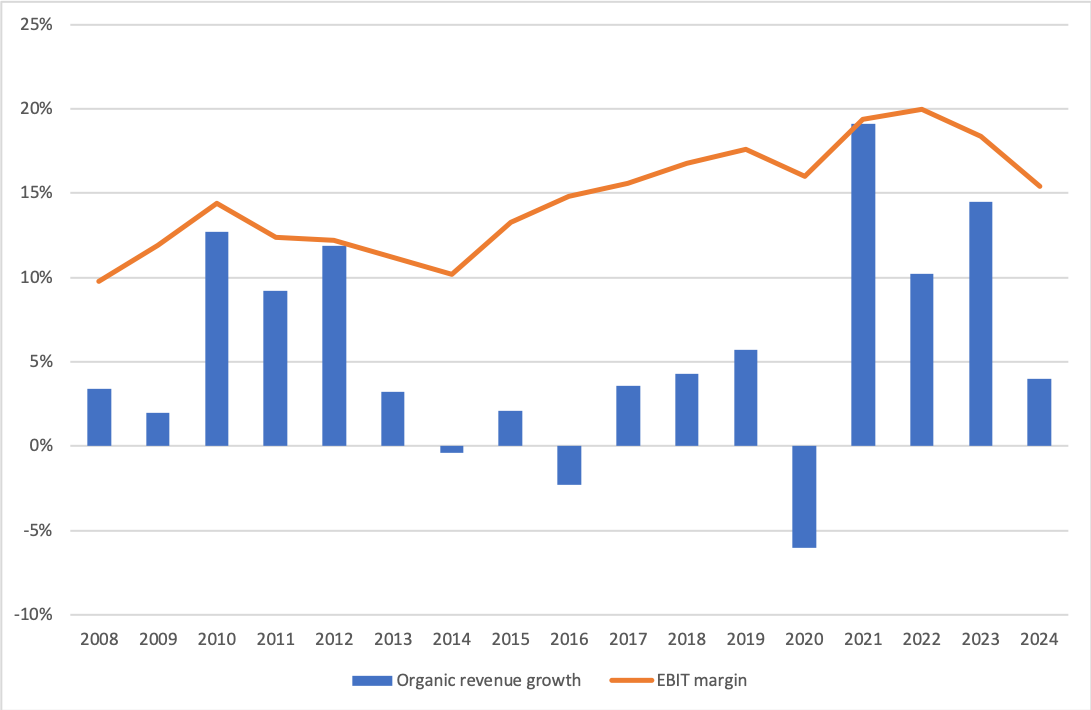
But starting in 2014, BRKR turned into a secular margin expansion story - with 1000bps of expansion in eight years, until the acquisition headwinds I mentioned earlier kicked in. From 2025, management are guiding for >125bps of expansion per year out to 2027 and then for continued expansion out to the mid-20s%. As a sense check, this would still leave BRKR well below peers such as Danaher, Waters and Agilent on margin. Additionally, after a decade of strategic moves to competitively position BRKR’s portfolio for long-term growth, management believe they can grow revenue organically 200bps above the wider life-science tools market, which has historically grown ~4-6% (notwithstanding a post-pandemic hangover for most players, BRKR largely excepted). Given a credible CEO who generally does what he says, I think they’ll do it.
BRKR is one of the most consistently innovative life science businesses I know of. Along with their successful M&A strategy which can continue to expand into tangential areas in a very large market, there’s no reason why BRKR can’t be a much larger business in years to come. The runway is there.
Underpinning this, BRKR is extremely well positioned in technologies that are indispensable to customers’ workflows. According to BRKR they’re are either the number one or two in ~70% of their product portfolio. And in some domains, such as ultra high field NMR, they’re literally the only game in town and five years ahead of anyone else. The key end markets are exciting too, with runways well out into the future: proteomics and multiomics, spatial biology, semiconductors, even nuclear fusion - we’ll touch on all of these.
Before we dive in further: while I don’t intend to make this note particularly technical, I will use numerous terms and concepts that might not be immediately clear to all. I would encourage you to use your preferred AI-powered tools to help out where necessary.
History
As noted, BRKR has a complex history. But I do think it’s worth going into, in order to get an informed perspective on how the company arrived where it is today. It’s helpful to break it down into several distinct periods.
1960 to 1990s - Beginnings
Bruker emerged from the intersection of academic research and entrepreneurship. In 1950s Germany, physicist Günther Laukien had dedicated himself to a then-emerging field: nuclear magnetic resonance (NMR). At the time, the only commercial player was US-based Varian Associates, who had pioneered the technology; but in his 1958 PhD thesis, Laukien had already identified a commercial opportunity: the need for an NMR pulse spectrometer. In 1960 Laukien was appointed Professor of experimental physics in Karlsruhe and in the same year Bruker-Physik AG was officially born. Interestingly, the company wasn't named after its founder - German university regulations prohibited professors from commercialising research while teaching. Instead, co-founder Dr. Emil Bruker lent his name to the enterprise.
Operating from a modest backyard workshop in Karlsruhe, the company began producing laboratory magnets and power supplies while immediately developing an NMR pulse spectrometer. By 1963, Bruker had grown to 30 employees, many of whom were former students of Laukien himself and they launched their first industrially-produced product: an NMR pulse spectrometer. The company quickly became financially viable.
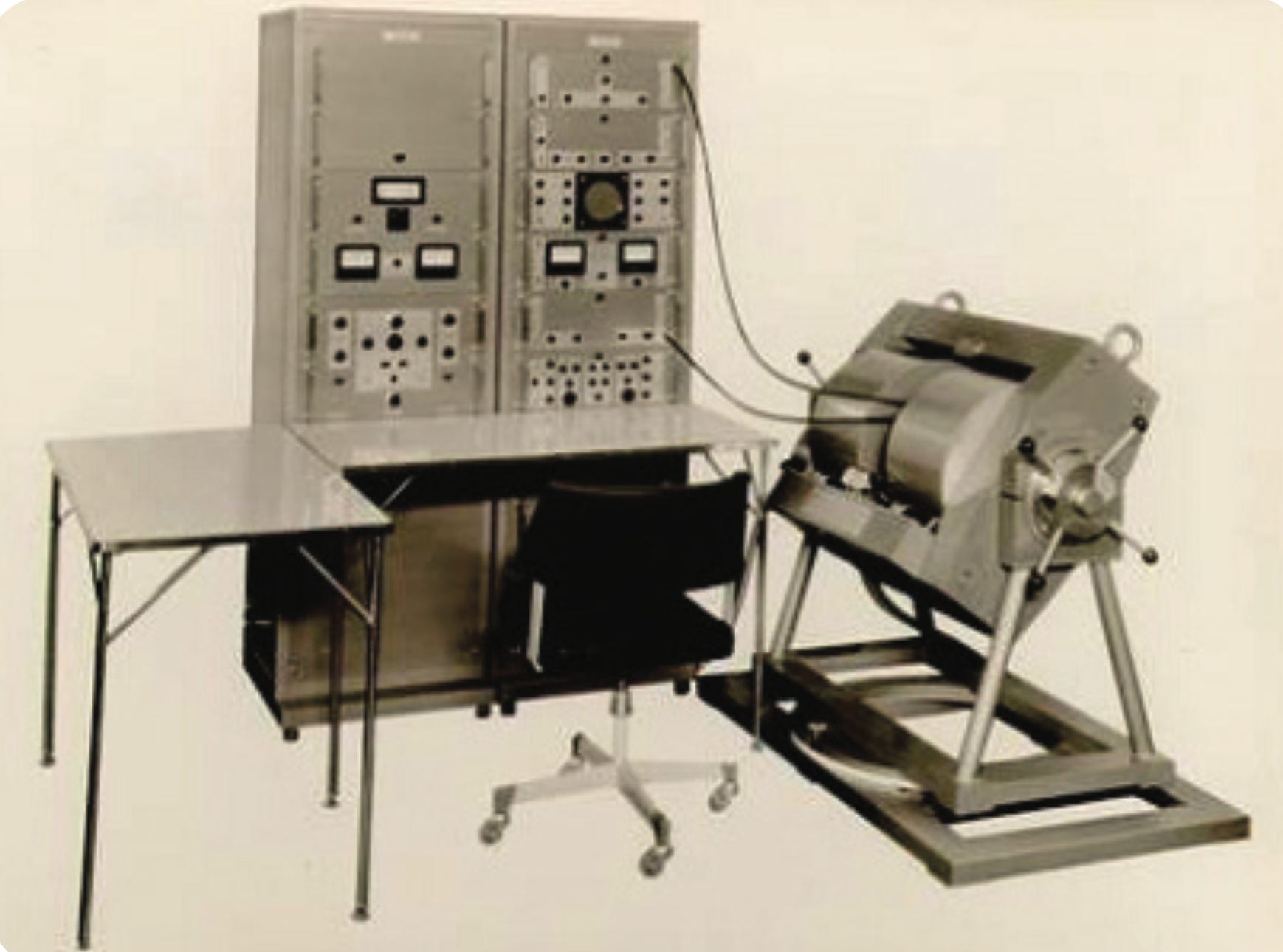
In 1965, Laukien acquired the NMR operations of a struggling Swiss company, Trüb Täuber, forming Spectrospin AG. This move brought two talents into the Bruker fold: Dr. Werner Tschopp and Tony Keller, who would influence the company's future for decades (Keller went on to become co-CEO and chairman of Bruker BioSpin well into the 21st century). The acquisition also led to invaluable partnerships with prominent scientists from ETH Zurich, including Richard Ernst. This collaboration between industry and academia became a hallmark of Laukien's approach to innovation that continues today.
Bruker’s growth in the coming years was fuelled by a series of technological achievements in NMR and the related field of superconducting magnets, accompanied by global expansion - reflecting Laukien’s vision that advanced scientific tools should be available to researchers worldwide (innovating with integrity). By the 1980s, Bruker had expanded beyond NMR into MRI, infrared and Raman spectroscopy and mass spectrometry.
1991 to 2008 - Extended Changeover
From the early 1990s up until 2008 the story gets complex and I will try to follow it and simplify it as best I can - it’s worth trying to understand. From a legal entity perspective, the company that I’m writing about today (BRKR) was founded in Massachussets in 1991 as Bruker Federal Systems Corporation - its chairman and CEO since that time has been, Günther’s son, Frank Laukien. More on him later. In 1997 Günther passed away and ownership of the numerous affiliated Bruker entities was transferred to a handful of Laukien family members. Also in 1997 Bruker acquired the analytical X-ray business of Siemens. We should take note at this stage that Bruker now had four core operations:
Biospin (the original business, including NMR, MRI, EPR and superconductors)
Daltonics (mass spectrometry)
Optics (infrared and Raman spectroscopy)
AXS (analytical X-ray)
As to what happened next, I asked ChatGPT to put it into a nice graphical chronology for us:
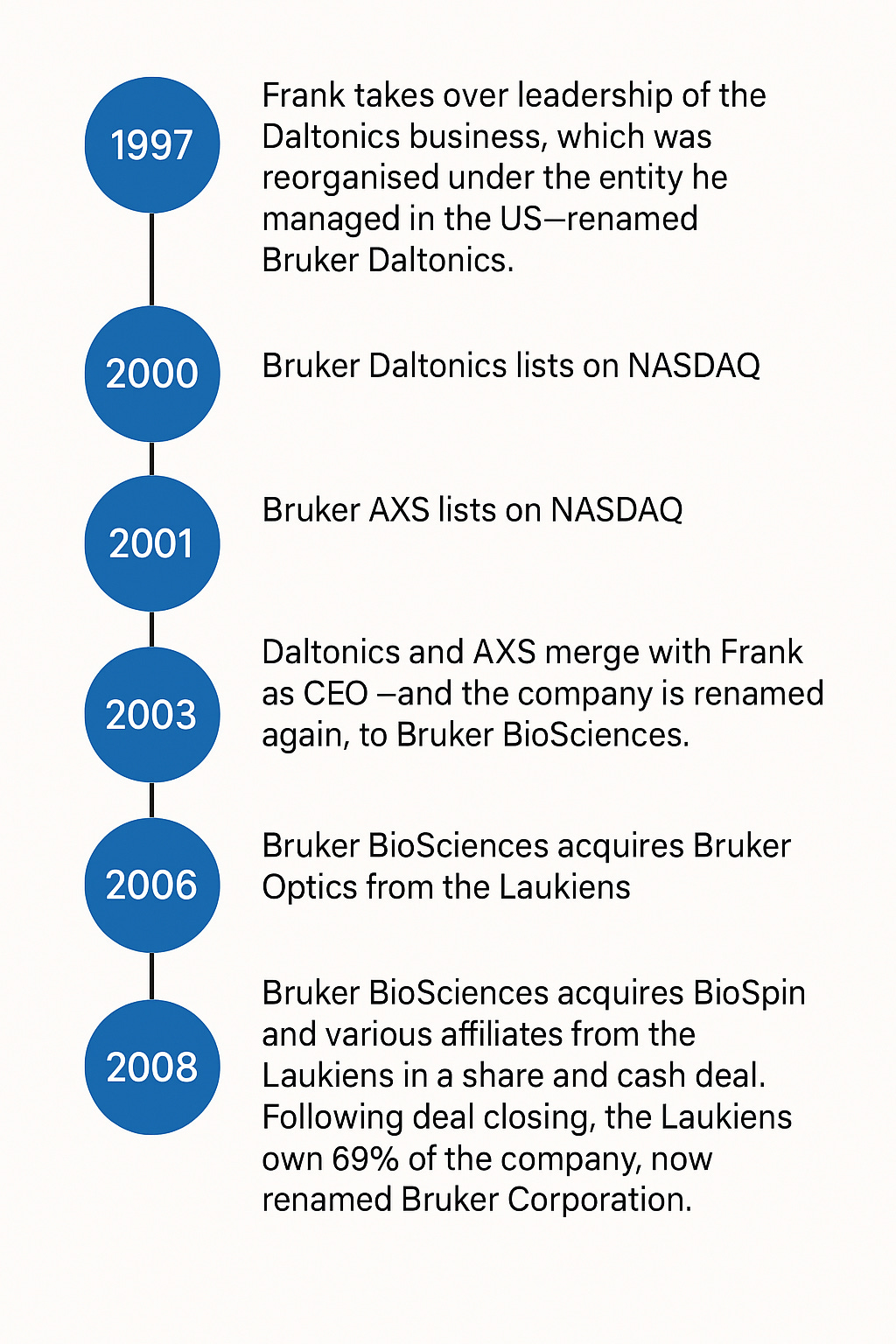
As far as I can make out, it seems that one of the principal reasons for this unusual string of transactions was to allow various family members to cash out. The principal exceptions are Frank who now owns 28% of the company (per the 2024 proxy statement) and his brother Joerg who owns 5% - the only other Laukien to now own a sufficiently large holding to require disclosure. Remarkably, Frank is the only Laukien to have more shares than he started with having acquired significant additional holdings from his family and in the open market.
Sidebar - Frank Laukien and a few notes on capital allocation
It’s worth brief interlude here to talk about Frank. Frank was born and raised in Stuttgart, Germany. Having always wanted to try living in the US, he went to study at physics MIT. He also took classes in accounting and economics in order to learn the business side of analytical instruments while spending his summers working at Bruker. Following MIT, he did his doctorate at Harvard in chemical physics. In Frank’s words:
After completing my Ph.D. at Harvard, I knew it was unlikely that I would be a science professor because I was equally focused on the science as well as on the fascinating business side of the industry. As a scientist, I really enjoy the product development emphasis on market-driven solutions for customers, where we try to find solutions to fit their needs in a real-time one- on-one marketing approach. I learned that aspect of the business by working in marketing, sales, and finance as my first real job after graduating.
Without any hesitation, I can tell you that Frank is one of the most impressive CEOs I have encountered. He has deep technical expertise in the fields of NMR and mass spectrometry, for example - contributing to breakthroughs both in the field and at Bruker. As recently as 2023, he had an NMR patent granted in his name. In addition to being an accomplished physicist, chemist and inventor, somewhere along the line he’s also managed to become an expert in evolutionary biology, cancer and multi-omics. In fact he has written an exceptional book on such things - even if the general readership isn’t wide, you only have to check out the endorsements to see that it was well received at the highest level of academic biology. It’s perhaps quite rare to find someone with such deep expertise across all three hard sciences but to fully understand many of BRKR’s instruments - how they work and what they’re for - that’s exactly what you need.

But if that’s not enough, Frank has proven himself as a top-rate leader, business operator and capital allocator. We just have to look at BRKR’s results over time for validation of this. His acquisition record is excellent. Peers typically compete for relatively mature businesses at premium prices, such that the ROIC often turns out to be single-digit. Frank (and his team) employ a more flexible approach to M&A. Occasionally they’ll buy something mature, but I would argue their expertise is in technology bolt-ons, on the one hand, and strategic/visionary acquisitions on the other. The latter typically means things that are earlier, less mature and potentially loss-making - and the price is frequently low. A great example of this is the Jordan Valley semiconductor metrology business that they acquired a decade ago when it was loss-making - today it has revenue 5X higher and operating margins in the 30s! Another example is the AXS business from Siemens - they’ve gone from number three in the market to number one, they’ve 6X’d the revenue and gone from loss-making to margins in the 20s. More recently, BRKR paid so little for PhenomeX in late 2023 that accounting rules forced it to immediately recognise a one-time bargain purchase gain. And in 2024 they acquired the assets of NanoString out of bankruptcy at a valuation Frank considers to be “brilliant”. Like Jordan and AXS these two recent ones were loss-making and, given their size, near-term dilutive to earnings - notwithstanding this, Frank thinks they’ll both be “great ROIC investments”.
2009 to 2014 - Birth of the Bruker Management Process
Following the GFC the enlarged company had several strong years of organic growth but margins began to slow and so did growth eventually - you can see this in the charts earlier. What happened? There were a few reasons but I’'ll highlight the principal ones. First, when Agilent acquired Varian in 2009, it was forced to divest various legacy product lines and BRKR picked up some of these in 2010. The problem was some parts of the Varian business proved to be persistently unprofitable, in large part due to underinvestment by the prior owners. This culminated in BRKR eventually selling these in 2014. Second, and more importantly, while there was a consistency in innovation culture across all the former Bruker affiliates, they had never been properly unified as a single entity and this was causing inefficiency across the manufacturing footprint and back office while generally holding the organisation back. Bruker set about course correcting this and it was a multi-year effort. They brought in or promoted new senior leadership - notably Jurgen Srega (a Thermo veteran) to head up what is now the CALID division and Mark Munch to head up the NANO division (see later). They consolidated manufacturing footprint while outsourcing production of non-critical components (critical components remain in-house). They did a major ERP implementation. Last, drawing on the combined experience of senior leadership, they adopted a formal ‘management process’ in 2014. For example, from the investor day in 2019:
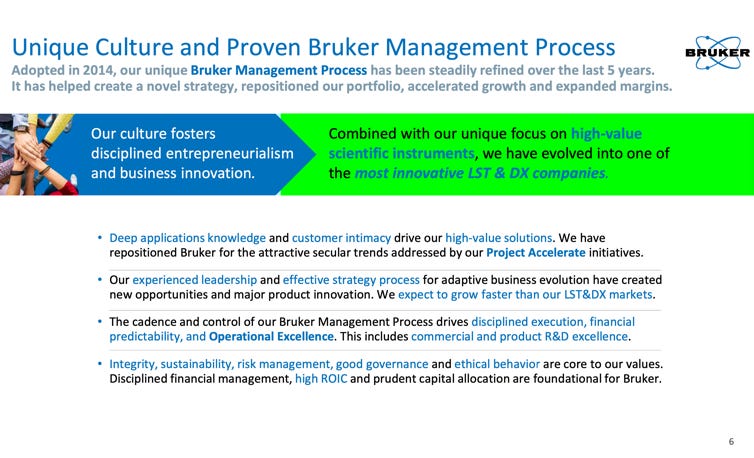
The management process forms a critical part of continuous improvement in margins and in integration of acquisitions. If you’re already making comparisons with Thermo and Danaher, good - you should. There are perhaps two ways in which BRKR differs from those two examples. The first is on acquisition ROIC - BRKR insists that acquisitions produce upwards of a 20% ROIC in the medium term, which is a much higher hurdle rate than you typically see elsewhere. The second, is that Frank believes the resulting Bruker culture to be more entrepreneurial - fair? unfair? Tell me what you think.
2015 to present day - Project Accelerate / Getting into a Stride
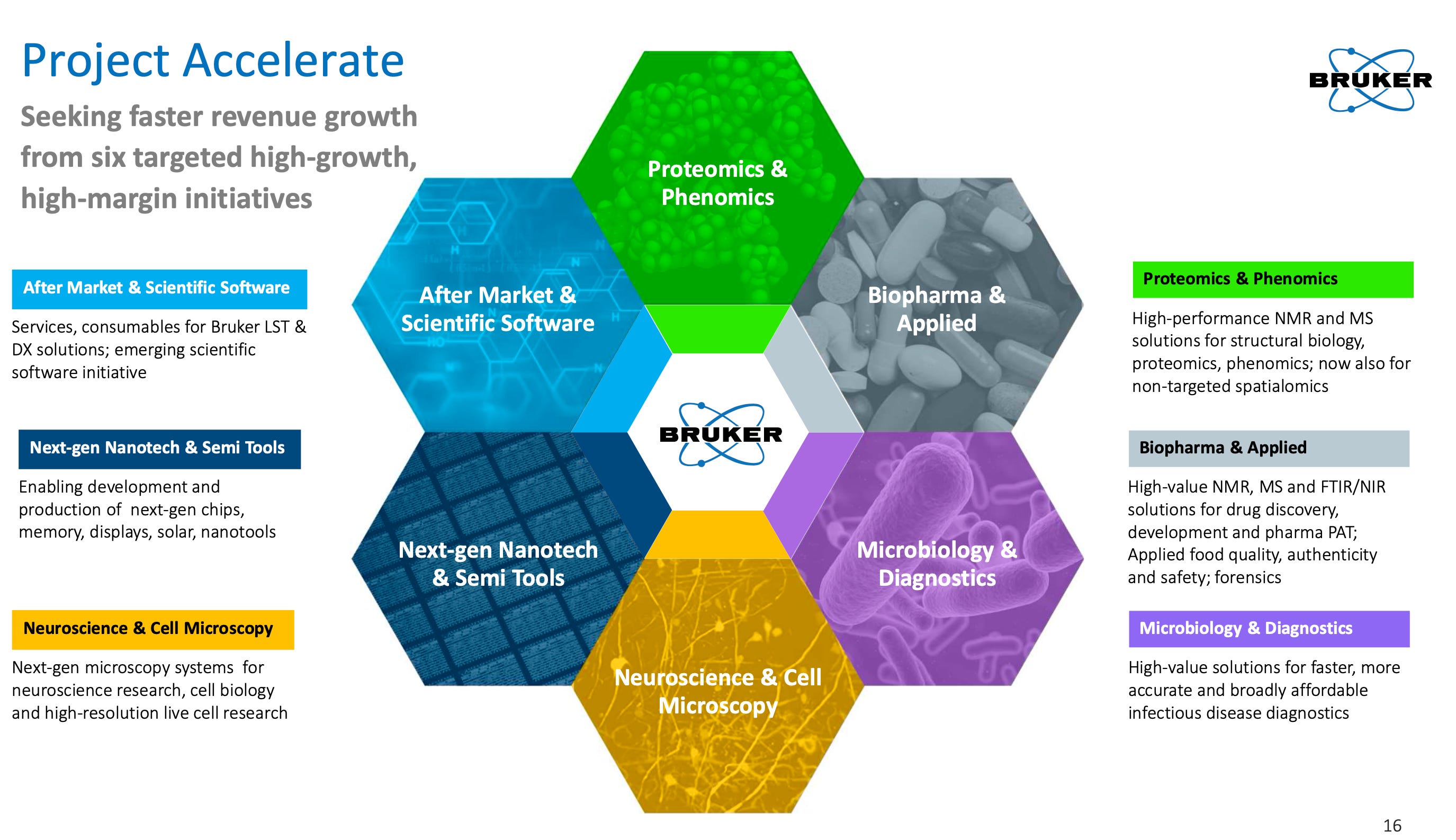
As you have already seen, BRKR’s financial performance began to accelerate from 2015, especially on the margin side initially as all the above initiatives started to bear fruit. But also on the revenue side with new products and important product updates coming to market - one key one being the launch of timsTOF in 2016 (see later). By mid-2017 the company started to highlight six high-growth high-margin areas that would increasingly drive the financial profile of business in the years ahead with higher overall margins and organic growth. Internally, BRKR had started to refer to these product groups as “Project Accelerate” and by early 2018 they began using this term with the outside world as well.
Also worth highlighting at this point that by 2018 BRKR’s current senior leadership team had been fully assembled, with the appointments of Falko Busse to head BioSpin and Gerald Herman as CFO. Srega, Munch and Busse all have science backgrounds (2/3 are PhDs) and wide-ranging business experience - very “Bruker”. Even Gerald has a pretty technical understanding of the portfolio, certainly more so than your typical CFO.
In 2019, BRKR hosted an investor day where they elaborated on Project Accelerate in more detail, while highlighting that PA accounted for slightly over 40% of revenue:
And then in 2021, BRKR gave us “Project Accelerate 2.0”, which was the same as the original but with expanded ambitions. By this stage PA accounted for roughly 50% of revenue.
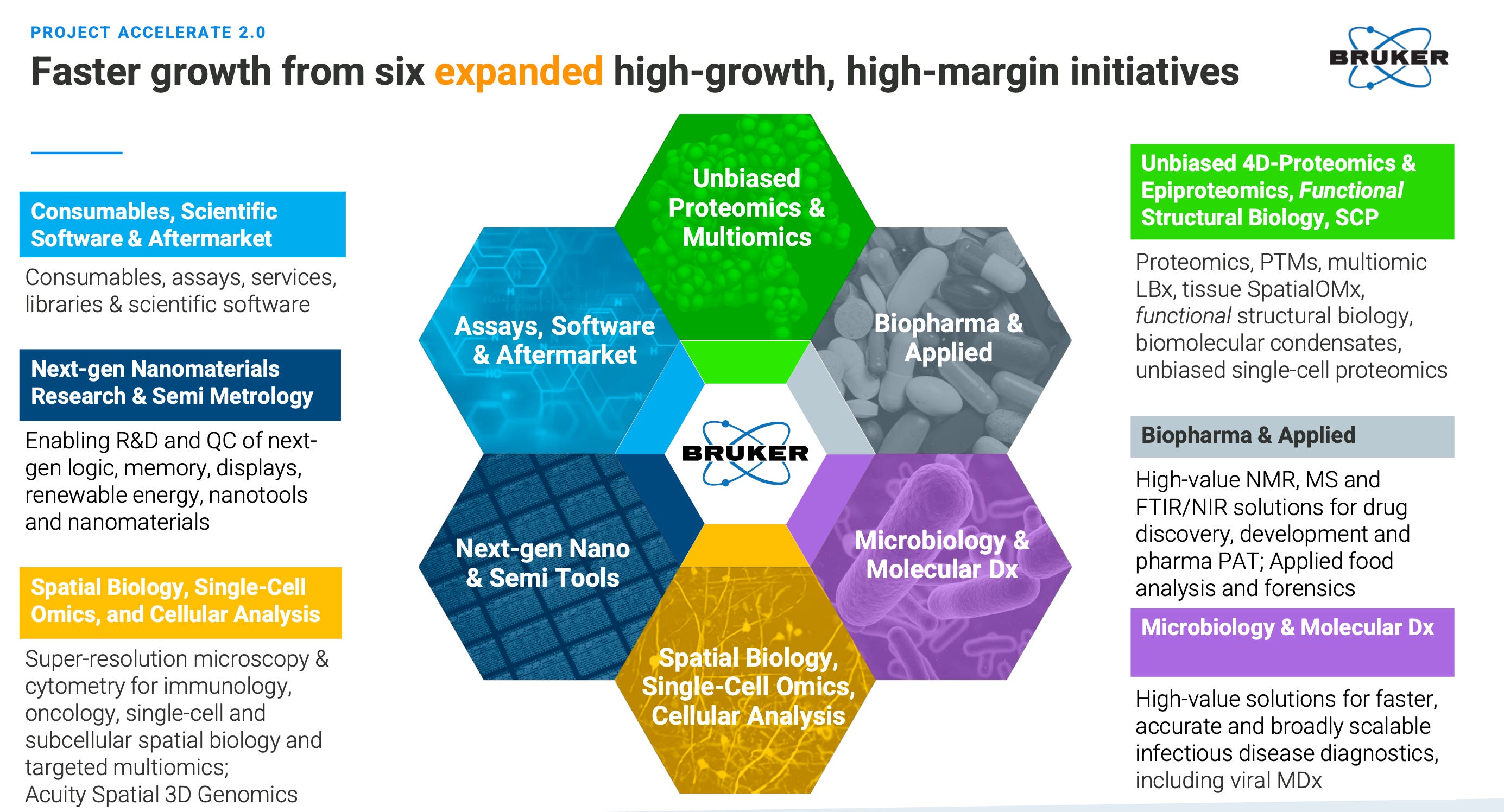
At the end of 2024 PA revenue mix was >60% according to BRKR. BRKR rate their PA2.0 business as a high-single digit organic grower in the medium term. If you ever listen to Frank (or read his book) you will quickly learn that he is particularly energised by proteomics, multiomics and spatial biology - areas of rapid development and central importance in the world of biomedical discovery. It’s no surprise therefore that the green area, and especially the orange area, are the key respects where PA2.0 has evolved from PA1.0. And while this evolution has absolutely manifested in continued product innovation, M&A has really accelerated BRKR’s capabilities in spatial, single-cell and cellular analysis (more later). Within PA2.0, BRKR attribute proteomics and spatial biology with double-digit growth.
Stepping back, you only have to look at the numbers to see that the PA strategy is working: in the seven years 2011-2017 organic revenue growth averaged 4%, whereas in the seven years 2018-2024 it averaged 7%.
Bruker today - Overview
For reporting purposes, BRKR is split into two segments: 1) Bruker Scientific Instruments (BSI) and 2): Bruker Energy & Supercon Technologies (BEST).
BEST
At slightly under $300m, BEST was ~8.5% of sales in 2024. BEST is the world-leading business in manufacturing superconducting materials and devices, a necessary offshoot of being the leader in NMR - you can’t be one without the other. Notably BEST supplies all the manufacturers of clinical MRI instruments (e.g. GE, Siemens, Philips) and this is pretty steady business. But other end markets include NMR (internal/external), high energy physics projects (colliders etc), semiconductor lithography and clean energy and fusion energy research. Frank recently said they do around $25m in annual revenue from fusion energy projects and he thinks it will become $200m over 5-10 years. It probably won’t surprise you, at this stage, to learn that Frank is big into fusion energy and chairs one such startup himself. But if you’re doing the magnetic confinement approach to fusion, there’s a good chance you’ll use BEST’s products. Perhaps with other approaches too, although I haven’t researched that much.
BSI
BSI is divided into three independently operating product groups:
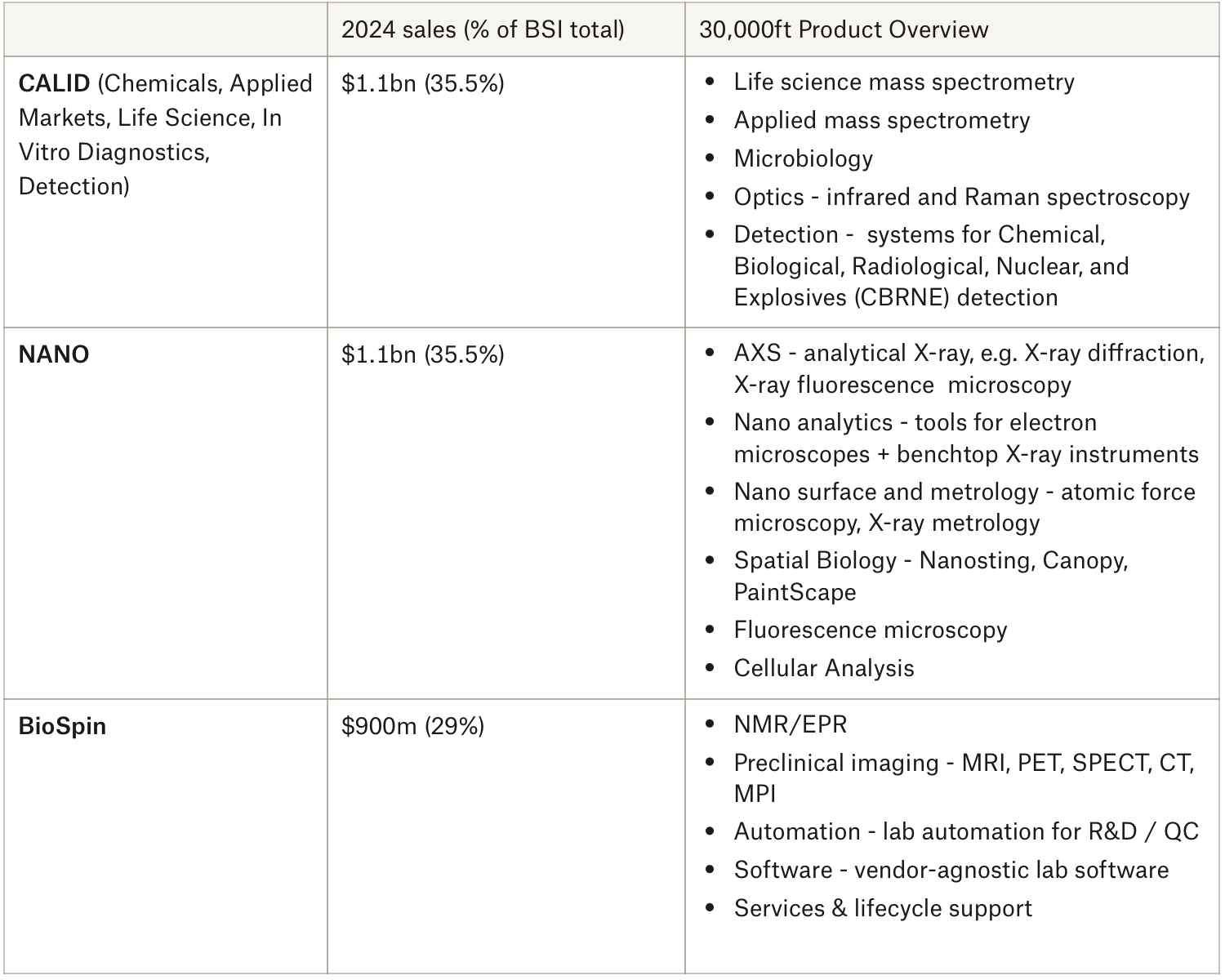
Per BRKR, they are either the number one or two in roughly 70% of their product portfolio. 30% of revenue is indicated as recurring, among software, consumables and services. This is up around 5pp over the last five years and it’s expected to keep increasing due to the impact of certain ‘razors and blades’ type product lines including MALDI Biotyper and recently acquired systems from ELITech and NanoString.
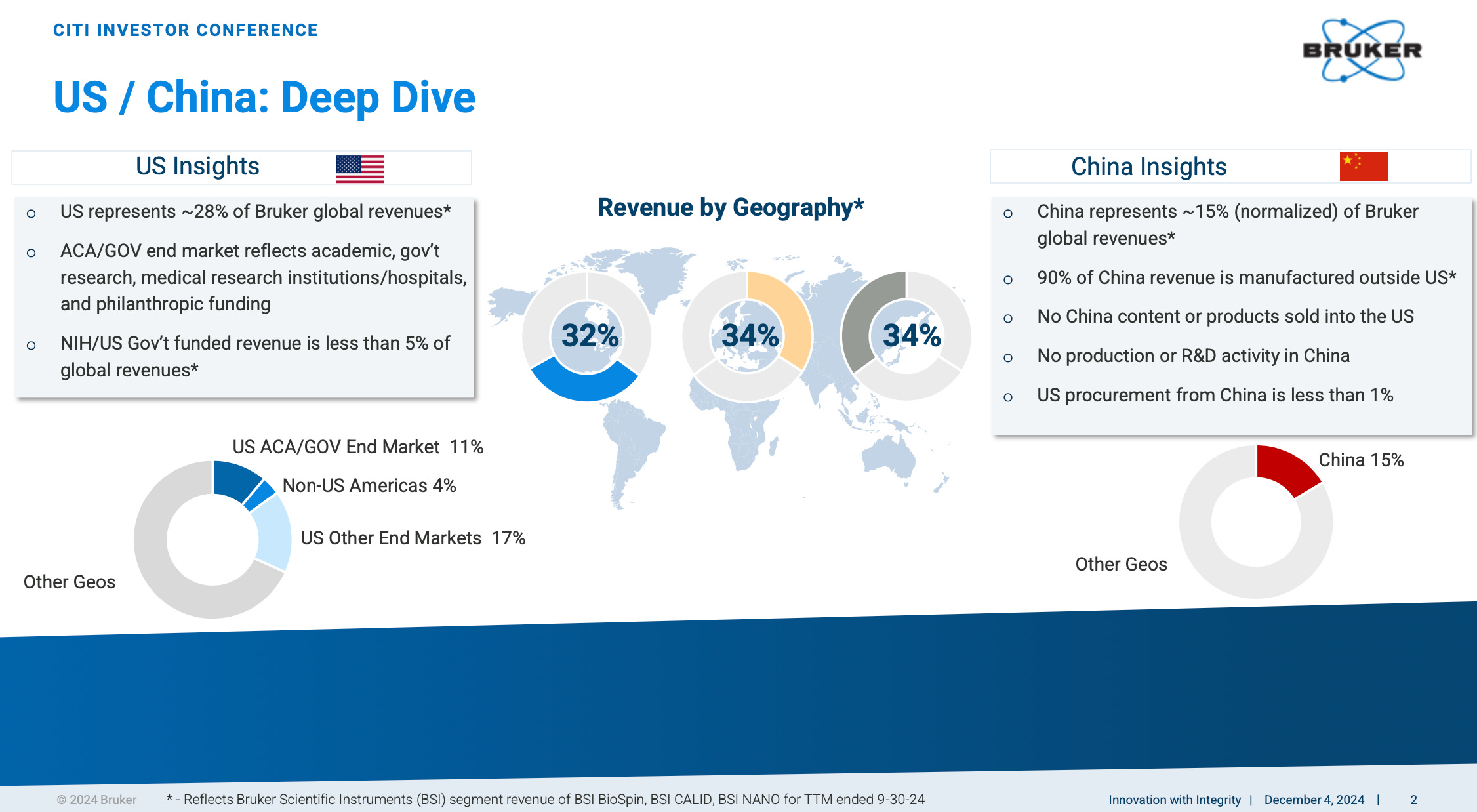
Breaking it down by the latest end market and geography exposures (provided at Citi in December):
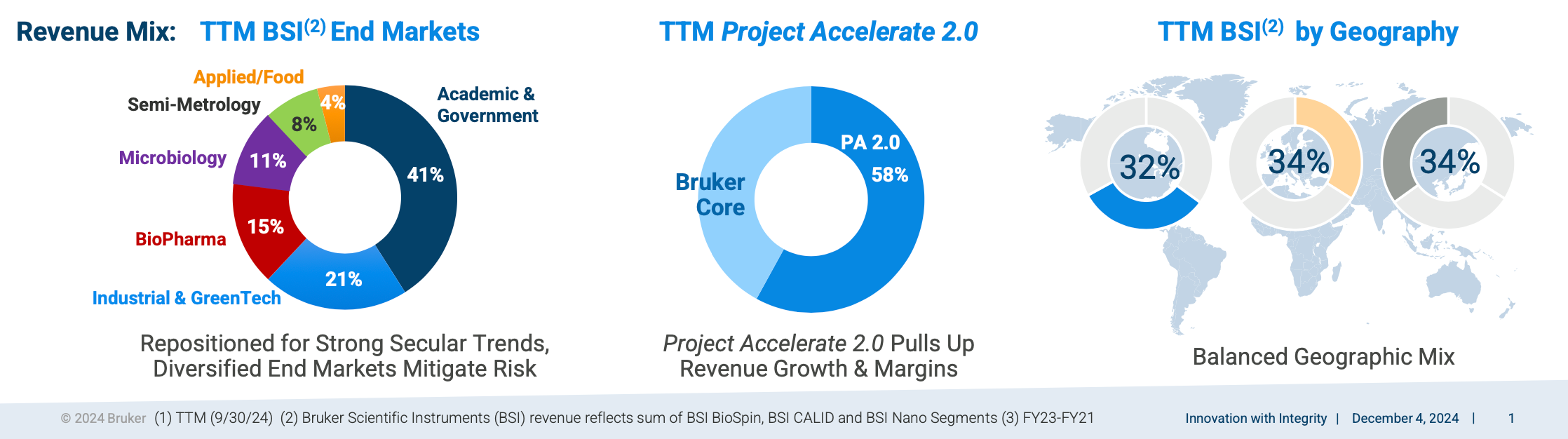
Bruker has long had a significant exposure to Academic & Government end markets given the role its instruments play in early-stage research. If you include BEST revenues, the mix would be even lower than 41% however. In any case, the relative proportion has been coming down over time - more than 5pp in the last five years and this is expected to continue. While the majority of exposure here is likely to be life science related, we don’t have a breakdown - just note that aca/gov also includes other fields such as parts of BRKR’s defense detection business, chemistry, materials sciences, environmental control etc.
BRKR intend to increase Biopharma exposure to >25% over time - albeit primarily on the R&D side rather than production. Additionally, given that growth in semi-metrology and microbiology are likely to grow above the group level, we can expect those shares to increase steadily too. And then on the Industrial side of things, it’s worth noting that BRKR is intentionally well exposed to some high growth areas such as analytical techniques across the battery value chain: research, production and recycling.
We can see that already >1/3 of BRKR’s business is outside the life science domain entirely. I say all this just to highlight that BRKR’s reputation as primarily a life science tools business serving academia and government is not entirely fair - it does a lot more than that.
Years ago BRKR used to produce a yearly almanac providing an overview of their product and software offering, although I’m not sure if they do something like this anymore. You can see the one from 2012 here - it runs to over 200 pages and I can only imagine it would be longer today. With that in mind, I don’t intend to attempt anything of the sort here. Instead, we’ll put the spotlight on a few areas of interest - primarily in PA2.0.
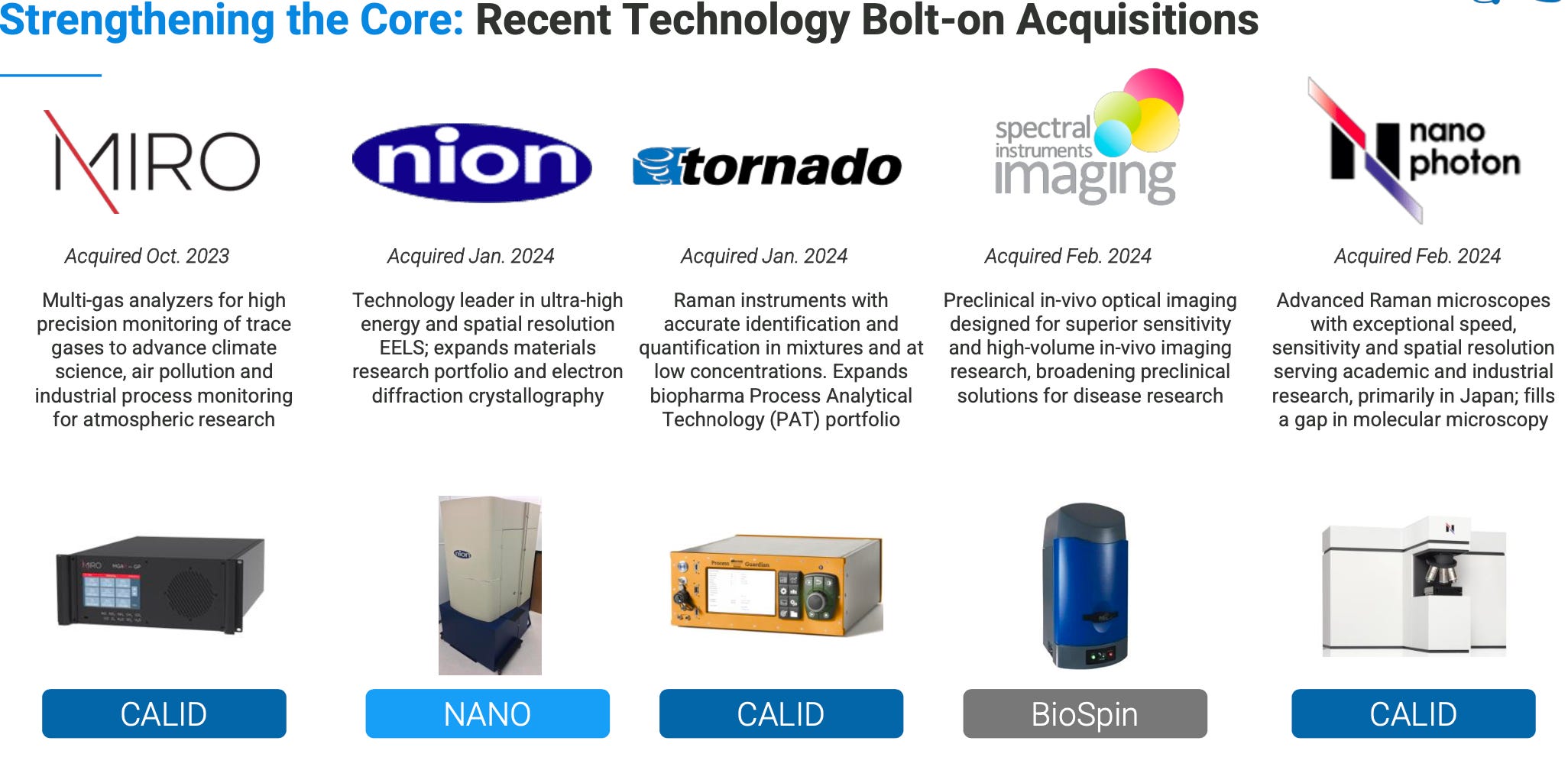
But before we move on, it’s worth spending just a moment on ‘Bruker Core’. I wonder if the acquisition of the Varian product lines was something of a learning exercise for BRKR, because it turned out that most of the Varian products had been under-invested in for a number of years. BRKR doesn’t want its own core portfolio to suffer from legacy neglect, so they continue to invest internally and through bolt-on acquisitions. For BRKR, the core business is both a source of future margin expansion as well as supportive to overall growth, with a mid-single digit growth contribution.
Product Spotlight
Ultra High Field NMR
If you’ll forgive me for cheating, I asked Claude 3.7 to provide a very simple explainer on UHF NMR:
Ultra high field NMR (Nuclear Magnetic Resonance) is like a super-powerful microscope that lets scientists see the tiny structures of molecules with incredible detail. It works by placing samples in extremely strong magnetic fields (much stronger than hospital MRI machines) and observing how atoms respond. This advanced technology is primarily used by chemists and biochemists to determine the exact structure of complex molecules like proteins and drugs, helping researchers understand how these molecules function and interact. It's important because it enables more precise drug development, advances our understanding of diseases at the molecular level, and accelerates scientific discoveries that can lead to new treatments and materials. The stronger the magnetic field, the clearer and more detailed the molecular "picture" becomes, similar to how a higher resolution camera captures finer details in a photograph.
That’s a reasonable starting point for our purposes here. Here’s a good video overview of one of BRKR’s Ascend 500MHz systems - note they essentially come in three parts - the instrument itself, a console and a software system. Just note that UHF is generally considered to be systems with 1GHz magnets and higher.
Since Agilent/Varian exited the field in 2014, BRKR has had a complete monopoly on ultra high field NMR. BRKR itself came out with the world’s first 1GHz magnet in 2009, whereas Varian relied on Oxford Instrument for its magnets. Following five years or so of trying unsuccessfully to compete aggressively on price (to BRKR’s detriment), Agilent closed its NMR business down. Despite concerns that BRKR would have less incentive to innovate, pretty much the opposite has happened and the pace has picked up, if anything. Just very recently they announced the world’s first 1.3GHz NMR. They have advanced in others ways too such as shielding, size/mass reduction (the instruments are massive!) and helium consumption.
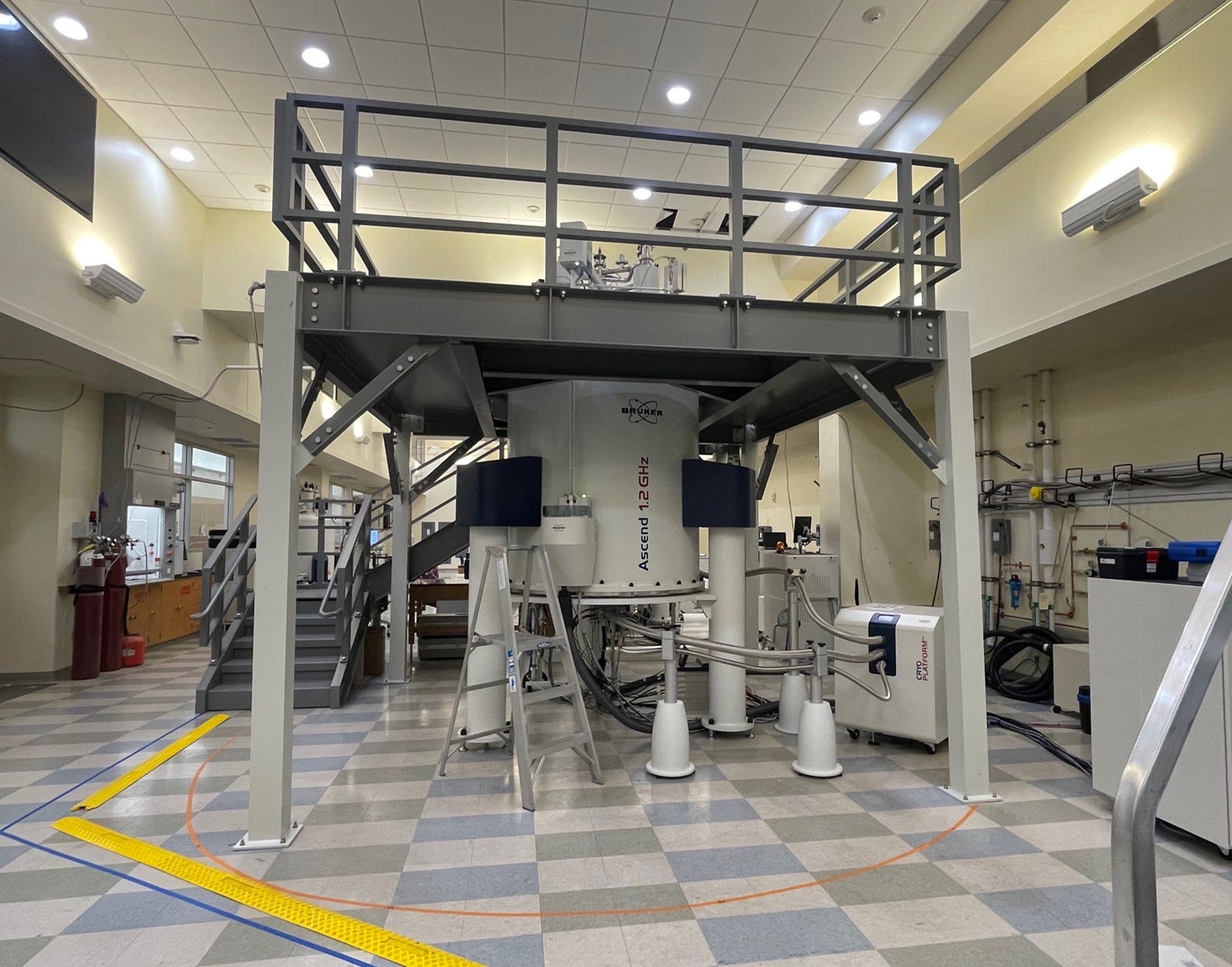
According to Frank, they’re at least five years ahead of anyone else in NMR given the technology, engineering and complexity involved. With no competitors in UHF, they make high margins without having to compete on price. Additionally, with a fairly steady innovation cadence, top labs around the world will continue to invest without some of the past lumpiness from when the cadence was slower - whoever gets a 1.3GHz system first is one step ahead in making the next breakthrough.
I don’t want to oversell the UHF NMR business here, because they only ship around four of these GHz systems per year. But I’m highlighting it for two reasons: 1) to show exactly where Bruker has been technology leader for so long and 2) because Bruker has a much wider magnetic resonance business (NMR, EPR, MRI) that benefits from the innovation and sells products, service and software in higher numbers all the way down bench top systems. While the higher-end NMR systems tend to deployed at academic centres, about 30% go to pharma. The broader portfolio is applicable across many domains down to profiling honey and olive oil for authenticity.
Microbiology & Infection Diagnostics
We’re going to have a quick look at two platforms with similar attractive economics but with different technology - one internally developed and the other recently acquired.
MALDI Biotyper
BRKR’s MALDI Biotyper is a type of mass spectrometry instrument, making use of matrix-assisted laser desorption/ionization - MALDI being a technology that BRKR has led in since the 1990s. An internal effort, MALDI Biotyper was released in 2006 after a decade of development. For simplicity I’ll call it ‘MB’ from hereon. MB identifies and classifies microorganisms. Making use of protein ‘finger printing’: “an incredible powerful technology that really has been perhaps the most transformational technology in the otherwise very conservative field of clinical microbiology”, per Frank. Better, faster and cheaper than alternatives, MB has emerged as the gold standard for identifying bacteria and fungi. The box itself works with push-button simplicity and without requirement for mass spectrometry training - basically unheard of in the world of mass spectrometry. Moreover, it delivers answers in minutes. Roughly 2/3 of sales are into the clinical setting and 1/3 into applied markets including water and food safety and pharma. So established is MB, that ‘to MALDI’ has now become a verb.
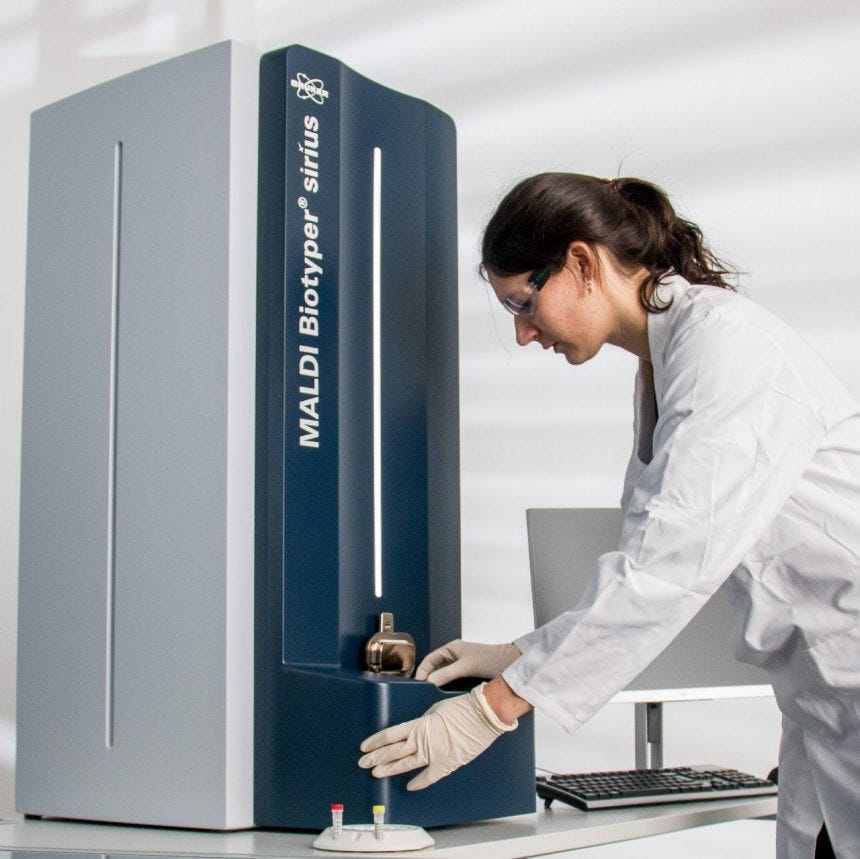
The installed base continues to grow and now sits at around 7000 instruments. MB is very much a ‘razors and blades’ model, with more than 50% of sales now consumables - this proportion will continue to grow over time. The platform itself is now annualising around $300m in revenue with >60% gross margins and >30% operating margins. While bioMérieux has had a competitor system on the market for a while, it has not been able to displace MB and BRKR believe they remain the technology leader, but in addition to technology there are moats around robustness, regulatory approvals and reference libraries. MB is a high-single / low-double digit grower - making it an extremely attractive business economically. The only downside is it doesn’t do virology…
InGenius
Last year BRKR acquired ELItech, along with its InGenius family of products, which are sample-to-answer molecular diagnostic systems. It’s around a $175m business in revenue, with an installed base of ~1,400, consumables share of >80% and EBIT margins in the 20s.
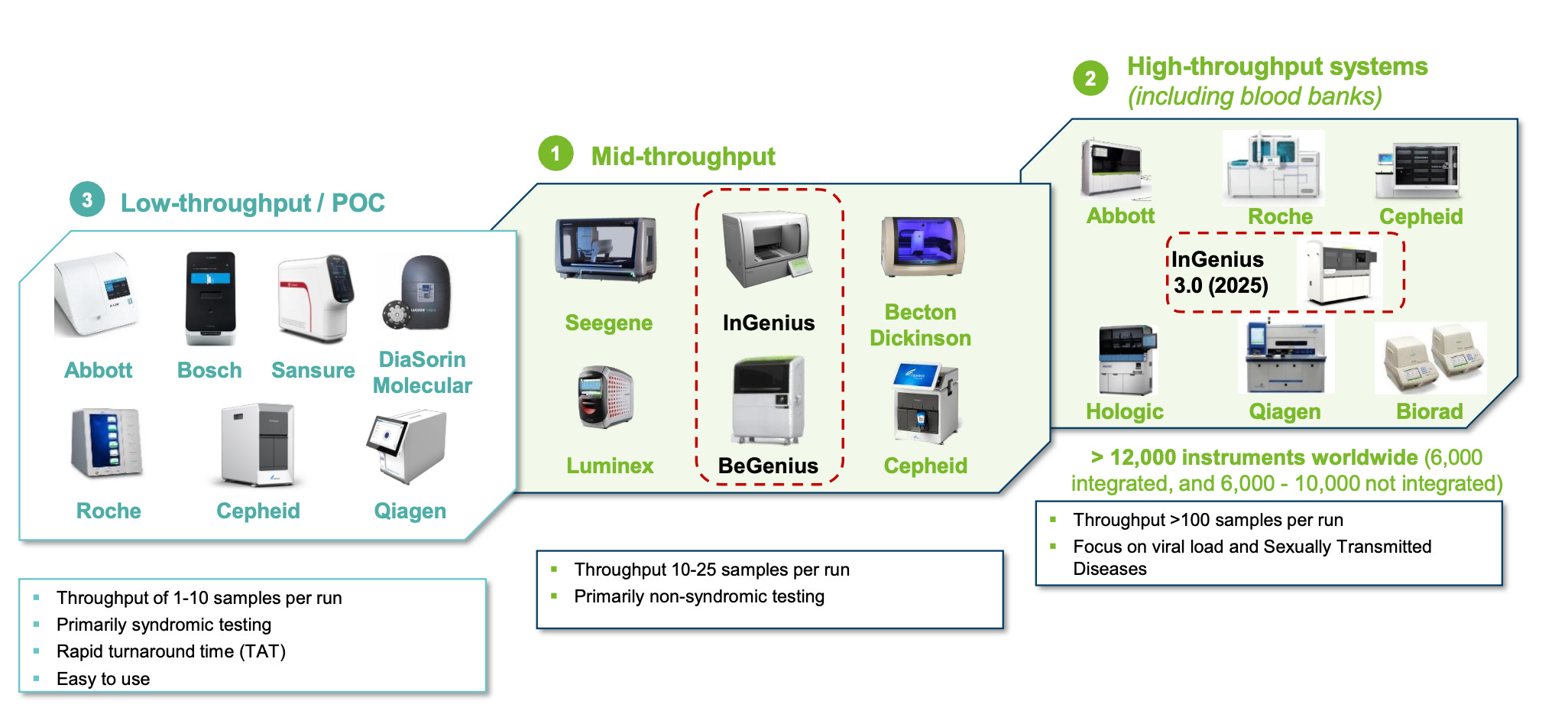
By focussing on mid-throughput, ELItech has carved out an attractive and large niche for itself, in what is otherwise arguably a crowded field - mid-throughput and esoteric tests. Here’s how ELItech’s CEO puts it:
So, what's so special about this mid-throughput segment? In this mid-throughput segment, you basically deal with parameters or with assays that are too small in volume to be high throughput and are in a certain way too complex to be dealt with in a point-of-care system. They also tend to be not time critical, again, very much unlike what you would do in point-of-care.
There's typically depending on how you count, 15 to 20 high-throughput parameters, sexually transmitted diseases, hepatitis B, hepatitis C, HIV, herpes viruses. And that's really the bulk of the test volume, and that's what the big market leaders are focusing on.
On the low end of the tail, you have a large number of what we call esoteric tests. That's a total of about 50 to 150 parameters. To just give you a number, that's about a couple of hundreds to maybe a couple of thousand tests per annum per laboratory. And that's a very, very long list of assays, Bordetella, whooping cough, various herpes viruses, meningitis, things like that. Those assays are not available from the large players and they are also not available on point-of-care systems, yet they need to be done. And that's exactly what we do. And this is exactly the solutions that we provide.
By not competing with the big players and offering something complementary instead, ELItech is able to offer something that no one else does - it’s a very attractive business. Growth is at a similar level to MB - HSD to LDD.
In total MB and Elitech together are approaching $500m in revenue - close to 15% of the total. Its high margin, high recurring, high barriers to entry. Recall that Danaher paid $4bn and 6.4x revenue for its own molecular diagnostics business, Cepheid, in 2016 - an acquisition that turned out to be highly successful. At a similar multiple, BRKR’s microbiology platforms could easily be worth in the region of $3.2bn or more than 40% of BRKR’s entire enterprise value.
Sidebar - Post-Genomics
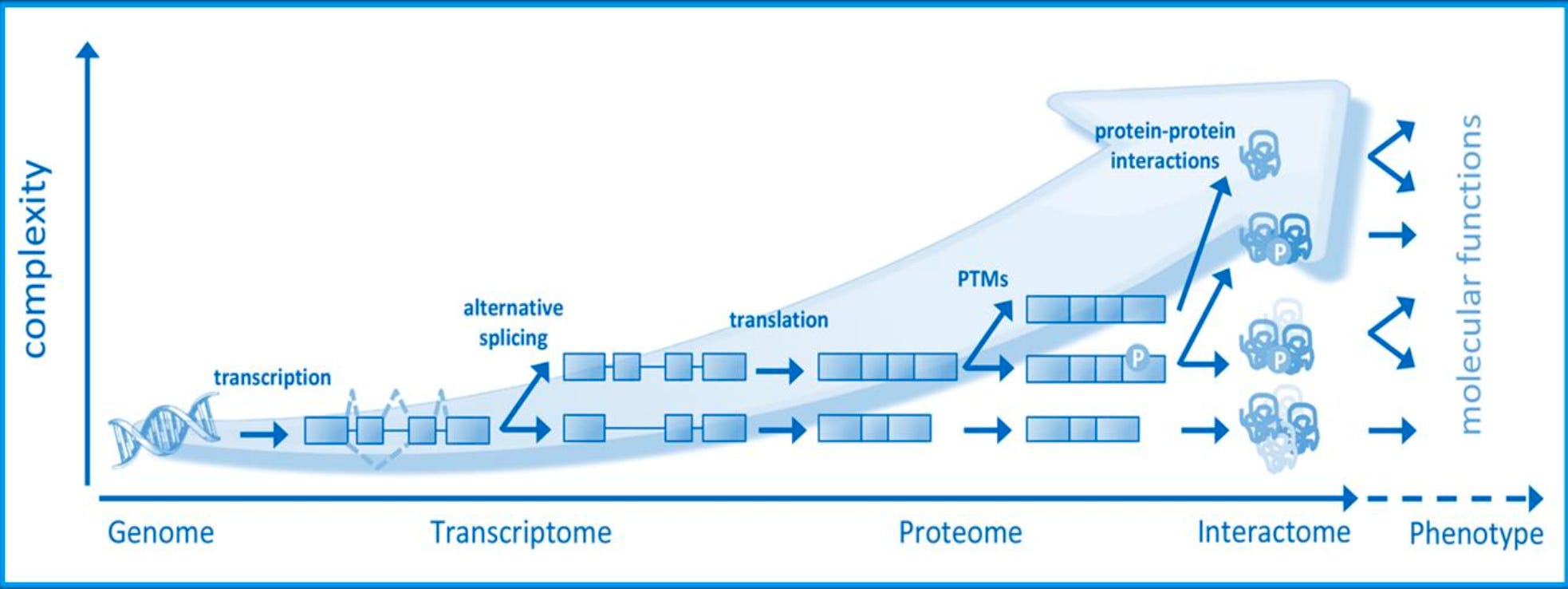
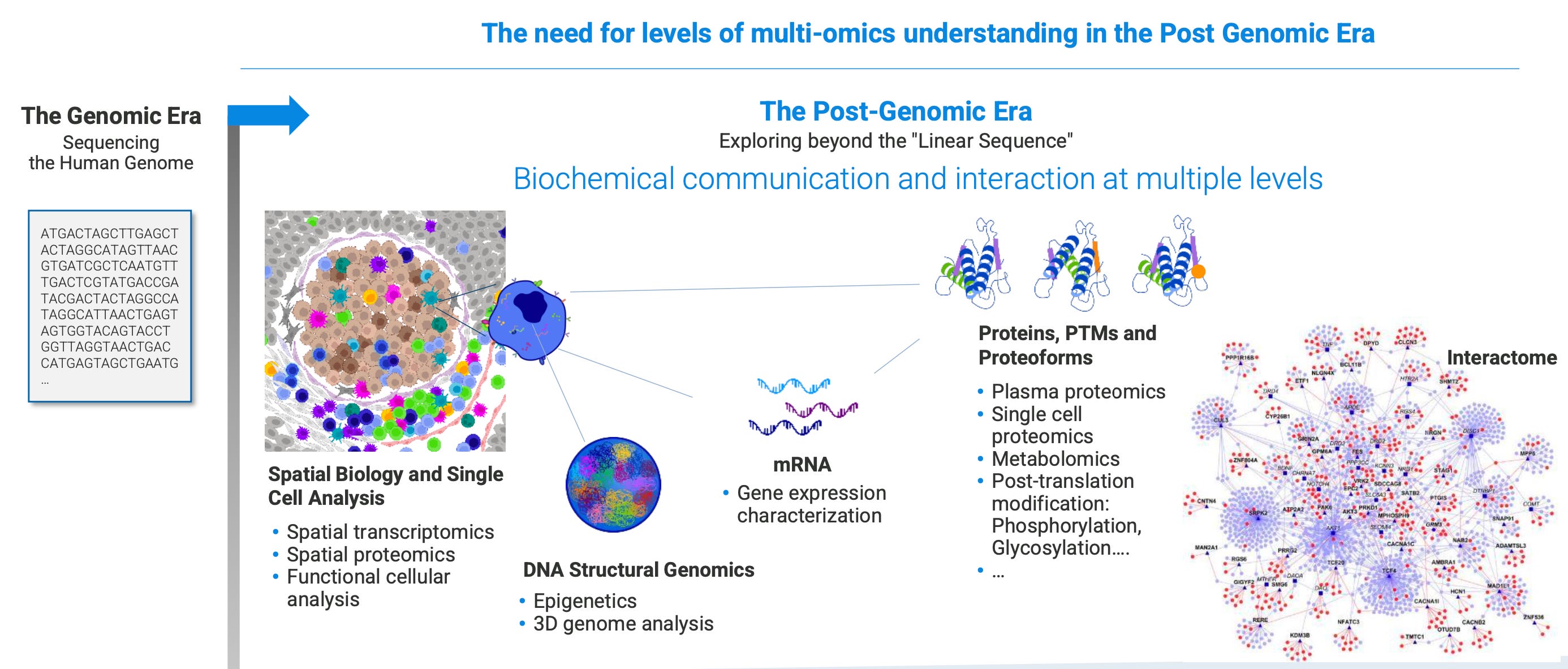
In the 21st century thus far, disease biology has been defined by the era of genomics. The degree of progress and understanding during this period has been profound, not least due to advances and cost reduction in sequencing technologies. But as Frank and others point out, we still only understand a small proportion of human biology - as it turns out, the analogy of the genome as a ‘blueprint for life’ is incorrect. Here’s how Frank puts it in his book (emphasis added):
Our 21,000 genes only have the ‘blueprint’ for basic RNA and protein family building blocks. By the time our cells transcribe and translate this information, and then interact with other molecules and regulatory systems in various sub cellular environments, human biology derives hundreds of millions of functional proteoforms in ways that are not pre-programmed by our genomes. Our genes needs to be properly understood as a ‘parts list,’ or a ‘blueprint of building blocks,’ and they are from from being that misleading ‘blueprint for life’.
Also:
Present-day evolved genomes, as well as all cell and molecular organismal biology, are inherently network-centric systems biology, driven by genomic, transcriptomic, protein-protein and metabolic interactions. This insight makes our excessive focus on reductionism in genetics, molecular and cellular research, as well as in disease biology, questionable. A better balance and greater focus on molecular systems, spatial and tissue biology will be far more productive and beneficial in terms of fundamental disease insights, and actionable diagnostics biomarkers and therapeutic strategies.
At this stage, we’re pretty good at doing linear sequencing of genetic bases in DNA and RNA (A, G, T/U and C) accurately and, increasingly, cheaply. The technology is maturing, it's well understood and is arguably becoming commoditised. From an investment standpoint it’s looking as though that ship as sailed. While genomics will unquestionably continue to play a vital role in in disease biology, the world of ‘multiomics’ and spatial biology is the next frontier for breakthrough progress and greater understanding. What makes it potentially interesting from an economic perspective is the vast differential in complexity versus genomics - arguably orders of magnitude. The fact that there are now numerous businesses slugging it out again in genomics, is an important datapoint - barriers to entry have come down. Whereas the next frontier and its associated complexity means that new approaches, breakthroughs and innovation are required - dynamics well suited to BRKR. In fact BRKR has been working hard in recent years to position itself as the technology leader in this space by building on in-house technologies while bringing in others from outside.
timsTOF
timsTOF refers to a suite of mass spectrometry instruments that BRKR started to introduce in 2016. timsTOF builds on an older technology called ‘time of flight’ (TOF) but the key breakthrough came from one of BRKR’s own researchers, Melvin Park, with the first patent filed in 2008. Specifically, ‘trapped ion mobility spectrometry’ or ‘tims’. But there’s more to it than that - another key breakthrough was ‘parallel accumulation–serial fragmentation’ (PASEF), which was co-invented by Matthias Mann at the Max Planck Institute, working in close partnership with BRKR. timsTOF’s domain is proteomics - the identification and study of proteins. Unlike NMR, the proteins generally have to be digested into peptides first - which makes timsTOF less suitable for studying deep protein structure. But there are numerous other advantages.
Without wanting to get overly-technical, here’s Claude again:
timsTOF is a mass spectrometry instrument that separates molecules based on their size and shape using trapped ion mobility spectrometry (TIMS), which works like a molecular sieve to sort ions before analysis. The instrument uses a unique technique called Parallel Accumulation Serial Fragmentation (PASEF) that allows it to analyze many molecules simultaneously, dramatically increasing speed and sensitivity compared to traditional instruments. What makes timsTOF special is its ability to identify more proteins with greater precision while using smaller sample amounts, making it particularly valuable for complex biological research. The combination of TIMS and PASEF technology creates an exceptionally powerful tool that has revolutionized proteomics research by providing deeper insights into protein composition with unprecedented detail and efficiency.
For the curious, here’s a good overview video of the technology. The basic key selling points for timsTOF versus alternatives are sensitivity, robustness, speed and 4D proteomics, the latter being unique to BRKR. And, indeed, in leading proteomics labs, it’s really just a two horse race between Thermo Fisher’s ‘Orbitrap’ family of products and timsTOF - one isn’t necessarily better than the other, they’re just different technologies that are good at different things and you’ll see that leading researchers such as Matthias Mann use both. Having launched about 10 years before timsTOF, Orbitrap has much higher market share although BRKR has been growing rapidly since launch. Currently the timsTOF platform (including software and consumables) is close to $200m in annual sales and potentially close to an installed base of 1,000 instruments I would estimate. For context, some of these systems sell for around $1m - the pricing power is very strong compared to less capable alternatives. I haven’t heard management gives specific on timsTOF margins, except to say that both gross and operating are above group level, and presumably increasing as the platform scales.
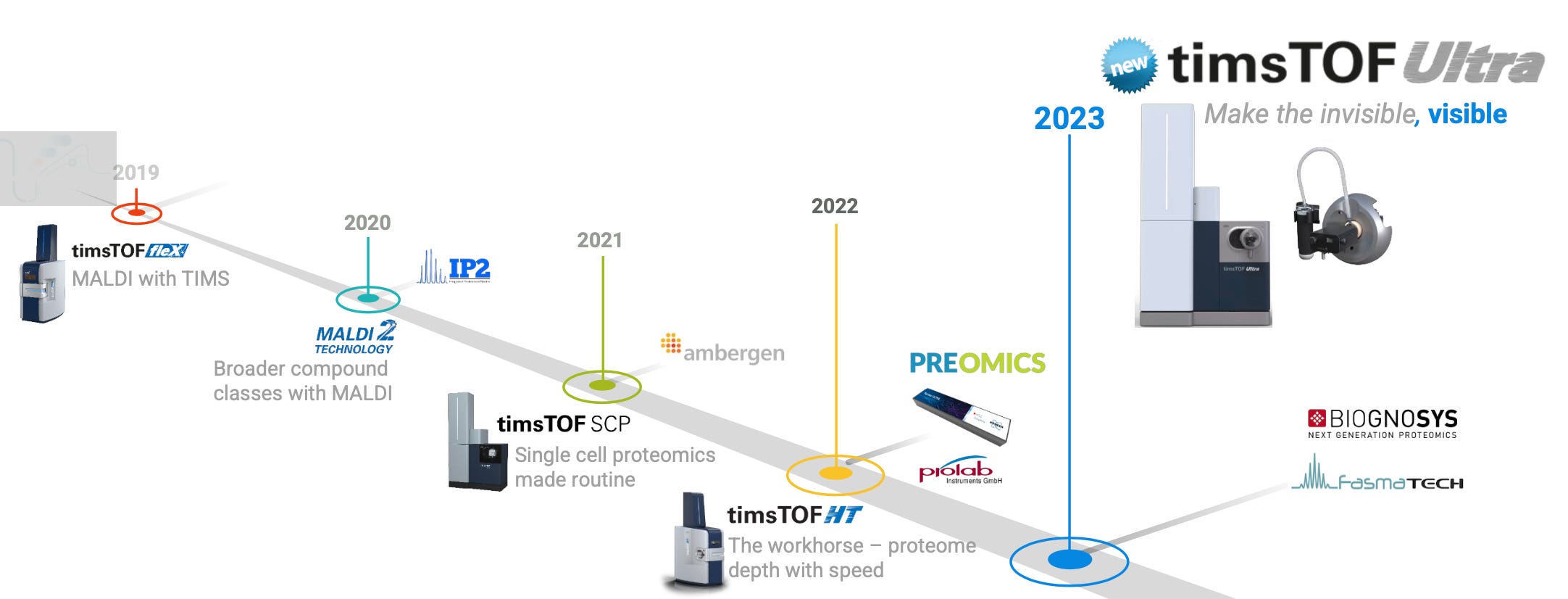
One of the great things about the platform is the cadence at which BRKR manages to operate, releasing an upgrade or expanded capabilities every year. It keeps BRKR honest against Thermo Fisher, who also advance fairly steadily, while also maintaining the distance from others. BRKR now has a range of timsTOF systems based around the same architecture but either specialised for different applications or optimised to be flexible. Critically, timsTOF is upgradable in the field, providing additional economic incentives for customers. While most systems currently go into academia, adoption is increasing in pharma (~30%).
As an aside, I’m convinced that one element of Illumina’s downfall was not moving fast enough, thereby allowing others to catch up. We’ll see how things evolve, but I’m persuaded that BRKR is working hard to avoid the same fate. I’m no expert, so please tell me if you think I’m wrong, but my impression is that a timsTOF might be a more complex instrument than, say, a NovaSeq from an engineering standpoint - for example operating across more fundamental physical domains (electromagnetism, vacuum physics, particle dynamics, timing etc). In the words of CALID President Rohan Thakur “we are making systems that are as complex as a rocket that goes to Mars”, while continuously upping the level of performance. The next question Thakar is grappling with is how to make the system push-button simple like the MALDI Biotyper - they're not there yet. Vis-à-vis genomics, here’s how Frank put it during the 2021 Investor Day:
Giving us that greater depth has almost made this timsTOF platform with the PASEF method by Matthias Mann a very big evolutionary step, if not, revolutionary in driving proteomics towards the throughput, the depth, the sensitivity, the robustness that you need to do what sequencing by synthesis did more than a dozen years ago, i.e., to kind of industrialize. Then it was genomics. Now it is proteomics. And we're doing that of course with many, many partners. But we're a crucial part of that.
…the inflection point in proteomics (with much work to do over the next 10, 15 years) to where proteomics indeed will become as important, if not, more important even than genomics, epigenetics, transcriptomics. That's a bold statement, but I'm very convinced that that will happen
Big words - we’ll see what happens.
Spatial Biology
I’ve asked our friend Claude to help get us started:
Spatial biology is a field that studies how cells are organized and interact within tissues, preserving their original physical locations and relationships. It combines advanced imaging techniques with molecular analysis to map where specific cells, proteins, and genes are located within tissue samples. This spatial information is crucial because cell function and behavior are heavily influenced by their location and neighboring cells, providing insights that traditional methods miss. Spatial biology has revolutionized our understanding of complex diseases like cancer, helping researchers see how different cell types interact in their native environment, which is leading to better diagnostics and more targeted treatments.
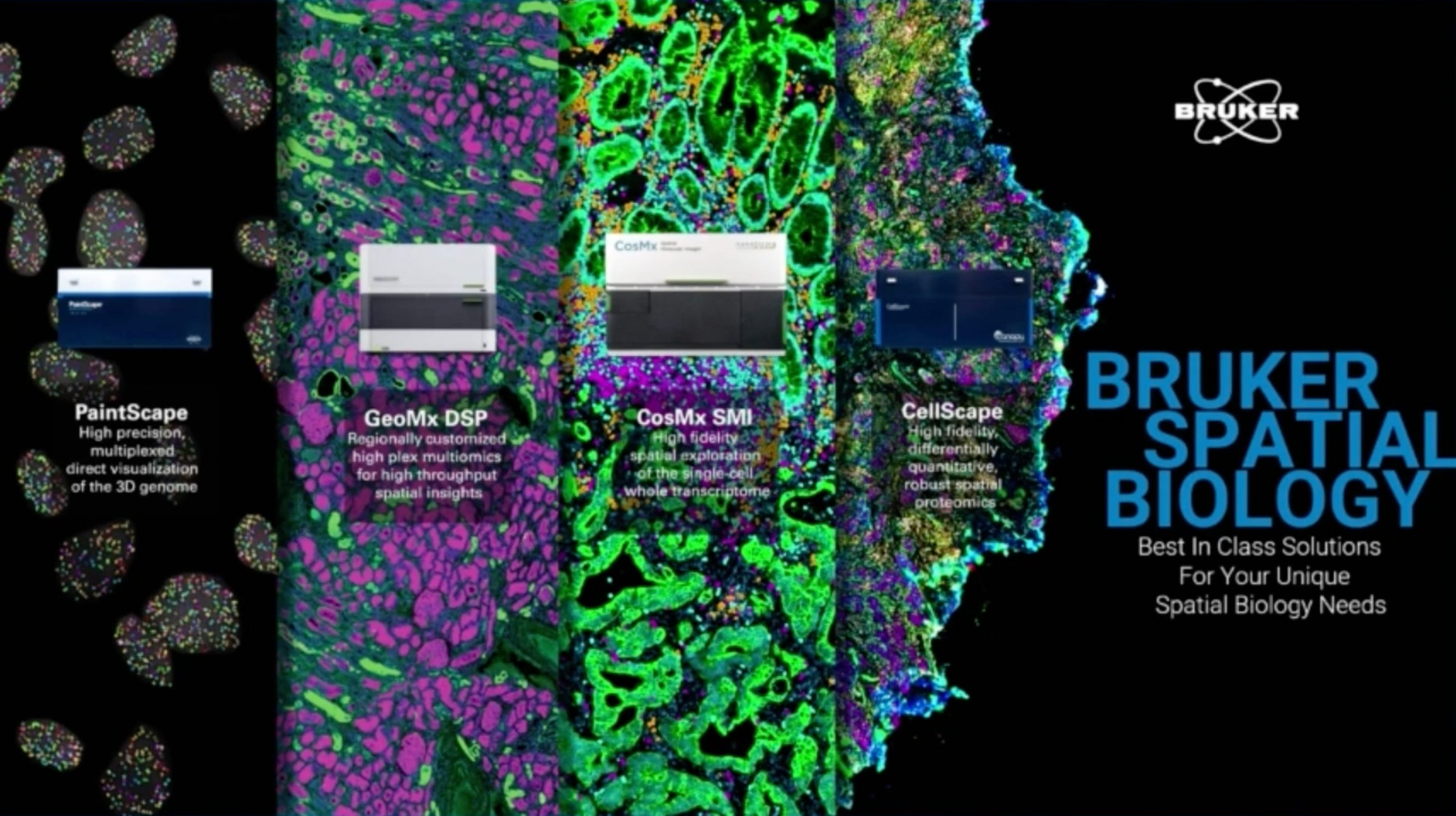
Arguably BRKR really got started in spatial biology with timsTOF fleX which launched in 2019, but we’re going to take a quick look at three dedicated spatial platforms here. Claude actually picked up on something really important, namely ‘advanced imaging’ - and that’s where BRKR found its entry. In 2020 BRKR acquired Canopy Biosciences. Canopy had an innovative chip cytometry platform but they didn’t have an instrument. Given BRKR’s expertise in fluorescence microscopy, it was a great technology match, and BRKR launched the CellScape platform in 2022. Next came GeoMx and CosMx with the NanoString acquisition in 2024. Most recently, PaintScape is launching this year. Each system depends on the type of optical imaging where BRKR is a leader. While the financial scale of these platforms is currently fairly limited, the growth prospects are exciting and potentially quite large. Additionally the economics are likely to be compelling with increased scale and razors and blades type models. Along with the NanoString acquisition and PaintScape launch, BRKR is now probably the number two player in spatial biology and, arguably the technology leader.
CellScape is a spatial proteomics platform that uses immunofluorescence to label and visualize many different proteins simultaneously in tissue samples. This provides a detailed map of protein distribution and interactions within the cellular environment. Competitors in the space are Akoya and Bio-Techne, although Frank believes they have the “premier position” given higher throughput and ability to identify proteins without damaging tissue. I can’t verify this, but I think I recall BRKR saying somewhere that It's about a $20m platform - it’s early in the adoption cycle. One advantage of the NanoString acquisition is a larger distribution channel and per recent comments from management, CellScape is growing very rapidly.
CosMx is a spatial biology platform that reveals tissue biology at the single-cell level with unbiased, whole transcriptome analysis. It allows researchers to visualize and analyze gene expression patterns while preserving the spatial context of cells within tissue samples. At AGBT this year, BRKR announced the whole transcriptome panel with the ability to detect and quantify over 18,000 RNA transcripts at single-cell and subcellular resolution. The competitor here is 10X Genomics, who claim they can do 5,000 transcripts, but Frank argues that their platform does not really scale beyond 1,000 to 2,000 in the field. Per Frank: “I think [CosMx] has almost an unfair advantage now in the spatial transcriptomics battles”. Per recent comments, the NanoString products (including GeoMx and nCounter) are currently annualising around $110m in revenue.
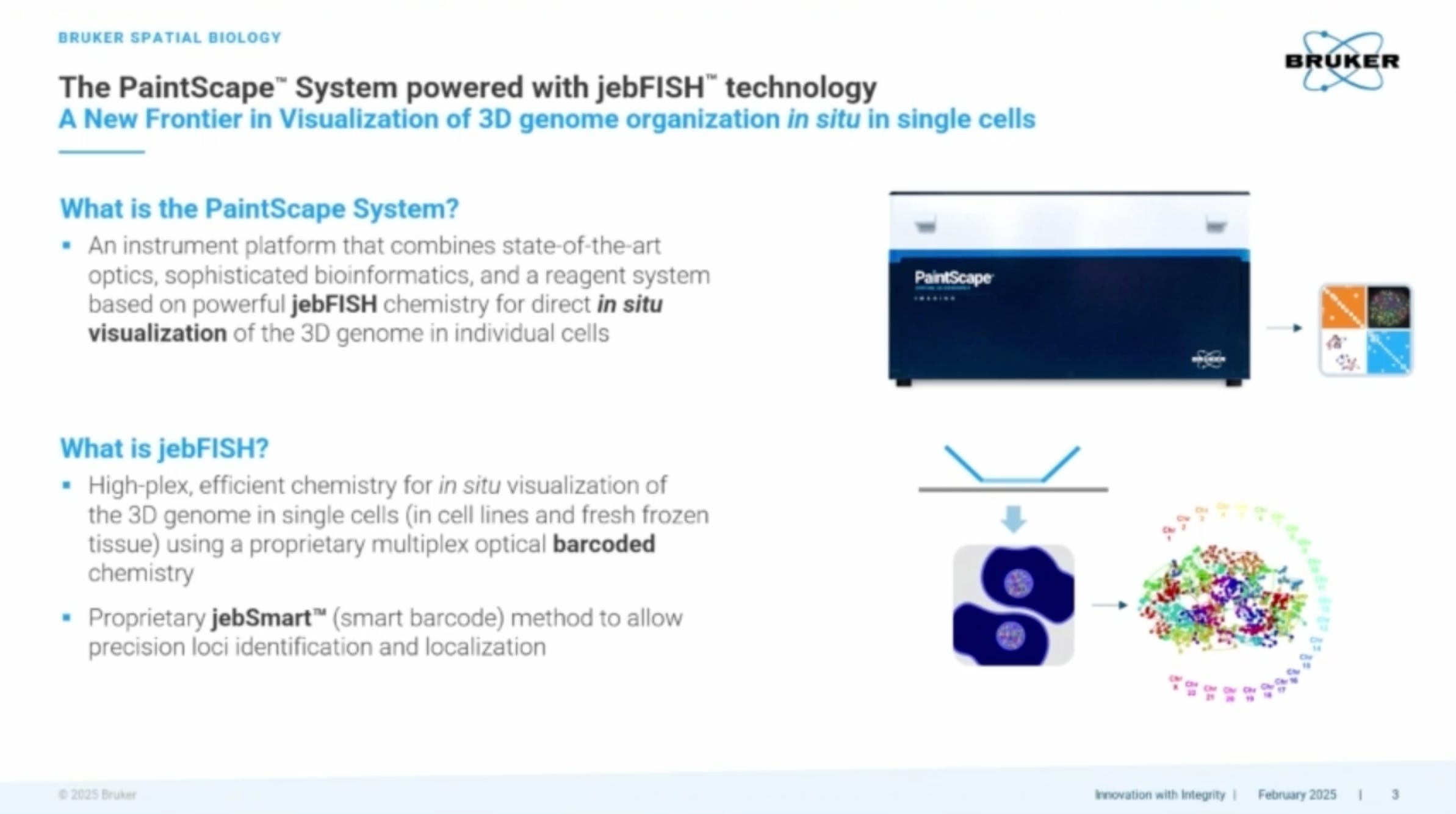
PaintScape is a truly first of its kind platform that allows scientists to directly see the 3D structure of DNA inside individual cells. It provides an unprecedented view of how the genome is organized in three dimensions with extremely high detail, helping researchers understand how changes in this structure affect gene expression and potentially cause disease. The technology was initially invented in Ting Wu’s lab at Harvard before BRKR licensed it and they developed it in partnership. Here’s how Frank puts it in his book:
The important novel insight into DNA is that, just like for proteins, it turns out that not only DNA primary structure, or nucleotide sequence, and DNA helical secondary structure are important. But in addition, 3D chromatin structures within chromosomes are functionally important, as is relative positioning within the genome and nucleus.
I think it’s pretty exciting to see where PaintScape will go, even if impossible to know at this stage. Brings to mind the famous Sydney Brenner quote: “progress in science depends on new techniques, new discoveries, and new ideas, probably in that order.”
Semiconductor Metrology
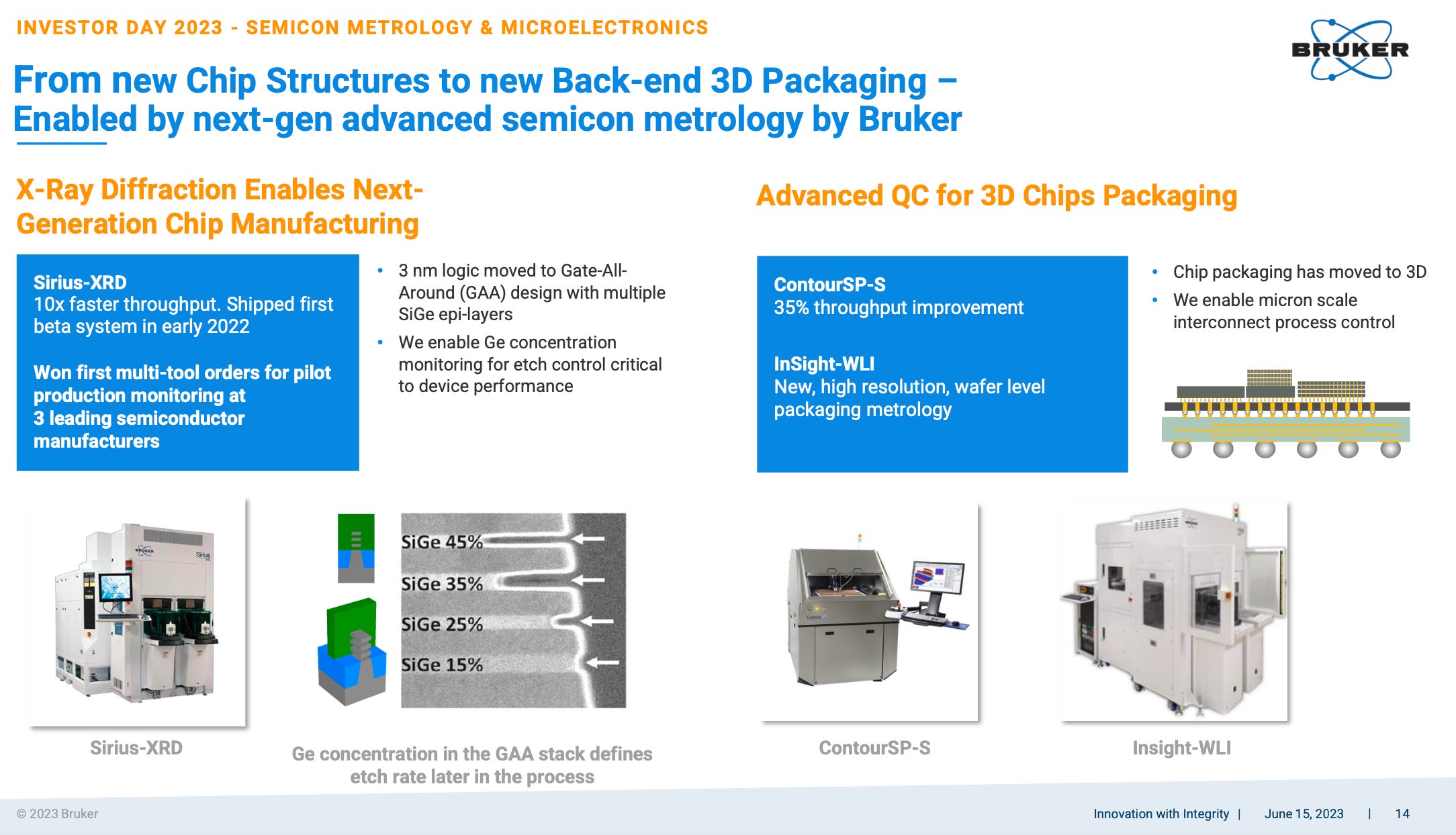
Per recent comments from management, BRKR’s semiconductor metrology business has more than $250m in annual revenue and it grew in the low-teens in 2024. About half of the total is for AI and high performance computing related metrology. BRKR is specialised in advanced capabilities for smaller feature chips, including multi-layers and 3D packaging - notably in quality assurance, quality control and R&D. From what I gather, specialisation is key here. Per Frank, their tools are indispensable in making NVIDIA’s leading-edge chips: “they need a few other tools, not only ours, but it wouldn’t work without our tools.” Mark Much sees the long-term CAGR in their markets as 10-11%.
Spotlight - concluding thoughts
Taking all of the spotlight platforms together, I estimate we are in the region of $1.1 to 1.2bn in sales - around 35% of the total or roughly 60% of PA2.0. And together, these businesses are growing in the low-double digits or thereabouts.
Numbers and Metrics
R&D / Organic Growth
Before we dive into a few numbers, here’s Frank speaking as far back as 2005, but sounding entirely consistent with his approach 20 years later:
“We probably spend a little bit more on long-term technological R&D and real innovation as opposed to regurgitating the next generation of something that exists," he continues. "Obviously, we work to keep our product lines young and to steadily improve them, but you have to have compelling new products to open up new markets.”
The invention of cryoprobes was, for example, "a vision we developed internally," Laukien explains. "There was no demand for it, no customer collaboration, and it took four or five years until the first product came out." Since then, cryoprobes have offered the single largest increase in NMR sensitivity in the past few decades. Other times, the companies will work with or even license ideas from key customers.
“But on some things you have to internally place some bets," Laukien adds. "Some things you don't get out of market research, and some things customers are not yet asking for because it never occurred to them to ask. You need to bring out new technologies and try to leapfrog yourself or the rest of the market technologically every once in a while.”
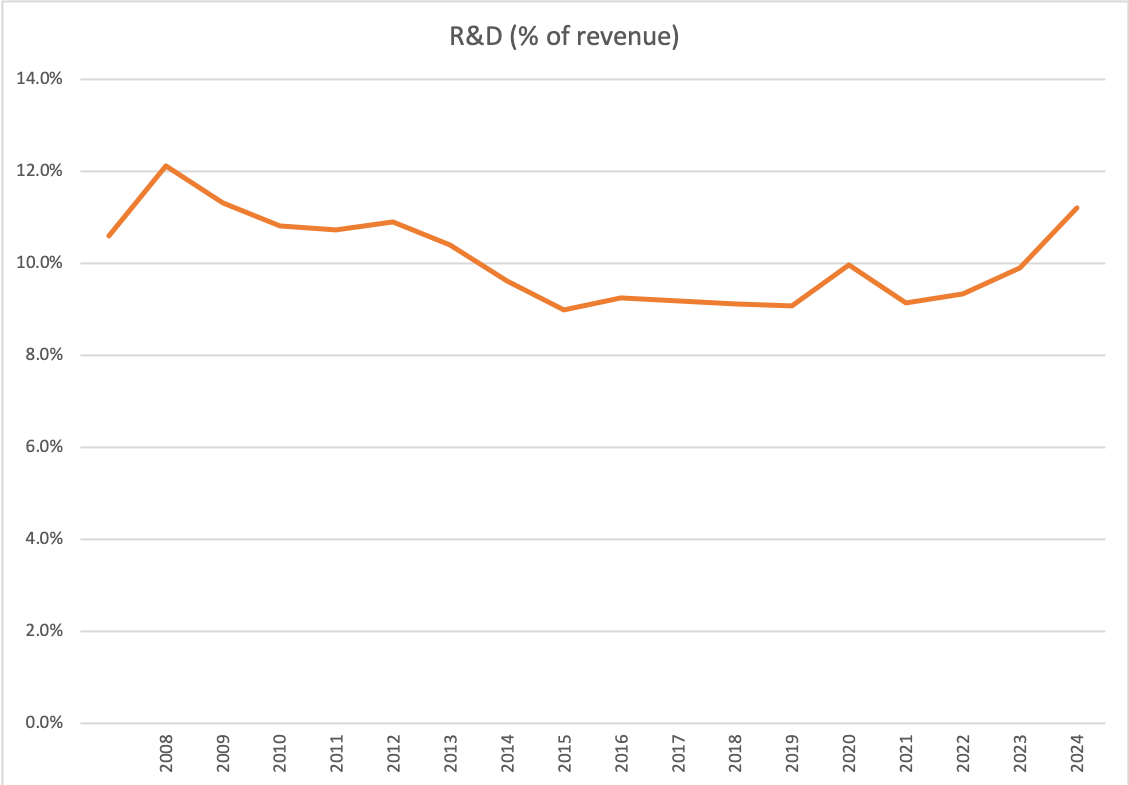
For most of the last decade BRKR has invested fairly consistently at a rate of 9-10%, although you’ll notice an uptick last year due to the loss-making NanoString and PhenomeX acquisitions which came with a disproportionate share of R&D relative to revenue. In the next several years, I expect the ratio to normalise once again. The thing to note is that BRKR invests 3-4pp high than peers such as Agilent, Waters and Danaher. Of course, higher R&D spend is not, of itself, a good thing unless it ultimately translates into monetizable innovation and revenue - just look at Illumina which has invested in the 20s for years.
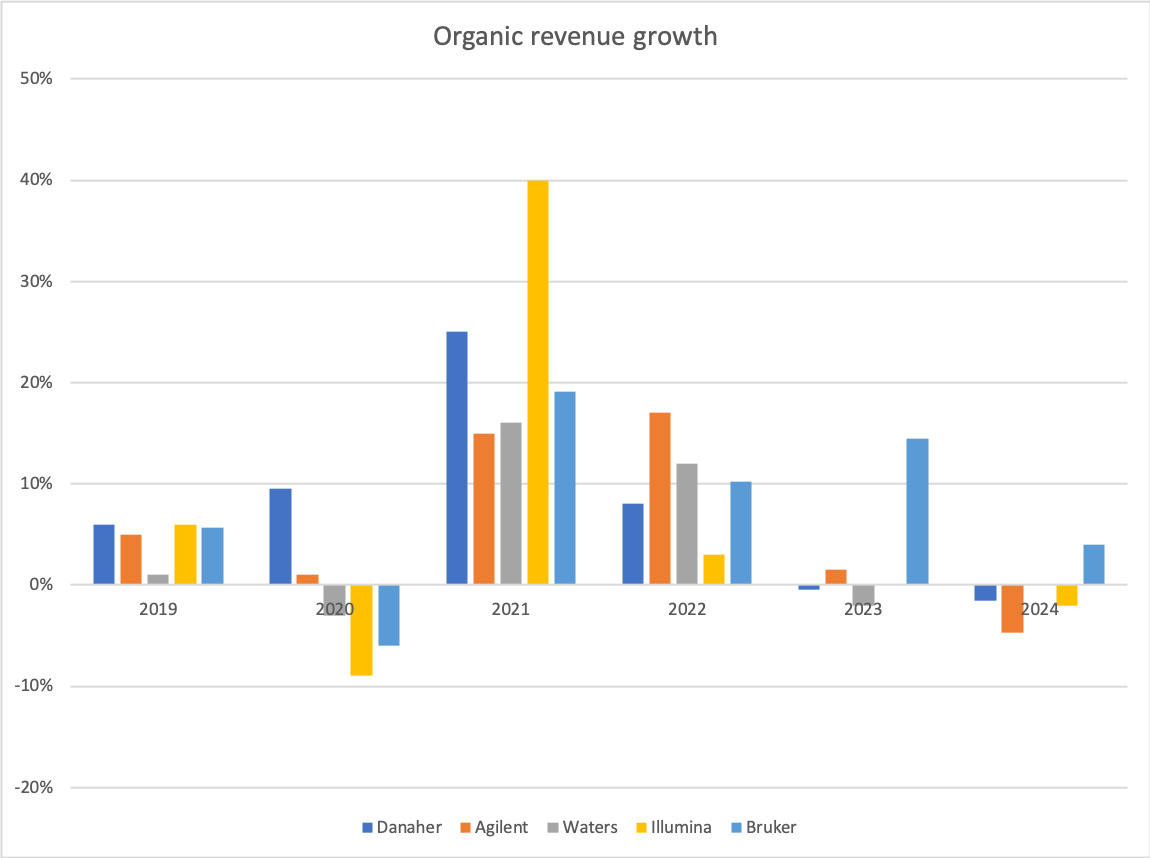
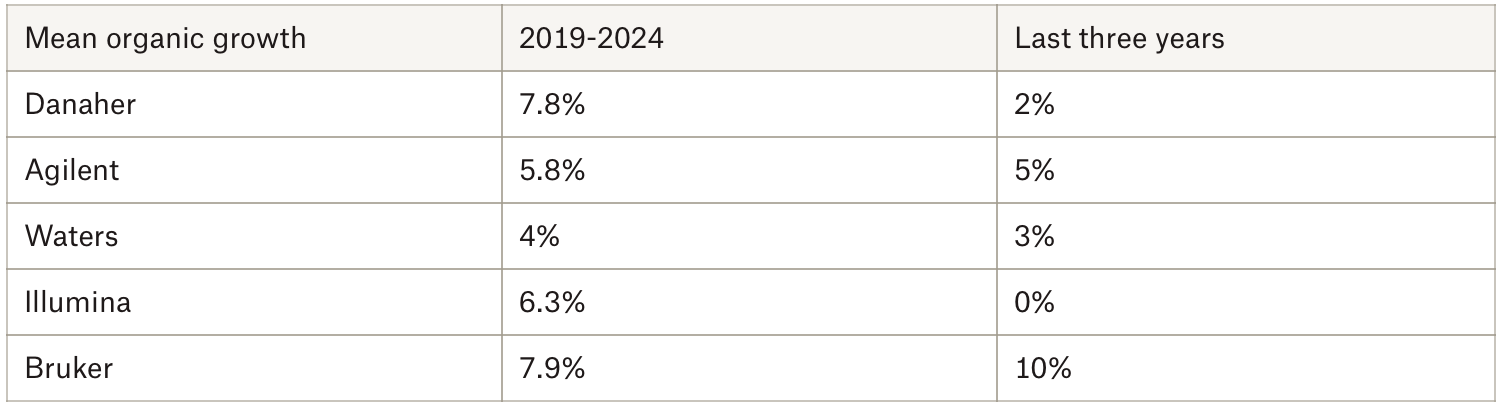
There are lots of ways of slicing it up, but in most ways you can look at it, BRKR has been outgrowing peers organically on average for a number of years. Most notably, this includes the last several years where many customers around the world have been cutting spending following a post-pandemic hangover. This suggests to me, along with BRKR’s steady product cadence, that the R&D expenditure is working. For its part, BRKR has emphasised numerous times that their relative outperformance is driven by customer demand for leading-edge instruments - when budgets are tighter, customers prioritise leading edge. One other thing occurred to me when writing this note - given all of BRKR’s close academic/customer partnerships, one has to wonder how much additional R&D they get for ‘free’…
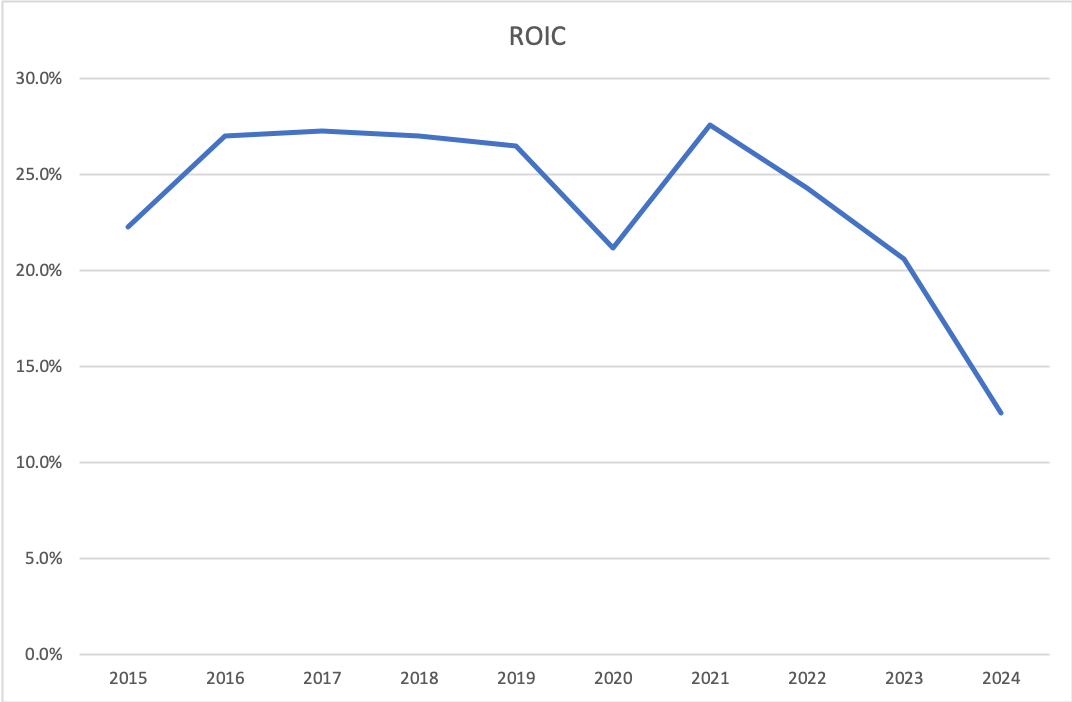
ROIC
One area that distinguishes BRKR somewhat from peers is a higher ROIC threshold for both acquisitions and at a group level - 20% or higher. That’s about twice Danaher’s threshold. It’s been this way for many years. Admittedly, when BRKR makes loss-making acquisitions (NanoString, PhenomeX) or premium price acquisitions (ELITech) you’ll see near-term dilution. But it’s not because they’ve changed the threshold - they fully intend to meet the 20% threshold in due course.
Cash Flow
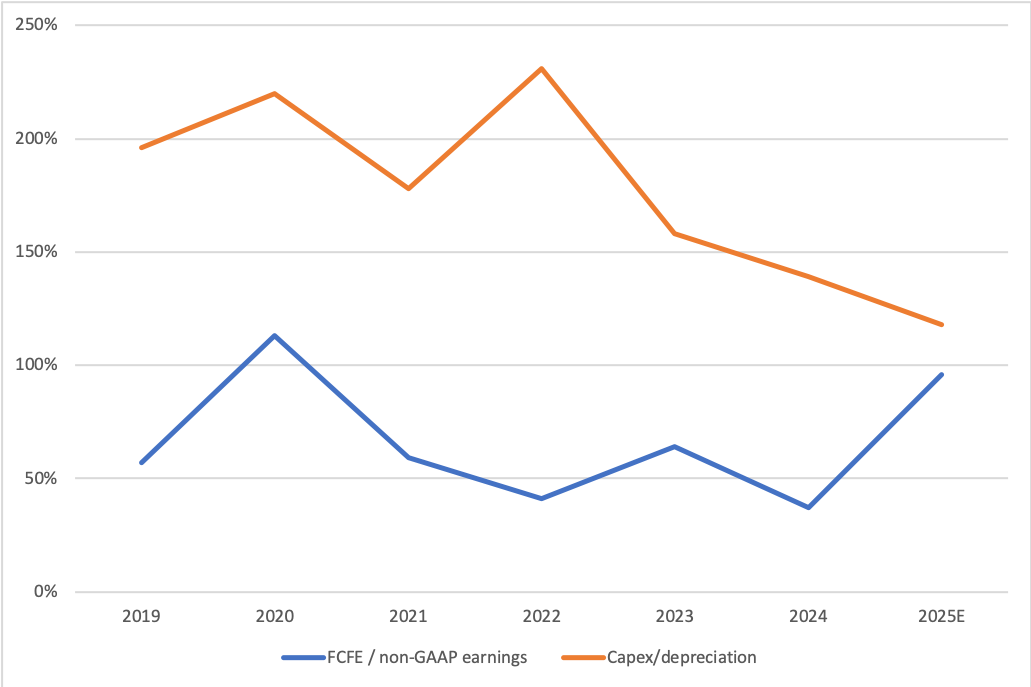
One area of weakness in the last few years has been free cash flow conversion. In addition to the squeeze on margins in the last 18 months, BRKR has been investing heavily in capex over a period of years while also seeing working capital demands through the pandemic and recent M&A. But here’s how Frank put it at JPM in January:
We did so much capex investment in recent years for productivity and for capacity that we think we’re all pretty much set for the next 10 years, so that I think we can bring down capex quite a bit for further for fast free cash flow generation. And I think you’ll see some evidence of that already in Q4.
And here’s Gerald at Q4 2024 on working capital:
We generated a significant amount of working capital improvement in the fourth quarter and expect to see that continue as we move into 2025. Our cash flow conversion has improved, I think, significantly after, I would say, some challenges especially related to initial working capital associated with our acquired businesses. But overall, we’re pretty pleased with the performance in the fourth quarter and expect to continue to see it.
Outlook: Growth & Margins
Management are targeting >125bps of annual operating margin expansion in 2025-2027 with 13-15% annual EPS growth. Beyond that, BRKR recently announced intentions to get to “mid-20s” operating margin in the “following few years after 2027”. Things rarely move in a straight line and we may well see some additional near-term noise arise from a possible trade war, but this is what the basic trajectory could look like - essentially a continuation of the pre-2024 trend:
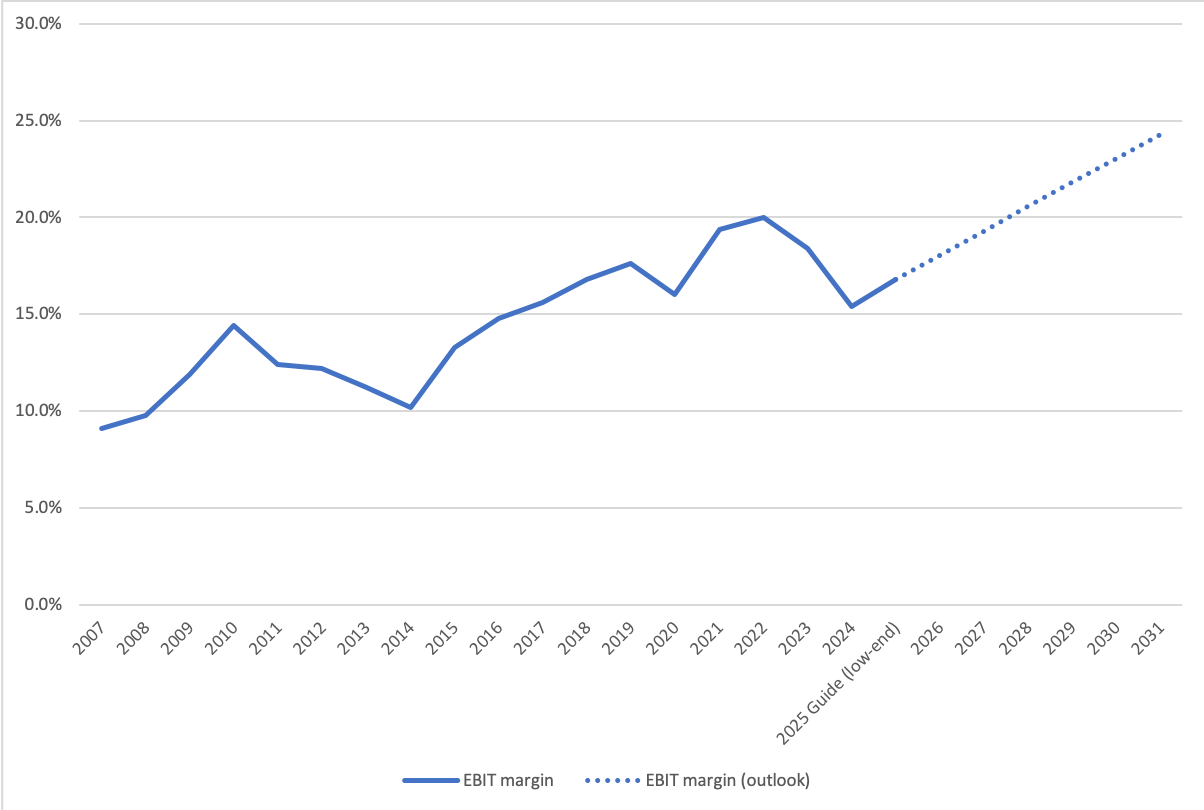
Even before factoring in sales growth, this would be sufficient for 7-8% EBIT CAGR out to 2031. Incorporating ‘market’ sales growth of 4-6%, gets you to 10-12% CAGR. Management however believe they can grow 200bps above market which puts it nearer 12-14%.
NIH & Trade Wars
NIH / US Academia
Earlier on I mentioned the threat of reduced funding for the National Institute of Health, the primary agency of the US government responsible for biomedical and public health research, as well as possible secondary effects on funding in the wider academic and government research field in the US. Rightly or wrongly (I would argue wrongly, as does BRKR), BRKR is widely perceived to be very exposed. I did some posting on X recently, conveying management’s recent thoughts on this. Here are some of the key points:
92% of their business is not US academia.
They’re currently modelling an 8% reduction in NIH budget which might mean merely they come in at the lower end of guidance in 2025 rather than ‘beating and raising’.
In the unrealistic scenario that all US academic spending is hit by 25% this year, it’ll take BRKR’s top line growth down by ~200bps to 3-5%.
RFK Jr’s (HHS secretary, at time of writing) focus on chronic disease fits with the post-genomic era
US customers are still likely going to invest in leading edge
“I think this is completely overblown and this people freaking out and going to whoever gives them the lowest number and the scariest number. I mean, this does attract clicks but I think it’s bullshit. You can quote me on that” - Frank, talking about NIH budget.
Here’s a slide Gerald showed at Citi in December (data TTM to September 2024):
Trade Wars
It’s a volatile situation, but so far we’ve heard that the EU will get 20% tariffs on exports to the US and poor old neutral Switzerland will get 31%. But at the time of writing the tariff rate is 10% for everyone pending a 90-day reprieve for negotiations. Who knows what the status quo will be by the time you read this. BRKR makes high-end gear in Germany and Switzerland, among other places, for the US market. They make some gear in the US too. At a guess, perhaps it’s likely at this stage that BRKR will miss its 2025 guidance now or just pull it entirely, such is the trend that’s emerging at the start of the 2025 Q1 earnings season - we’ll find out in May. BRKR’s Q1 preliminary revenue beat by around 500bps, but we don’t yet know why - perhaps it was due to conservatism when they guided at Q4 (they specifically said they were being conservative) or perhaps it’s pull-forward on tariff fears. To try to predict what’s going to transpire in the short-term would be a largely fruitless endeavour in my view, so I won’t try. We’ll focus instead on the long-view combined with the flexibility to adapt as needed to arrive there.
Because it’s such a big deal right now in everyone’s minds, I shall quote Frank, at length, speaking at Leerink in March (skip to key points below, if you prefer):
Mexico, Canada. Thank you. I misspoke. Thank you. Yeah, Mexico and Canada doesn't really – it doesn't affect us. China, we have an exceptionally beneficial setup there and we don't manufacture, for our final test, anything in China. We manufacture in the US; in Penang, Malaysia; and in Europe, but not in China. So, we're not importing anything that's affected by these increasing tariffs by the US on things imported from China. China will have retaliatory tariffs. But of what we, Bruker, sell into China, 90% comes from Europe or from Malaysia and only 10% comes from the US that could therefore be subject to the increasing Chinese tariffs on US-made goods. To your Europe question, so the posts to Truth Social that I had seen from a Cabinet meeting at some point by Trump was on tariffs on the European Union.
So first of all, Switzerland's not part of the European Union. And a very big part, essentially all of our NMR business, all of our NMR business, not – some of our MRI and EPR business, although they could also come out of Switzerland very easily, comes from Switzerland which, with their Swiss neutrality, does not seem to be implicated because they are not European Union. So that might be a good guy. That's a big chunk. The things that do come out of the European Union, mass spectrometers, X-ray equipment, things that we make mostly in Germany but also in France and Belgium, that's all European Union. So, if you look at tariffs on – are there any European Union tariffs on scientific equipment made in America and coming into Europe, there are none, none that I'm aware of. It's not like pickup trucks or SUVs or steel or aluminum. There aren't any, so there shouldn't be any retaliatory tariffs against that.
Now, it could be broader brush, right? Maybe they'll say, well, equipment coming in from the European Union. That could be very broad, and that then could also include Bruker scientific equipment coming into the US. So there, I have – we're not doing anything at the moment because this is also unclear. There, I have reasonable agility because we used to make X-ray equipment in Madison, Wisconsin. Now, it all comes from Karlsruhe, Germany, but we could go back. We already have the facility there and could – for the US market, I wouldn't move all my global manufacturing. But for the US market, I could move it back to Wisconsin. And mass spectrometry and NMR, NMR comes out of Switzerland, but both of those used to be also made in Massachusetts at our Billerica headquarter site. That's where we did all the MALDI Biotypers, and we have a big mass spec R&D footprint.
So, we could bring our mass spec to Massachusetts and, if needed, our Swiss NMRs to Massachusetts because we used to do final tests over there. That doesn't happen overnight, but it also doesn't take – so it probably would take maybe $10 million, $20 million in CapEx that we're presently not planning, and it could take us maybe two or three quarters with rehiring and resetting everything up appropriately. But that's very different from oh my God, I need a couple of $100 million and a greenfield site and this will take me two or three years to execute, so we have reasonable agility there. And we have all the X-ray, NMR, mass spec experience on these sites that we could pull it off, and we still have manufacturing and even FDA regulatory systems in these sites. So, we could move it within a few quarters, but we're not doing that right now because you don't know what to solve for, right?
Here are the key points:
If needed they can bring mass spectrometry and NMR production to Massachussetts and X-ray to Wisconsin, where they have existing facilities, manufacturing, experience and FDA regulatory systems in place. It would cost them $10-20m and take 2-3 quarters.
Only 10% of what they sell to China comes from the US
While we could well have some turbulence therefore in the coming weeks and months, it seems to me that BRKR is pretty well-placed to adapt. The greater risk is a global escalation with increased trade barriers between Europe and China. But even then it’s worth noting that China does not generally have locally produced substitutes for BRKR’s high-end instruments - if they want to stay at the frontier of life science research (and by all accounts they do) then they need these instruments. This latter point applies to the US and Europe too - putting major taxes on BRKR’s gear is effectively shooting yourself in the foot relative to nations acting more strategically in life sciences, although that’s not to say it won’t be done anyway.
Final Thoughts
From time to time, the market prefers to discount BRKR relative to its peers due to lower recurring revenue and higher aca/gov exposure. But as we’ve seen, BRKR grows faster than its peers on account of greater innovation at the leading-edge. Additionally, BRKR has considerably more opportunity to expand its margins in the coming years. Over time, we should also expect to see the share of recurring revenue increase and the share of aca/gov decrease.
Happy to hear from you if you’d like to continue the discussion.
Selected Further Reading
Books
Active Biological Evolution: Feedback-Driven, Actively Accelerated Organismal and Cancer Evolution, Frank Laukien, 2022
Searching and Researching: An Autobiography of a Nobel Laureate, Richard Ernst, 2021
Articles / Essays
Bruker Companies Go Their Own Ways - https://cen.acs.org/articles/83/i13/BRUKER-COMPANIES-OWN-WAYS.html
Zurich′s Contributions to 50 Years Development of Bruker, Richard Ernst -https://onlinelibrary.wiley.com/doi/full/10.1002/anie.201005067
Bruker: 50 Years of Innovation - https://www.bruker.com/en/about/history-new/_jcr_content/root/sections/section_1864966682/sectionpar/twocolumns/contentpar-1/calltoaction.download-asset.pdf/links/item0/Bruker50.pdf
Interview with Frank Laukien, American Chemical Society https://pubsapp.acs.org/subscribe/archive/mdd/v06/i10/pdf/1003business.pdf?
Great stuff!
Thanks a lot, I enjoyed your writing on Regeneron and the same goes for this one on Bruker! Very complex products that are part of research grants that can span 5-10 years. For example, doing proteomics on a 3-4 year clinical trial. My department uses Olink from Thermo Fisher. Working in clinical pharmacology here.