

Friends of NFTBC
Before we get to BRKR earnings I thought it might be interesting to start with a brief detour into the proposed use of particle accelerators in semiconductor lithography. It’s been making headlines in the last week and worth drawing attention to the possible implications for BRKR. If you’d rather skip ahead to earnings, please do.
Particle accelerators and next-gen lithography
One of the least noticed parts of BRKR’s business is the superconducting materials part. Actually, there are two parts - one is majority owned subsidiary Research Instruments, the other is Bruker EAS. Both form part of the BEST reporting segment which stands separate from the principal Bruker Scientific Instruments (BSI) segment. RI produces highly specialised components used in particle accelerators and other high energy physics projects - SRF cavities, couplers, accelerator modules, particle sources etc. According to RI they have more than 50% market share in SRF cavities. For its part, Bruker EAS is the world leader at producing specialist low temperature superconducting wire - they make over 100,000km of it per year. Most of it goes into MRI machines. Bruker also makes smaller quantities of even more specialist Niobium-Tin (Nb3Sn) wire used in pretty much all major particle accelerators. It’s very difficult to produce economically at the right specifications and in sufficient quantity. The processes at both companies have been developed over decades and are not in the least bit easily replicable. There’s really only a couple of private businesses that turn up in contracts as principal suppliers of either the cavities or wire in major accelerator projects - Bruker being the only one doing both.
What does this have to do with lithography? For several years BRKR have been mentioning that they’re involved in projects to develop next-generation lithography - and I’m pretty sure they’re working with xLight. xLight’s business model is to build particle accelerators / free electron lasers (FELs) to replace the existing light source in ASML’s EUV machines to give greater power and to enable sub-EUV wavelengths (X-ray lithography). The technology is intended to be complementary to ASML and the current semiconductor ecosystem. They plan to have a prototype up and running in 2028. The ultimate goal is to unlock productivity gains and 50% lower wafer costs. xLight say one of their accelerators (actually two - one for redundancy) will serve up to 20 ASML machines in one fab.
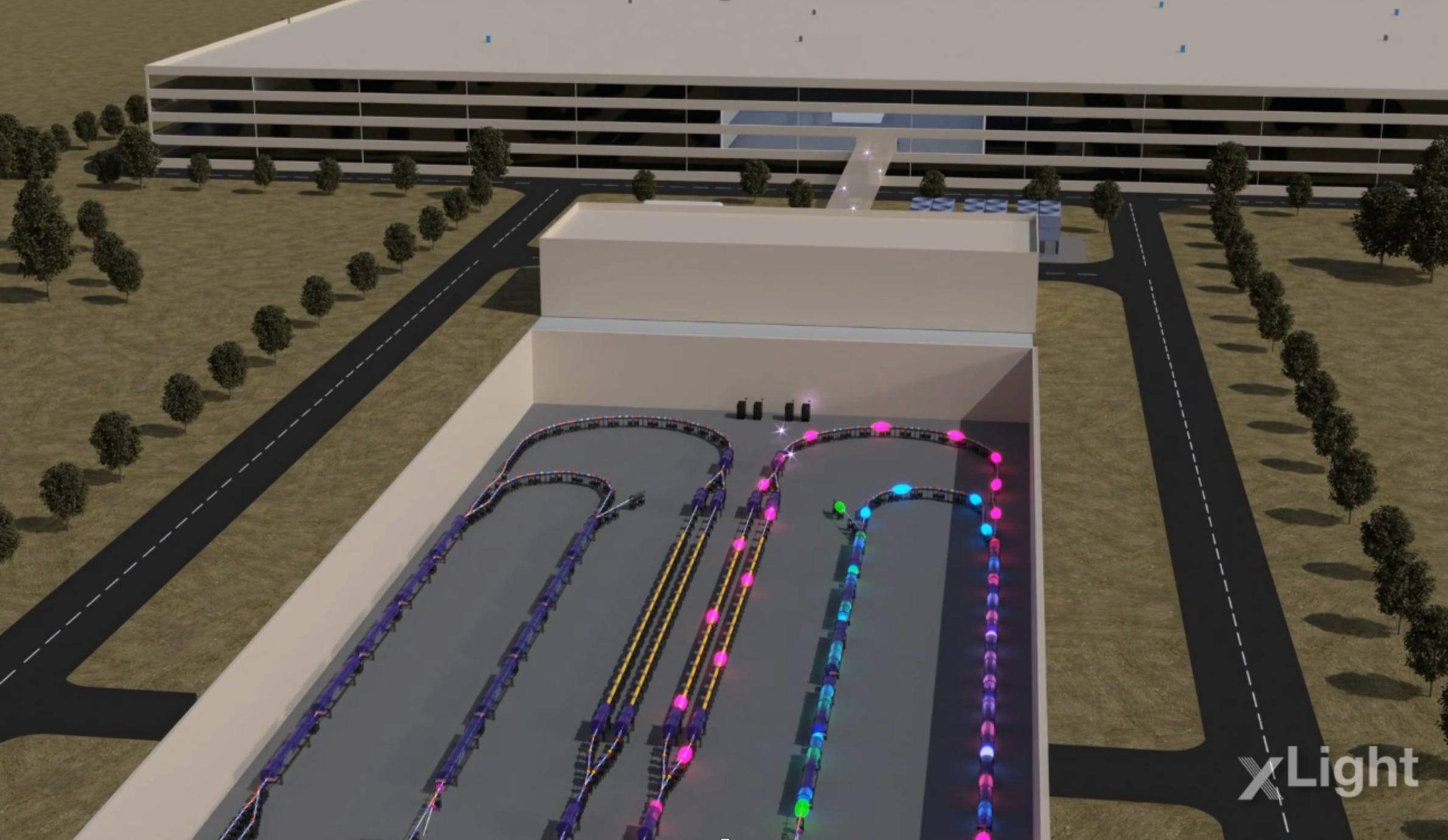
And then last week Substrate came out of stealth mode. If you think xLight’s plan is radical, Substrate’s is more so. I recommend both the SemiAnalysis piece and Ben Thompson’s interview with Substrate founder James Proud if you want to get up to speed and if you want more context around X-ray lithography and why historic attempts failed. In brief, the plan also involves building large FELs but additionally building the lithography tools and even the fab. Proud’s audacious plan is to lower wafer costs by an order of magnitude and to reduce leading-edge fab costs into the single-digit billions from tens of billions as the currently are. I can offer you no useful opinion on whether this plan will succeed - I’ve no idea. But, according to Proud, there are a couple of reasons they’ve come out of stealth mode at this moment. First, they’re apparently printing 2nm parts consistently now (and it’s looking “legit” according to SemiAnalysis’s diligence). Second, they’re literally going to start building a large particle accelerator very soon, and people would otherwise notice. And apparently they intend to have their first fab online in 2028. It’s this last part that has captured my attention and why I’m writing about it today. If xLight and Substrate are set on 2028, then they’re talking to their suppliers today and I can’t really see how that doesn’t include BRKR.
FEL particle accelerators of the sort contemplated by xLight and Substrate don’t get built very often - they’ve been ‘big science’ projects historically. In the last decade or so there have been a couple of notable ones - one in Europe and one in California. And it appears to be the case the latter one at the SLAC National Accelerator Laboratory is where Substrate has been testing. For BRKR such contracts have run into the tens of millions. They add very considerably to BEST’s backlog and there are, of course, lead times - so I’m guessing that if this is really happening we’ll probably start hearing about it from Bruker’s side eventually (even if it’s in vague NDA-disguised terms). We’re missing a lot of details at the moment - the accelerators may well be shorter than the FEL at SLAC, but for redundancy purposes there are likely to be two at each site.
But let’s not get ahead of ourselves. For discrete projects we’re probably talking about a low single digit contribution to total BRKR revenue. The more interesting possibility is if we ultimately arrive at a place where most new leading-edge fabs have a couple of particle accelerators - the industrialisation of particle accelerators. BRKR’s CEO Frank Laukien has also recently raised the likelihood of $100-200m in BEST sales into nuclear fusion projects within 5-10 years - yes, deliberately vague, but sizeable in relation to the current business in either case.
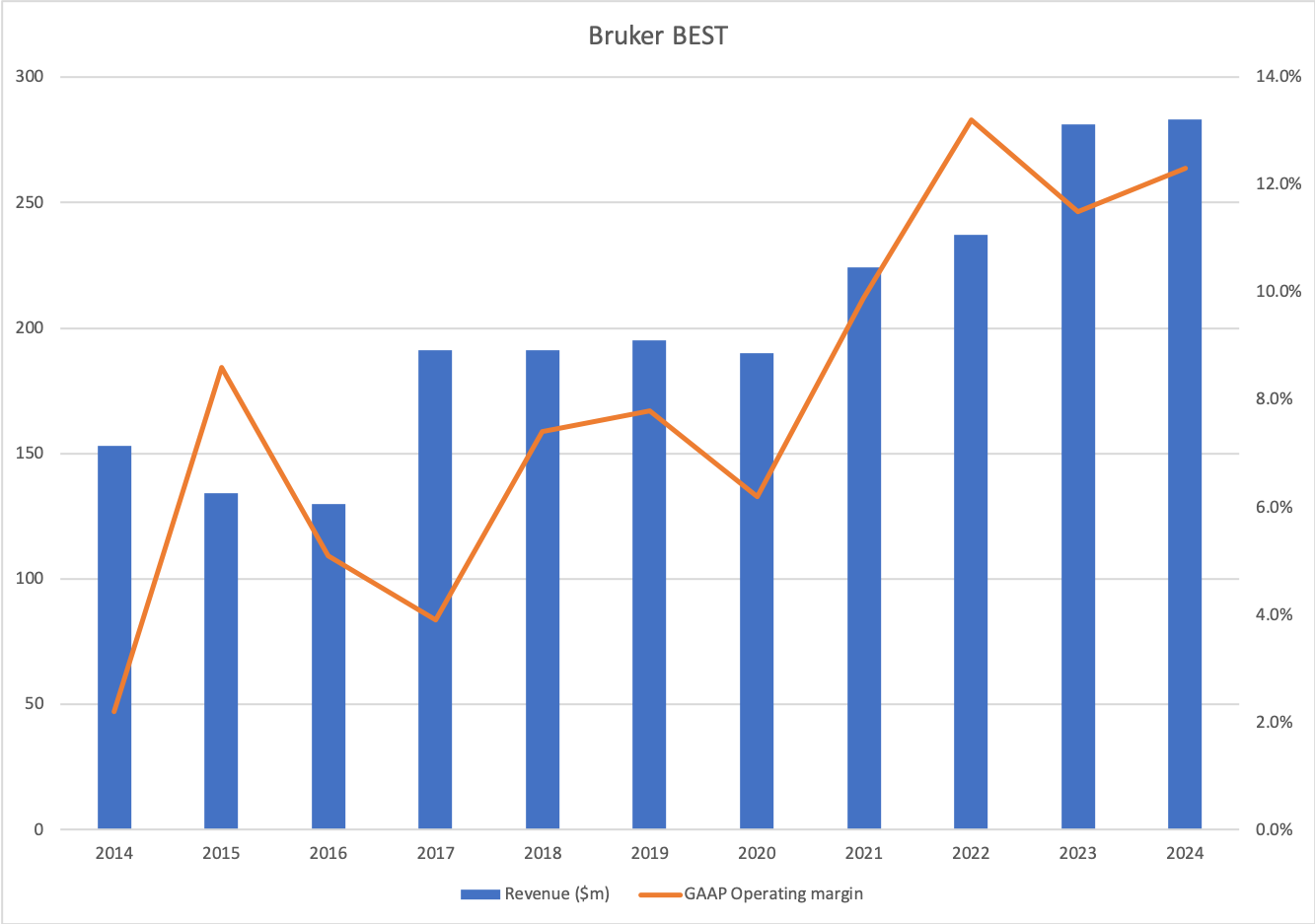
BEST itself used to be something of a problem child for BRKR with volatile revenue and weak margins. A decade or so ago they even filed to list it separately, before ultimately deciding to invest in it and improve its performance. They’ve done a good job. But it’s interesting to wonder what might happen if they sell a lot more of their highest margin products.
With that, let’s talk about Q3 earnings
[NFTBC does not give advice - please do your own research. I currently own shares in BRKR]
