


Friends of NFTBC
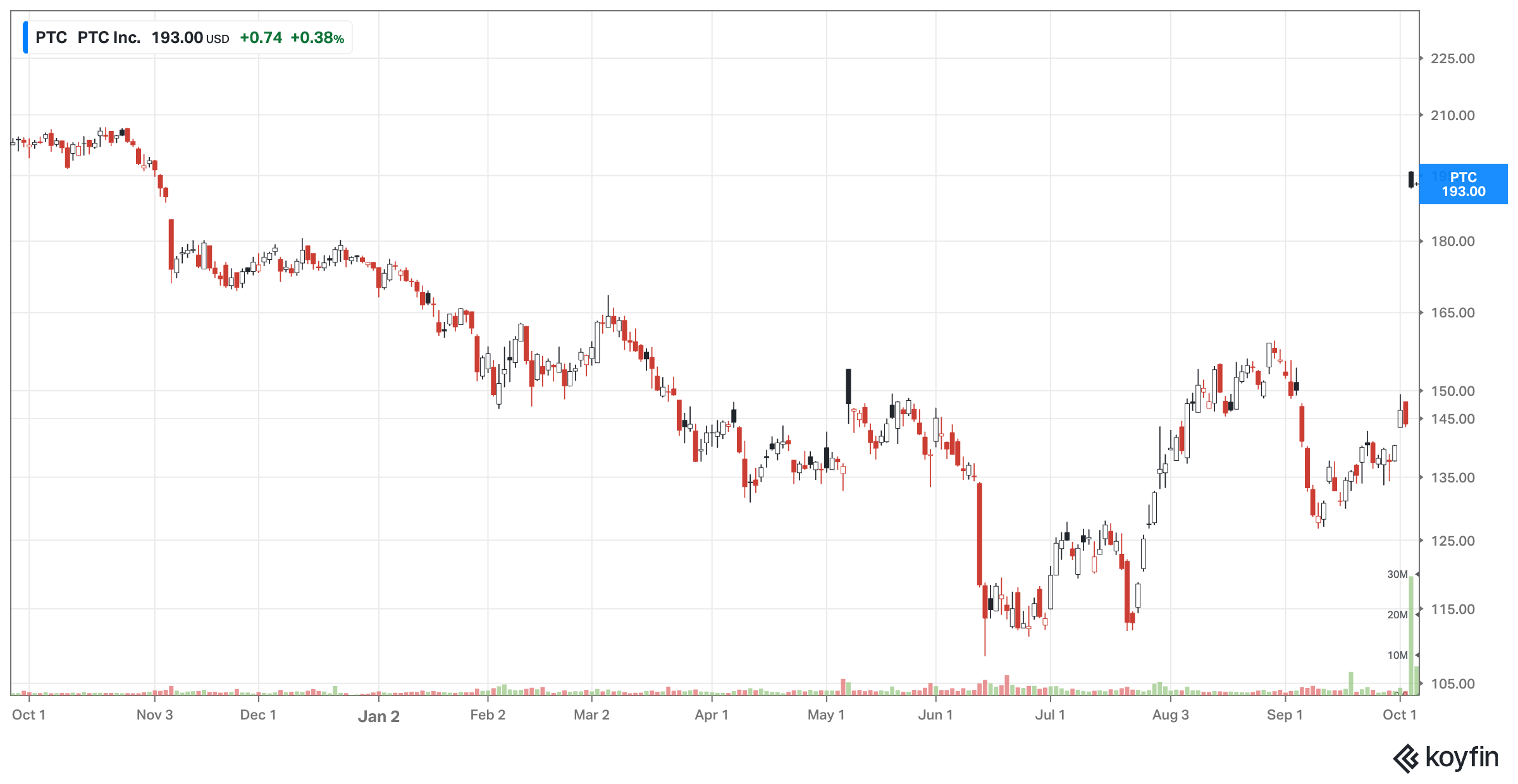
This week Schneider Electric announced an agreement to acquire PTC in an all-cash deal. The transaction has been unanimously approved by PTC’s board of directors and represents a 42.3% premium to the prior closing share price. While the deal still requires various approvals (including that of PTC’s shareholders) and is expected to close by the third quarter of 2027, it looks very likely to go ahead. For this reason, and barring the unforeseen, this post will be the last of my musings on PTC.
Concurrently, I’m taking the paywall off all of my standalone PTC posts, including both parts of the deep dive - please help yourself (link here). There’s a good deal more PTC content within The NFTBC Digest, but given the impracticalities of separating it, I’m unable to open it up in the same way.
The purpose of this post is twofold:
To wrap up our shared PTC journey and reflect on the experience of the last 12 months - the bitter and the sweet.
To use the case study to highlight to you what I’m trying to do with NFTBC.
The Sweet
When I started writing about PTC, the company was in the midst of a major go-to-market transformation to reaccelerate organic ARR growth back into the double digits and to sustain it there. A year later, we can say that progress is encouraging: ARR growth is now starting to accelerate and management have outlined a credible near-term path back to double-digits.
There were three other specific elements of the thesis that I highlighted and explored as well: 1) untapped pricing power, 2) AI as a tailwind (in particular the foundational role played by PLM software in industrial enterprise AI adoption) and 3) Onshape - PTC’s uniquely disruptive cloud-native CAD system. As the year progressed, PTC demonstrated a shift towards longer customer contracts, as well as a new pricing model that is only beginning to flow through the business. This incorporates annual contractual pricing uplift of around 3–4%, compared with the 1–2% historically achieved through renewal negotiations - an extra couple of percentage points as contracts move onto the new model (pricing power ✅). We also saw PTC increasingly winning in competitive PLM displacements. Historically, displacing PLM has been notoriously difficult, but PTC has made a compelling case for a modern PLM implementation as table stakes for manufacturing businesses that want to incorporate AI into their product lifecycle workflows (i.e. presumably most of them, in the end), with Windchill as one of the best solutions. And, as promised, PTC continued to roll out thoughtfully developed AI features throughout the year (AI ✅). And last, Onshape - after years as a start-up in the shadows, Onshape finally broke out into the limelight, both in terms of coming to the fore in management discussions about strategic positioning and in a snowballing competitive displacement story, including the largest-ever Onshape enterprise deal (Onshape ✅).
Also on the Sweet side of things, and I’ll touch on this more below, I won’t deny that owning software stocks this year has been a headache. A headache that, in PTC’s case, potentially won’t fully subside until the company has well and truly proven the AI as a tailwind story. Precisely how long that might take remains unclear, but for now PTC sits very much in the ‘AI loser’ basket. In this context (again, I’ll touch on this later), the Schneider takeover has provided me with the opportunity to cash out with a respectable IRR of 30% while dispensing with all the ongoing drama wrought by AI.
The Bitter
With the journey cut short, there are lots of things that we’re not going to get to see play out, potentially missing out on a compelling longer-term compounding story. Again, not to rehash the complete thesis here (which includes other elements such as a traditional on-prem to SaaS conversion story), what I’ll miss most is observing the AI as a tailwind story develop. Notably, we saw a divergence in investor perceptions across the broader SaaS sector this year, and relevant for our purposes here, some of the data infrastructure players have already been judged ‘AI winners’ and accordingly re-rated. Well, if you believe that the industrial sector will ultimately adopt enterprise AI, then PTC’s Windchill is one of the most important data infrastructure plays. In PTC’s vision of the future, product lifecycle management is going to be agentic, with agents operating across the entire workflow within a framework of governance, permissions, traceability, security and controlled execution. At the centre of this would sit Windchill. As is the case with the other ‘AI winners’, the vision here also incorporates a growing consumption-based pricing component for advanced AI capabilities. But while PTC is moving with relative haste, we weren’t there yet - the debate about the relevant value capture was likely to continue for some time.
And, again, there’s Onshape. On the assumption that Schneider will be a good steward, I think Onshape might eventually be the biggest CAD system in the world in commercial terms - this is perhaps considered a fringe view, but nevertheless I favour the odds. Onshape is far better suited for the age of AI than legacy CAD systems. There are numerous reasons for this (which I won’t repeat - read the posts), but perhaps the most interesting one has really only recently emerged, and it relates to FeatureScript, Onshape’s native CAD feature programming language.
One prominent source of investor anxiety about PTC this year has been the increasing capabilities of frontier models in ‘one-shotting’ impressive-looking CAD models from text prompts. But as superficially impressive as some of these AI-generated designs are, there’s something else that frontier models are particularly good at and well suited to - I’m talking about coding, of course. And so Onshape’s pitch via FeatureScript is text-to-code-to-CAD. Your coding agent (e.g. Claude) writes the FeatureScript code, and FeatureScript natively implements the CAD geometry, with explicitly encoded engineering rules and design intent. The engineer still needs to specify and validate those rules but deterministic execution means the same code and inputs regenerate consistently. What interests me about Onshape here is the native integration and the creation of reusable engineering tools. The resulting custom feature becomes a native Onshape tool, with parameters engineers can adjust without returning to the AI model. Once developed and validated, it can be reused across designs and teams without repeated prompting or further AI token consumption.
But there’s more! One of the historical friction points to Onshape adoption was its relative lack of features compared with decades-old competitors. That’s one reason why FeatureScript exists - you can make your own custom features. But the problem was that it required coding skills, and not everyone could code. Onshape is, of course, introducing new features constantly, but if a user can’t wait, a coding agent like Claude can now help them build custom features themselves. This could lower one important barrier to switching: the difficulty of recreating specialised features and workflows.
There is, of course, the risk that frontier labs and others will more or less try to ‘brute force’ their models into being much better at CAD through specialised training, and it’s clear that some are trying. But one challenge is access to high-quality industrial CAD data together with the requirements, constraints and engineering rationale behind it. Much of the most valuable data remains within commercial businesses with little incentive to hand their IP over to labs - there may even be legal and regulatory reasons why they couldn’t even if they wanted to. This isn’t an insurmountable barrier: public datasets, synthetic data and feedback from executing generated CAD code provide other routes to progress. In any case, it’s still not entirely clear that improving CAD intelligence would necessarily disintermediate the FeatureScript approach. There’s much that remains unclear in the emerging world of AI as applied to design and engineering, but at the very least these were all lines of thought worth investigation.
NFTBC
Since starting NFTBC last year, PTC is the first stock to have completed its journey - albeit in a shorter interval than I might otherwise have expected. That said, when your focus is on businesses that are doing strategically fascinating yet under-appreciated things, it’s not uncommon for these businesses to be acquired from time to time. In the case of Schneider Electric, it turns out that they certainly recognised the strategic value in PTC and had been eyeing up the business for some time (as became apparent on their conference call) - the market action of 2026 provided the opportunity to strike. Additionally, for one reason or another, PTC seems to attract very little coverage outside the sell-side and tends to go very under-discussed in the usual places. This all made it an enticing choice for the NFTBC universe. So I was pleased by the reception when I started writing about it - it turns out that investors actually did want to read about this interesting business!
At NFTBC, my long-form posts are not intended to be pitches, so much as the start of a journey - an open-ended journey. Most of these businesses are trying something unconventional and possibly overlooked or misunderstood - or dare I say even ‘obviously wrong’. When a business promises to be higher growth and/or higher margin at some stage in the future, the typical response is scepticism, and rightly so much of the time. NFTBC endeavours to weigh things up ex ante and deploy a little imagination in doing so, rather than relying too heavily on extrapolation of the past or taking cues from others. There’s no avoiding the fact that, in many cases, it’s going to take time to see how these situations pan out - but that’s partly what makes it a satisfying and worthwhile pursuit. Actually, in most cases I would not expect the market to come round to my point of view quickly - there’s likely to be too little visibility and too much uncertainty for that. Again, with this context, I encourage readers not to take my long-form posts as near-term entry points.
Insofar as I provide any useful investment signals or insights, you should fully expect many of these to show up at some stage after the deep dive, most typically in The Digest - I tell full subscribers what I’m up to. For example, when I initially posted the PTC deep dive, I did not have a significant holding at the time - I had left plenty of room for averaging down and specifically highlighted this as my intention. In the event, I certainly did do some of that when the SaaSpocalypse got underway (see here and here, and also here). The long and short of it is that even though the agreed takeover price is only marginally above the share price at the time of my first PTC post, I still managed to wring out a respectable 30% IRR in 12 months of ownership. With hindsight, obviously the return could have been significantly higher if I had better timing and bought it all at the bottom - I hope some of you were able to do that!
Thanks for reading.