

Friends of NFTBC. Welcome to deep dive number five.
Thus far at Notes From The Beauty Contest, the ‘Notes’ have primarily concerned severely out-of-favour stocks. Not so many years ago PTC was one such stock which, of itself, makes it an interesting case study for NFTBC. More importantly, the PTC story is still playing out - PTC is in its strongest competitive position since the early/mid 1990s. But what makes things more interesting this time round is that the moat is far more entrenched and growth drivers are multivariate rather than univariate. The durability of PTC’s growth remains under-appreciated in my view.
Introduction
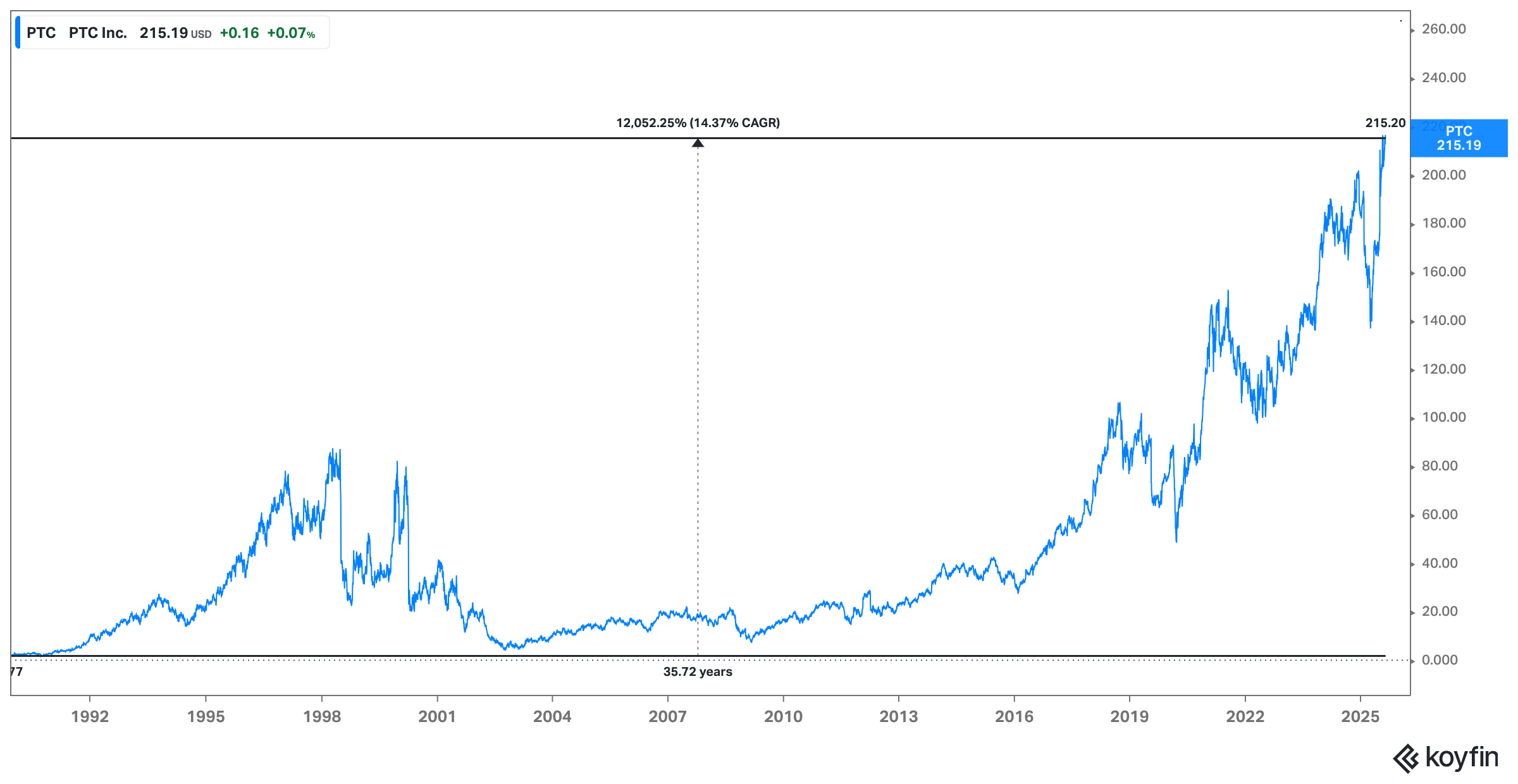
For those not yet particularly familiar, PTC is an industrial software business and a leading vendor of computer-aided design (CAD) and product lifecycle management software (PLM) to customers who design and manufacture products. 10 or so years ago PTC stock was an extraordinary dog, having underperformed its peers and market indices by an extraordinary margin over an extraordinarily long time:
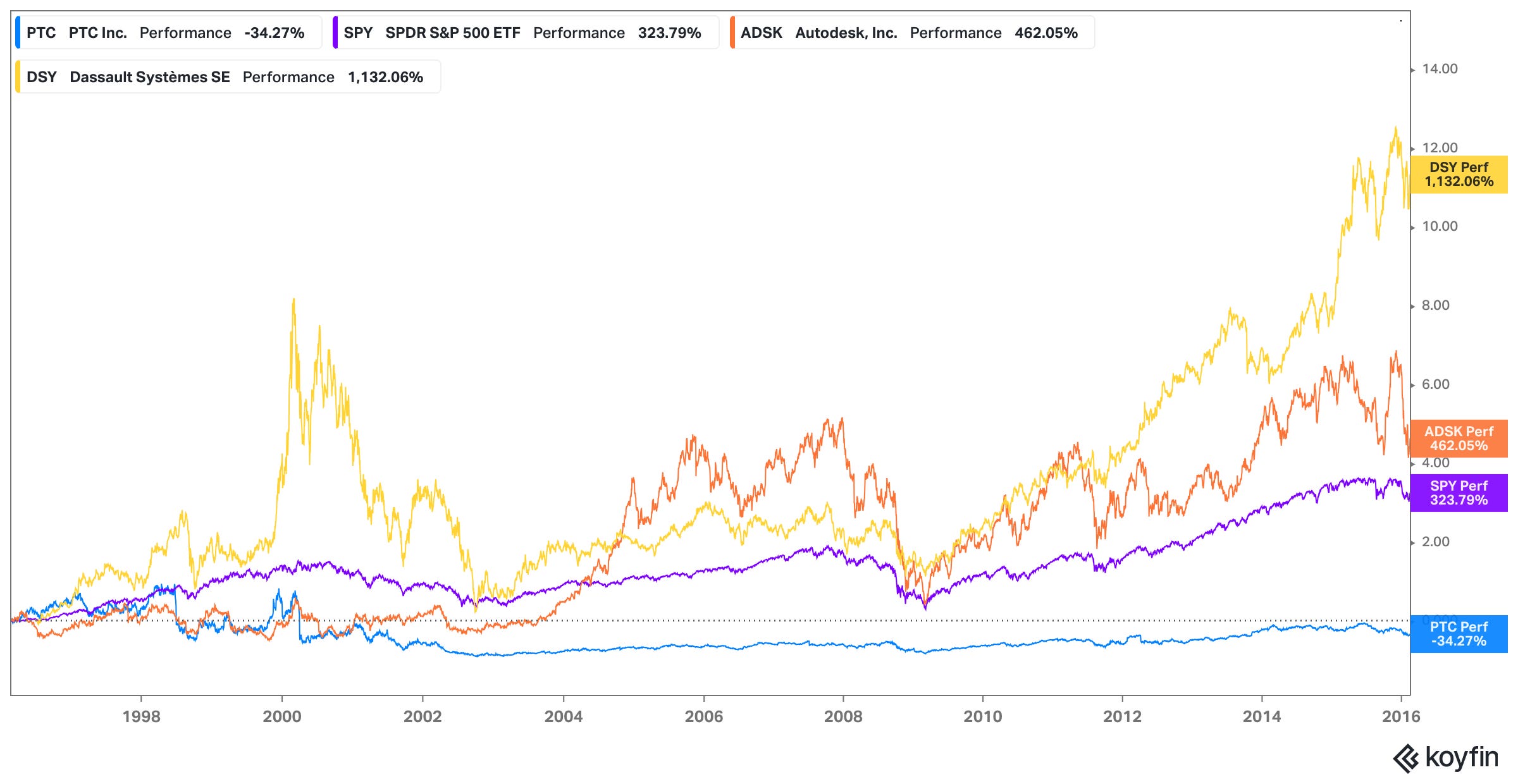
Having once been a hot stock itself and the disruptor in a fast-moving field, PTC had itself been disrupted, facing years of headwinds. We’ll cover all that later. Incredibly, in its 36 years as a listed business, PTC has spent the majority of its time in the doghouse. With a change of leadership and strategy, there eventually started to be cause for hope and some investors began to pay attention starting around 2017. But it would still take years to become fully manifest in the financials. In the meantime, scepticism remained and short sellers continued to make their case.1 Then this happened:
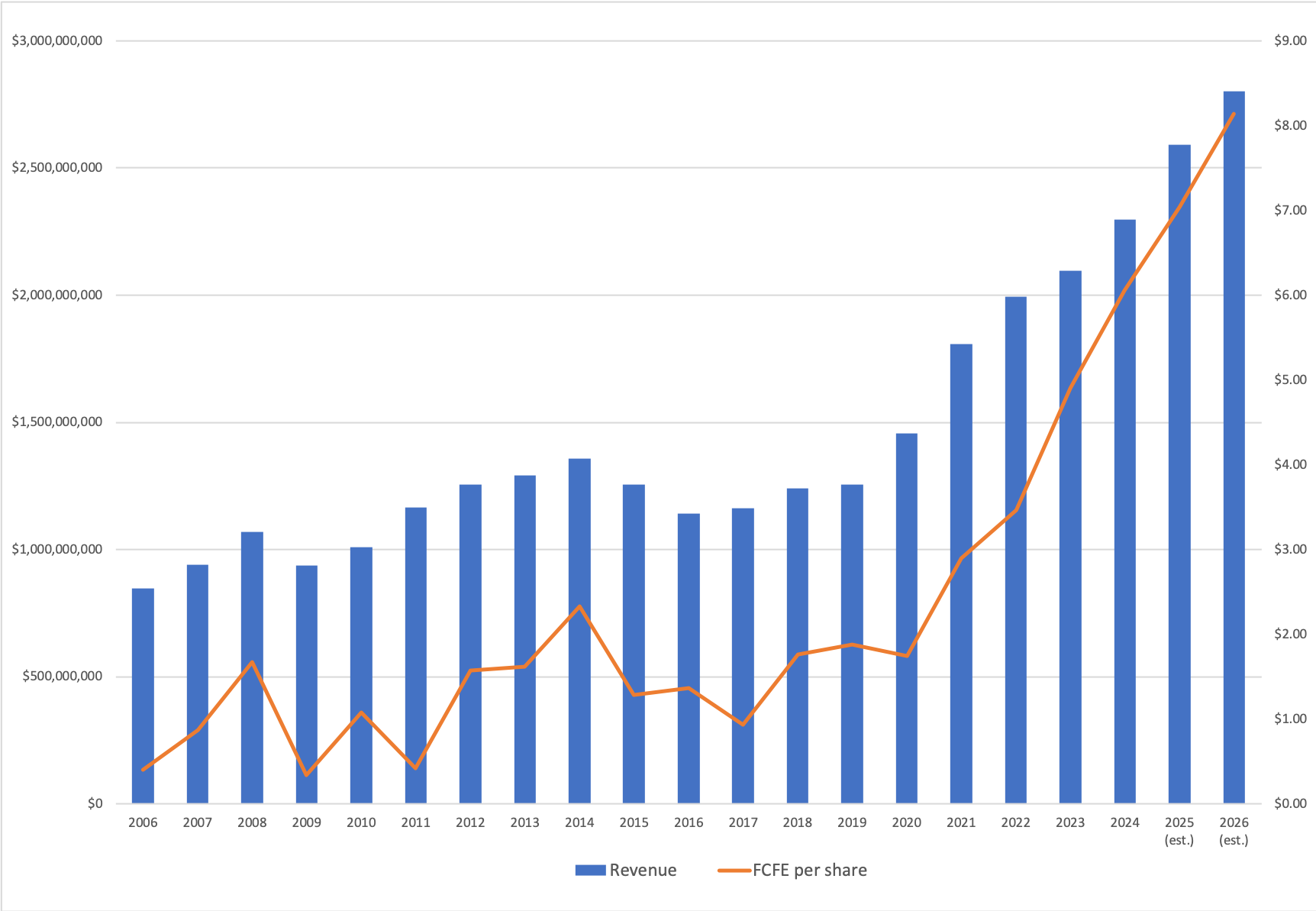
And this:
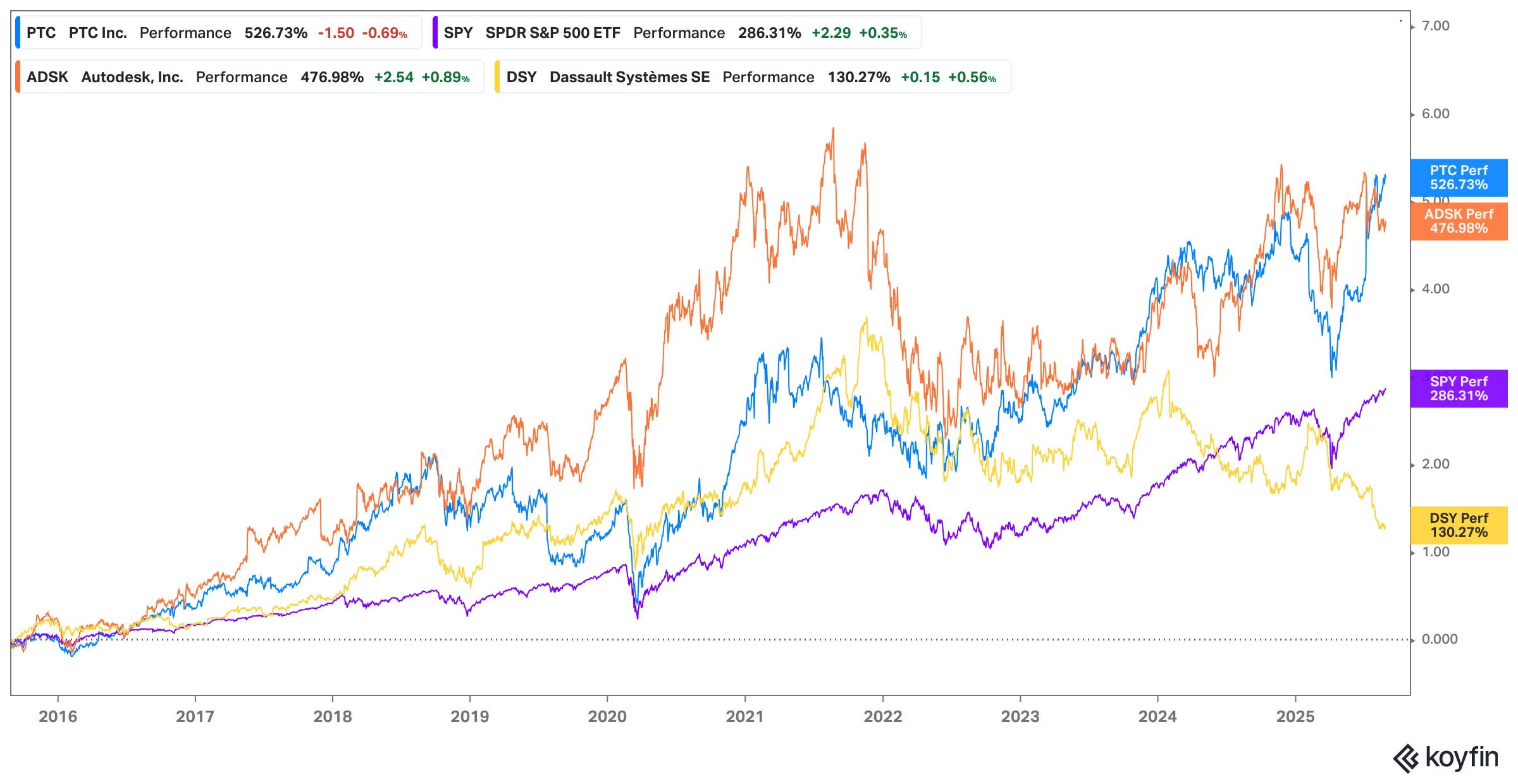
In the years I’ve been following PTC it has always remained in the shadow of Autodesk (ADSK) and Dassault Systèmes (DSY). Even today with the obvious turnaround in fortunes, investors still don’t seem to talk about it quite as much as the others - and that’s partly why I’ve decided to write this post. As recently as early April 2025 you could have bought PTC shares at a sharp discount to both ADSK and DSY as measured by price-to-free cash flow. In early July rumours began to emerge of ADSK’s interest in acquiring PTC, which caused a significant bump in PTC’s share price - curiously, with ADSK now having distanced itself from any such ambitions, PTC shares have not reverted to pre-rumour levels.
PTC is certainly a business with a bit of history and a bit of baggage - it’s not one of those beautiful compounders that has done 20% year-in-year-out since IPO. But even with 20 years spent out in the cold, PTC has still somehow compounded at more than 14%, which isn’t bad.
In this deep dive I’ll start by reviewing how PTC got to where it is today. Notably, PTC’s software has always been the benchmark in parametric CAD modelling capabilities (the clue’s in the name: Parametric Technology Corporation). Even during PTC’s darkest years of disruption, the company managed to hang onto a foundation of large customers who were there for those capabilities - an important indicator of the incredible stickiness of CAD software. But there are lessons too: being the best at one thing isn’t enough, even if that thing is an important one. So what I really want to talk about is PTC’s present and its future - this is the focus for Part I.
PTC’s last CEO, Jim Heppelmann, was a strategic visionary and spent years assembling the most complete and coherent portfolio among peers. Grounded in inter-operability and the creation of a ‘digital thread’, PTC’s solutions help manufacturing companies to act with increased agility across the entire lifecycle of their products from design through to servicing. And in a world increasingly defined by software, regulation and ever-faster moving competition, product companies are faced with a choice: sink or swim. PTC provides the tools to help them swim. And thus, PTC has completely transformed its defensible position relative to the past while growing in both CAD and PLM well above-market over the last six years. From this position of strength, PTC can continue to execute on its playbook for above-market growth:
Up-sell
Seat expansion
Cross-sell
SaaS conversion of existing customer base
displacing legacy/outdated software
digitalising previously undigitalised processes
taking share from traditional rivals
As it stands today PTC is a high margin business with the vast majority of that business recurring in nature. Additionally the growth algorithm is robust and the runway long for double digit ARR growth ahead of costs. But did Heppelmann get everything right? Perhaps not. In the 1990s and early 2000s, PTC had an over-optimised sales strategy, run at the expense of technology and innovation - ultimately leading to years of underperformance. Arguably under Heppelmann things went just a little too far in the other direction. PTC’s new CEO, Neil Barua, believes that PTC could be performing even better than it has been, with a re-orientation of the sales strategy and aligning the business around key verticals in order to better serve customers - “putting more wood behind the arrow” as he often likes to say. And PTC isn’t short of arrows either, so we can add a little extra sparkle to Barua’s corny metaphor: Blessed is the man whose quiver is full of them (Psalm 127:4–5). Multiple growth drivers plus a possible acceleration if Barua and his team can execute well.
Thesis
The thing about long runways is that we investors tend undervalue the genuine ones. My purpose with this deep dive is to explain why I think PTC’s is one of the genuine ones. But there is more - PTC has several important layers of additional optionality, which aren’t currently at the forefront of the discussion:
Currently untapped pricing power: PTC’s PLM and CAD systems are about as sticky as they come, but pricing has previously been near the bottom of PTC’s growth hierarchy, especially relative to peers. With Heppelmann now retired (including from the board), the scope may now be increasing, particularly in conjunction with ⬇️
AI: insofar as PTC starts taking more price, I suspect customer conversations could be within the value-added context of a big AI feature rollout across the suite. With PLM the system of record for manufacturing and product companies, PTC is well placed to act as a foundational layer in the deployment of AI technologies at these businesses. Yet PTC has been acting in a thoughtful, measured way - new AI features are intended to be genuine upgrades to customer workflows. Features are now going live, and PTC has a roadmap for a lot more.
Onshape: more of a medium- to long-term story adding to PTC’s growth durability, Onshape is one of the least discussed but potentially most interesting parts of PTC. Acquired in 2019, Onshape is PTC’s second CAD system and the only truly cloud-native system on the market - imagine the Google Docs or Figma of CAD and you’re heading in the right direction. Agile product development, realtime collaboration, no installation, no CAD files, can run on smartphone(!), updates every three weeks. Onshape is at least as disruptive as Solidworks was back in the 1990s/2000s and that’s a $1bn business today (and in fact built by the same people).
PTC management are committed to growing ARR at least in the low-double digits, and to growing costs at around half the rate of ARR. And that gets you to free cash flow growth in the teens. This is the base case. As we get into 2026, we should be able to achieve more visibility around Barua’s new go-to-market strategy and whether it’s merely defensive or potentially offensive. You see, before we get too giddy with excitement, it’s not all wine and roses - as things stand, PTC has drifted below double digit ARR growth. There are several elements here. Notably, US manufacturing PMI has wavered below the critical level of 50 for the last several years - a prolonged challenging selling environment for a business like PTC. Then, of course, there’s the volatility around tariff policy - manufacturing investment kryptonite. Last there’s the new go-to-market reorganisation which brings with it a substantial degree of internal disruption at PTC over a period of several quarters.
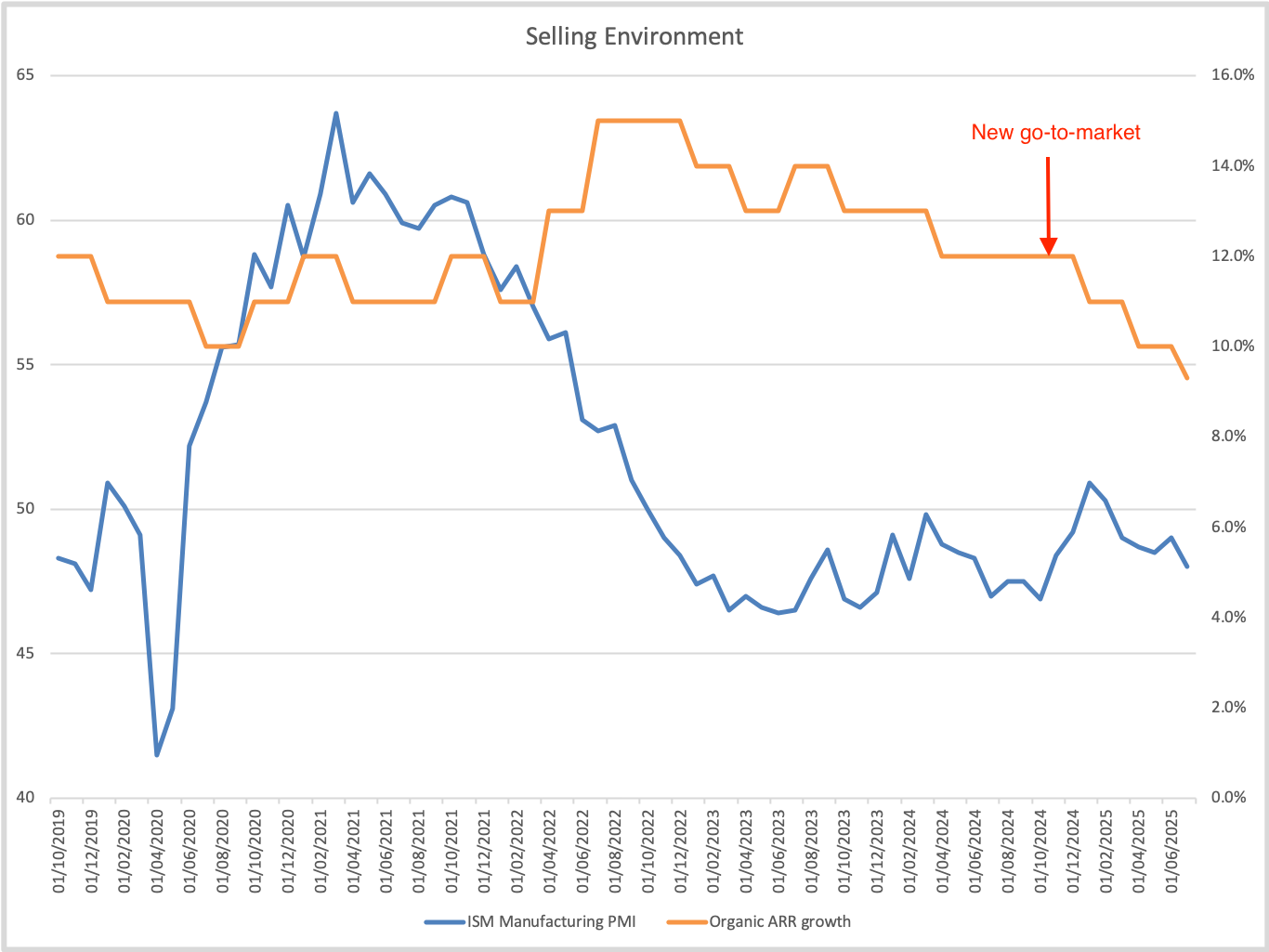
It’s possible, perhaps even likely, that PTC could be growing faster this year without the re-org, but equally it should be performing better once the new strategy has bedded down. Putting it all together low-double digit ARR growth and mid-teens free cash flow growth seem like a very credible base case. Then there’s buy backs. From 2019 to 2023 PTC invested around $3bn in strategic M&A, not too far off the company’s cumulative free cash from 2019 to 2025 - with the portfolio looking very rounded, debt now paid down and the stated focus organic growth, PTC is in a position to shift capital allocation back to share repurchases. And in fact the company’s policy is to return excess cash to shareholders, which could amount to around a 2% reduction in share count per year. With improved PMI and a little extra pricing, it’s quite possible that per-share free cash flow growth could extend into the high teens or low 20s for a few years - this is the bull case. But I don’t think you’re even paying for the base case, so that makes it all pretty interesting in my view (P/FCF of 25x against per-share growth in the teens).
Turning to risks, the obvious ones land in two categories. The first is macroeconomic - the worse the global economy does, the less well PTC will do. Due to the strength of PTC’s portfolio and customers’ willingness to continue investing to remain competitive, growth has been resilient so far. But this could change, if the manufacturing economy deteriorates further. But unlike in the past, PTC’s business is now almost 95% recurring. If there’s anything that’s likely to throw PTC’s share price off course, it’s jitters about the economy - it’s almost certainly going to happen sooner or later but these are usually buying opportunities. I anticipate that I’d be likely to do some averaging down myself should something like this occur in the months ahead. But I offer no predictions here. The second category is execution risk regarding the go-to-market re-organisation - if they get it wrong, it could potentially be quite disruptive to growth prospects. However, so far as we can tell from the outside, things are progressing well and, as we shall discuss later, the new chief revenue officer brought in to implement the strategy has done this before.
A very brief word about the current software elephant, and a question I feel obliged to ask: Will CAD or PLM be displaced in the foreseeable future by vibe coding? It seems vanishingly unlikely to me. In Part I we’ll explore what can go wrong for manufacturing businesses when they tinker with their CAD and PLM systems. These systems are also incredibly complex and hard to build with suitable functionality and robustness. It took the best CAD team in the world four years and $150m to build and launch Onshape. Not to mention that Onshape is a cheap product and great value with new features added every few weeks. To try to build your own rather than use Onshape, would be mad. Let’s leave it at that.
One last thing before we get going: ARR (“Annual Run Rate”) and Free Cash Flow. Whether you’re valuing the business or analysing business performance these are the metrics that matter, rather than revenue and earnings2. If you listen to PTC’s CFO Kristian Talvitie you’ll hear about this a lot. And for good reason. The quirks of accounting for on-premise subscription software make for much noisier revenue and earnings relative to the underlying steady contractual cash receipts that actually take place. Consequently, I would suggest not bothering with PTC’s P/E ratio as it could lead you astray - go for price to free cash flow instead. We’ll get into this in Part II. And on that note:
Part I will focus on the PTC story at a higher level - history, management and strategy. It will be self-contained with most of what you need to know.
Part II will go deeper into products, AI, financials and accounting considerations. For those who want to go deeper.
As is usually the case at NFTBC, this deep dive will be long but I’m hoping interesting and relevant. PTC’s present position very much lies in the context of the journey taken and it’s worth learning about it, I believe. But do please skip around if that’s helpful for you. Personally, I like to take longer posts out for a walk using the read-aloud feature in the Substack app (if you haven’t discovered it yet).
[NFTBC does not provide advice - please do your own research. Disclosure: I currently own PTC shares]
Parametric Technology Corporation: Chapter 1
The Disruptor (1987-1997)
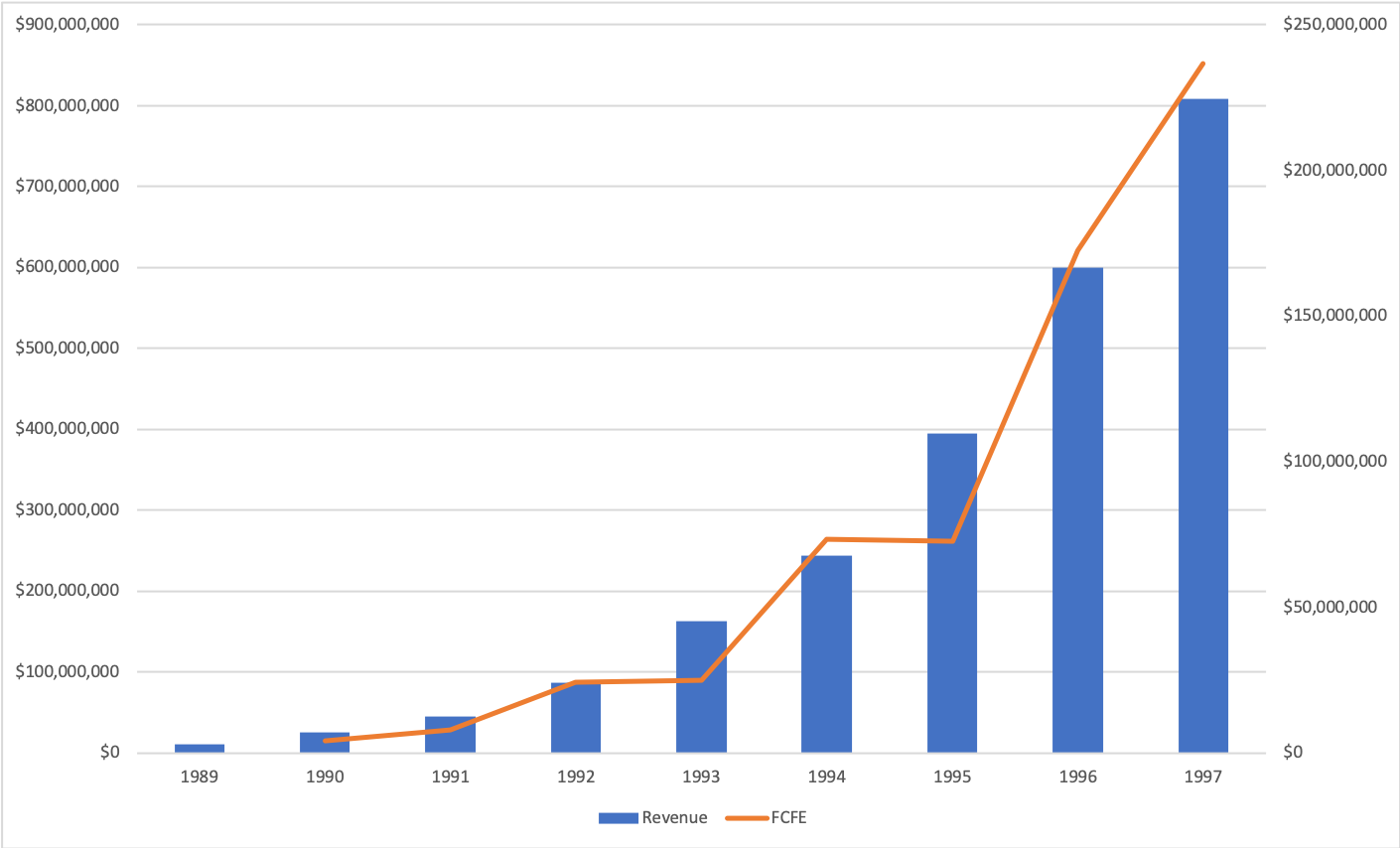
Once upon a time, PTC was a hyper-growth stock. From IPO to 1997 sales and free cash flow compounded at over 70% - and this was almost all organic growth. If you had bought shares in the 1989 IPO, you’d have nearly 70-bagged by early 1998. What on earth was going on?
Back in the 1980s, while 3D mechanical CAD (MCAD) software did exist, 2D software was the industry standard. Founded in Boston in 1985, PTC did more than anyone to push 3D CAD into the mainstream and rapidly became the largest MCAD business in the world. The field was ripe for disruption and PTC was the disruptor with its revolutionary CAD software: Pro/Engineer.
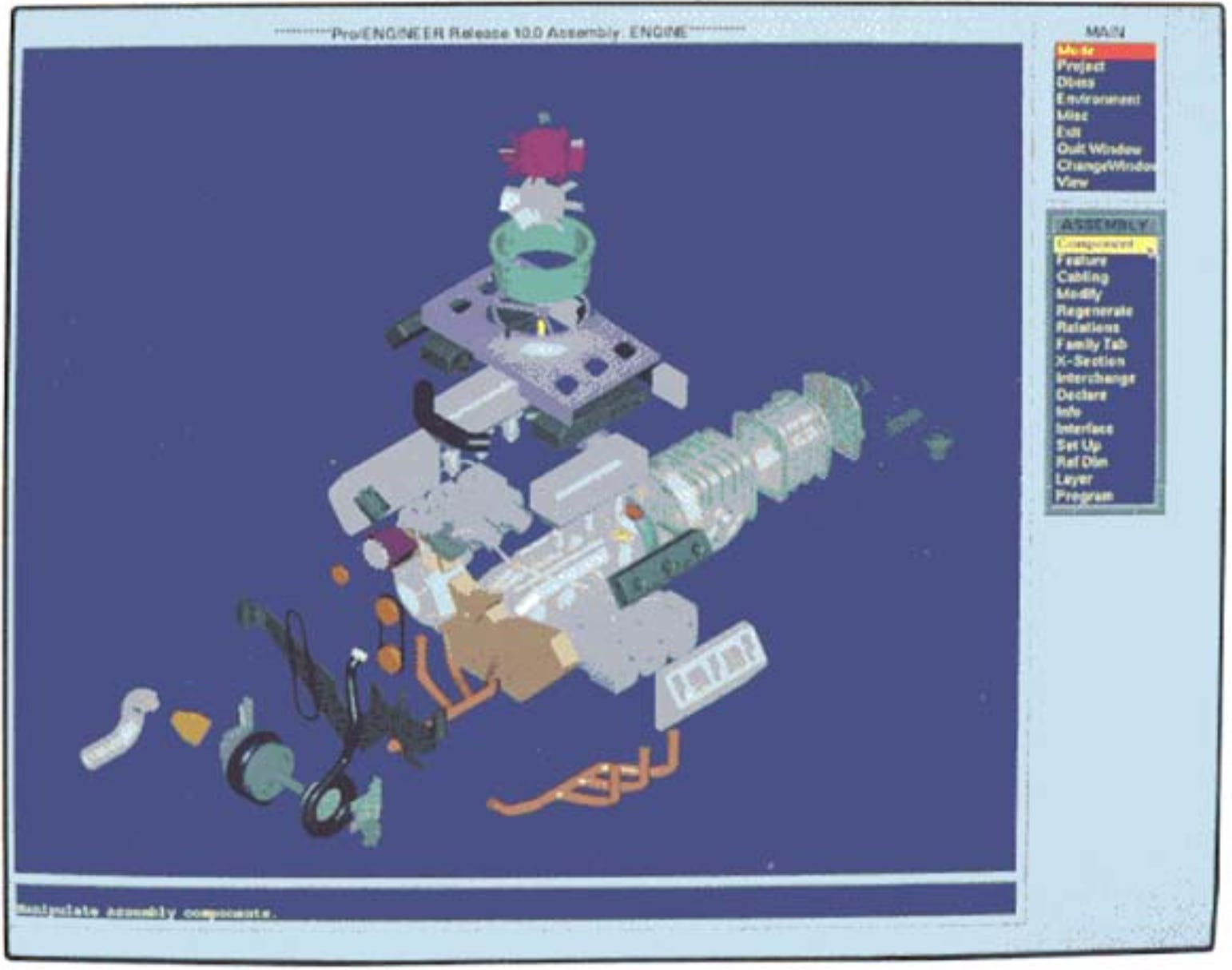
Most competitor solutions at the time had evolved from older 2D code, with solids and 3D capabilities only added later on. These older systems generally ran on mainframes and minicomputers and were difficult to maintain. And in some cases, the software and hardware came from the same vendor - these were especially expensive systems. PTC was founded to create the first effective feature-based parametric3 modelling system, from the ground-up. Pro/E changed the game through a number of disruptions:
Designed to work on modern, vendor-agnostic, networked UNIX workstations
Worked with solid models rather than obsolete wire-frames
Modern UI and significantly easier to use
Faster pace of releases than competitors (two per year) with a steady cadence of additional features optional extras
The demand for such a system turned out to be huge. Early on PTC started signing major accounts with such names as Caterpillar, Cummins, Ford, Toyota and many others. With a basic seat price of $9,500 in the early 1990s, average pricing per seat was significantly higher ($14,000 - $20,000) after options. By the end of 1997 PTC had sold a cumulative 100,000 Pro/E seats.
The Innovator’s Dilemma (1998-2000)
But 1997 turned out to be the high-water mark for financial performance for the next 15 years or so. And while revenue crept higher in 1998 (in part due to acquisition), PTC is only now starting to close in on the same level of CAD revenue that it had in 1998 - fully 27 years earlier. Indeed, 1998 marked an immediate change in fortunes. In July of that year PTC reported its first ever year-on-year quarterly revenue decline - the stock market reaction was an immediate one-day hit of 35% to PTC’s shares. Within a few months the shares were down more than 70% from 1998 highs and the shares would ultimately reach the bottom in 2002 at the nadir of the Dotcom crash - down 95% from the highs.
Frankly, it would have been difficult to turn constructively bullish on PTC’s strategic direction for quite some time yet - even with hindsight. What follows is the short version of what went wrong - it’s perhaps best to do it with bullet points and these are the main ones:
Disruption by new mid-range Windows CAD systems. PTC launched a windows version of Pro/E in 1993, as well as a lower cost version, Pro/JR, in 1995 (50% of the functionality at 50% of the price). But the strategy wasn’t sufficiently fast or aggressive enough to ward off competitors. There were a number of reasons why Pro/JR didn’t gain much traction, but perhaps the main one was price. When windows-based Solidworks came onto the market, it was priced at less than half a Pro/JR seat - it proved to be a highly disruptive product. But there were other reasons too - for example, only in 1998 did PTC switch their user interface to a more modern Windows style (from a dated, clunkier UNIX interface). Solidworks was cheaper, easier to use and easier on the eye.
While a number of PTC’s traditional high-end competitors were floundering (including Computervision, which PTC acquired in 1998), others had not only caught up, but arguably moved ahead - including DSY with its CATIA product and Unigraphics (later acquired by Siemens). By 2000, some considered Pro/E to be aging and lacking in certain features desired by large customers including surface modelling
PTC was therefore squeezed between the mid-range (where it was considered too pricey) and the high-end (where it was considered to be lacking) - by 2004 the average price of a Pro/E seat had more than halved relative to 1997.
Neither did the complacency of PTC management help:
Our perspective on low-end products has not changed. They provide most but not all of the functions of Pro/Engineer. Our customers demand end-to-end design automation. I don't think SolidWorks will close the gap. SolidWorks [and all the other low-priced systems] are fundamentally flawed.
- Steve Walske (PTC CEO), 1997
Famous last words - Solidworks (which was acquired by DSY that year) went on to become a $1bn+ product and the largest in the market for general MCAD. Curiously, DSY’s leadership said something similar about Onshape a few years ago - we’ll get to that in Part II.
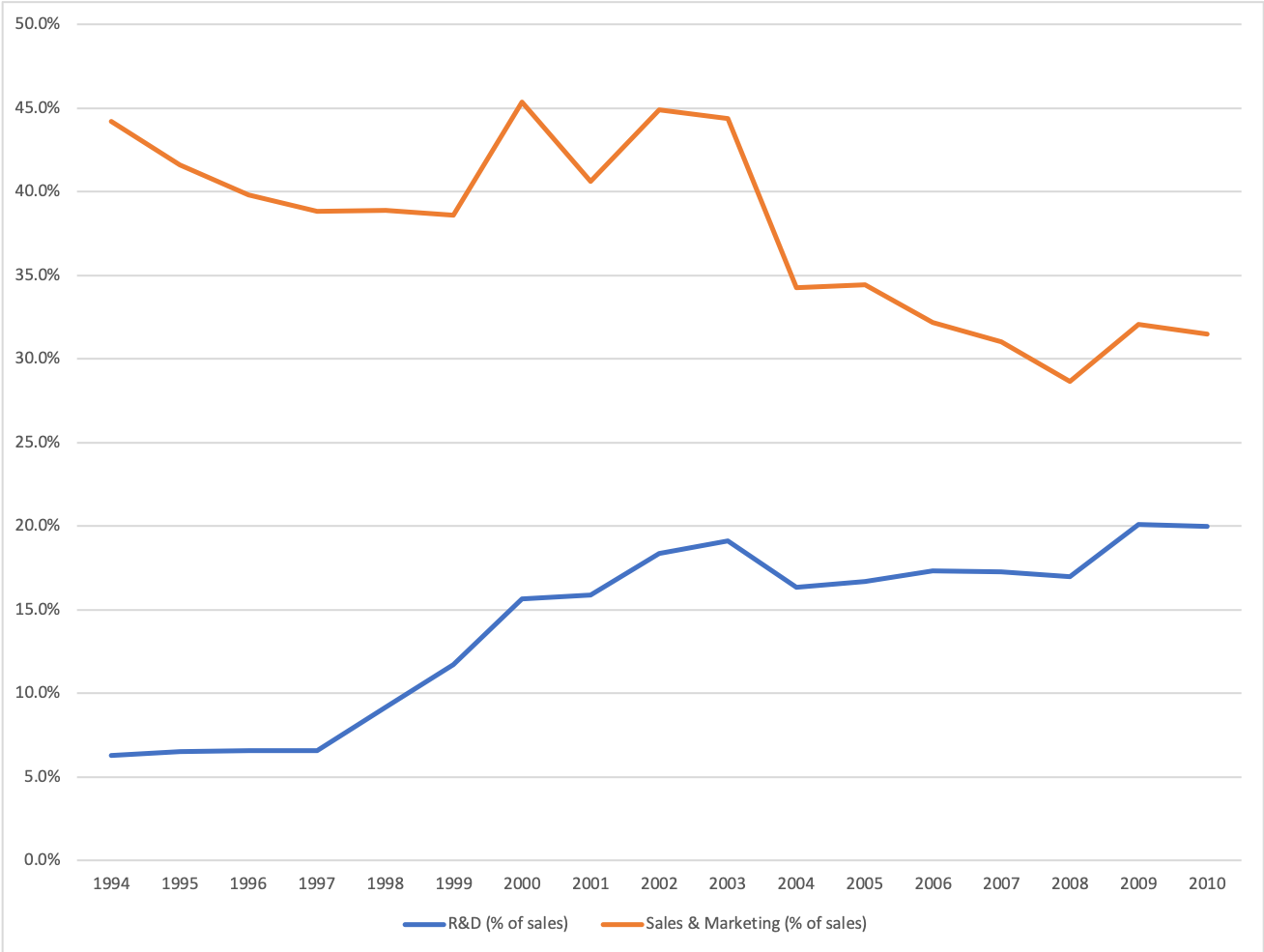
Nor did under-investment in R&D help, with the company investing significantly less than 10% of revenue for most of the 1990s. Conversely, PTC was known at this time for its aggressive sales behaviour both in terms of spend and tactics - it’s clear where the priorities were and PTC had far more sales reps than software engineers.
And there’s more. With the acquisition of Computervision, PTC’s management had become distracted and over-burdened with too many products. Their strategic focus shifted to Product Lifecycle Management software (PLM) - a great move in the longer-term but the lack of focus played a role in PTC’s loss of CAD leadership, including lengthening development cycles from the previous fast pace.
Steadying The Ship (2000-2010)
By 2000, PTC’s then CEO Steve Walske was out and the company restructured under Dick Harrison who had been at the company since early on. PTC spent the next several years working on a much improved version of Pro/E called Wildfire - a more capable, easier to use and more competitive product (including on price). It was a significant $100m investment, especially at a time of profound financial difficulty, but it was necessary. The company incurred several years of heavy restructuring charges on the road to getting the cost structure into a sustainable position.
In addition to getting Pro/E and the cost structure sorted, the main thing Harrison did was to press ahead with PTC’s efforts in PLM.
Sidebar - PLM / Windchill
I’ve been taking it for granted that most readers will have a good enough idea of what CAD is, but I’m not sure I can take the same liberty with PLM.
Back in the late 1990s, PTC management started to realise they needed to improve their capabilities in Product Design Management (PDM) - engineering data management software used in conjunction with CAD, basically the way for organising CAD files. This was one of the principal reasons for the Computervision acquisition due to their fledgling efforts in the area. But as it happened, the acquisition led to “the surprise discovery of a gem of a PDM solution called Windchill hidden among the rubble.”4 Computervision had invested in a PDM startup called Windchill thereby bringing it to PTC’s attention - as a result PTC decided to acquire Windchill in 1998. Windchill Product Lifecycle Management (PLM) would eventually go on to become the backbone of PTC and the biggest growth driver. But what is PLM then? Rather than being confined to CAD and engineering, PLM is the system of record for product information across a product’s entire lifecycle from design to manufacturing to servicing to disposals. It included full bill of materials, standards compliance, configurations, as well as integrations with CAD, ERP, manufacturing, application lifecycle management (ALM), field service management - the list goes on.
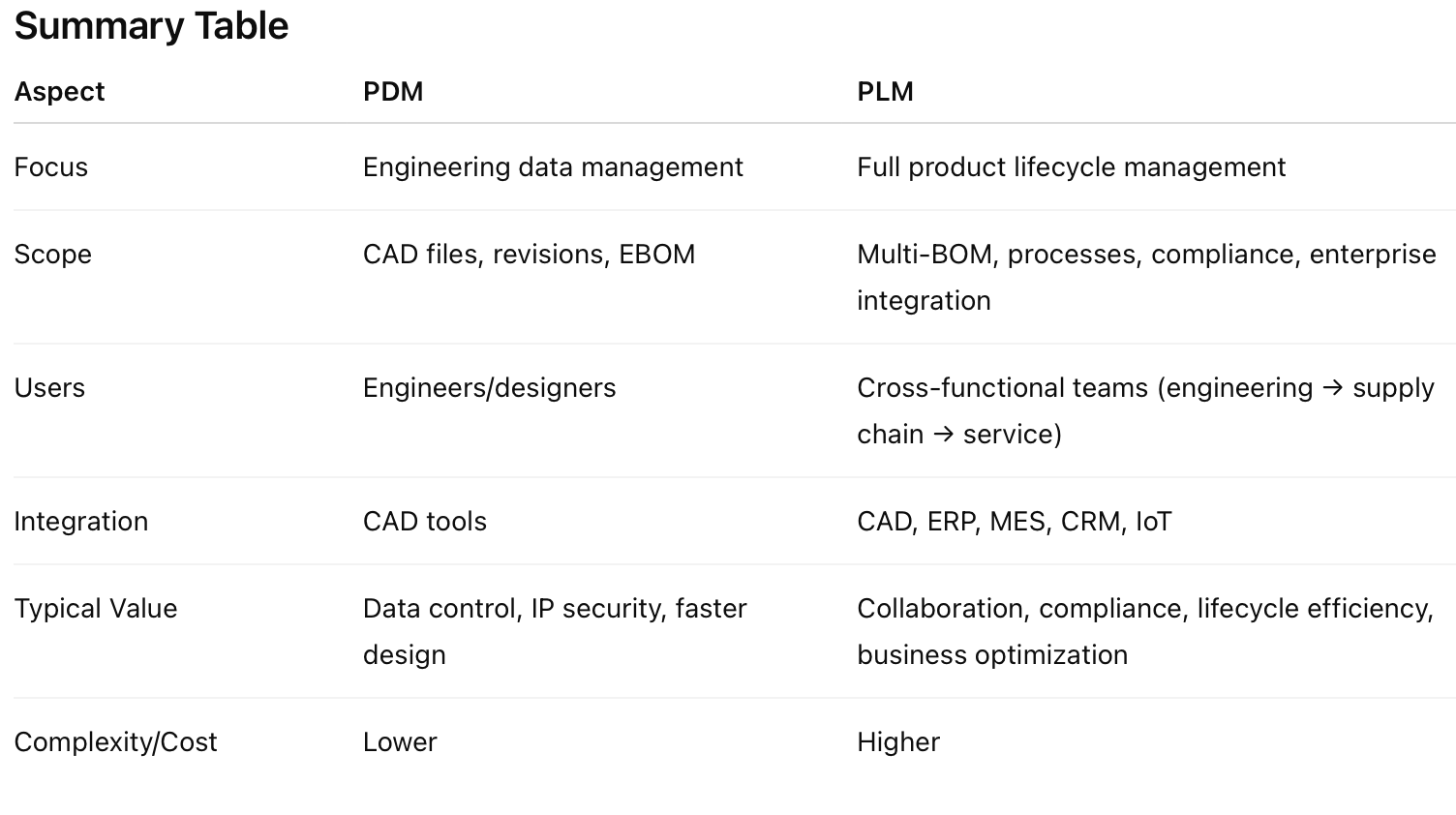
But PLM took a long time to get into its stride. To give you a sense of just how “carried away” PTC management became with PDM/PLM in the late 1990s, Walske thought it would generate two thirds of PTC’s revenue by 2001. Eventually PLM would get to 60%, but not until 2015!
Peak to trough (1999 to 2004) revenue was down close to 40%. Earnings and cash flow were down even more. From 2004 PTC’s business began to recover - CAD had stabilised and resumed growth while PLM grew rapidly to become a greater share of the business. By 2008, the business had re-attained the $1bn revenue mark after almost 10 years, margins were continuing to expand and things looked pretty good. But then, of course, the GFC hit. At the time software licensing was around 30% of the business, and in the industrial sector this high-margin revenue stream was hit hard enough (-34%) to drag PTC’s overall revenue down by 9% for FY2009. Operating income fell by 50%. PTC is a far more resilient business these days, although it’s been hard getting past the memory of the GFC.
Chapter 2: The Heppelmann Years (2010-2024)
When PTC acquired Windchill in 1998, Windchill’s founder Jim Heppelmann decided to stick around:
When I came in, PTC itself had many problems. But of course, the business I brought in was doing quite well. And I hung around and I took the attitude that “there’s a lot of goodness here to work with - we’ve just got to solve the problems. And we shouldn’t run away from the problems. We shouldn’t quit, we shouldn’t go find another job - we should try to solve these problems because I think they’re solvable”.
And I didn’t run away from it. I’ve always taken the attitude that a problem is an opportunity. Inside every problem you solve is an opportunity to do better.
- Heppelmann speaking in 2020
Following Walske’s dethroning, Heppelmann went through a series of promotions over the next decade: SVP, Windchill » EVP & CTO » EVP & Chief Product Officer » President & COO. Ultimately, Heppelmann became CEO in 2010 and remained so until early 2024. No single person has had more influence on PTC’s strategic direction over the last 15+ years.
Prior to taking the reins as CEO, he was already making his mark, for example, driving strategic acquisitions such as CoCreate and Arbortext. And, in fact, the former would prove particularly important for PTC’s next major initiative - under Heppelman PTC had a complete CAD reboot, launching in 2010, the same year he become CEO:
they re-wrote the code base
introduced direct modelling (via CoCreate) alongside parametric modelling
made it far easier for users to import files from other CAD systems
Improved the UI and made it easier to use
designed to work better with Windchill
PTC’s flagship CAD system was now, in effect, a suite of interoperable applications rather than a monolithic program. So great was the change, PTC felt a new brand was necessary: Creo. They even discontinued the Pro/E brand, a highly controversial move at the time. But we can’t really overstate the importance of these steps and the (eventual) return of PTC as the most consistent grower among its CAD peers. As I write Creo is closing in on $1bn in ARR and has compounded at over 12% since 2019. It has been 27 years since PTC last managed $1bn of CAD revenue. But at least this time the foundations are immeasurably stronger and there are no good reasons why PTC won’t continue to keep growing from here.
Let’s now run through the principal impacts that Heppelmann had as CEO. But before we do, it’s worth noting the switch from an long era of sales-led leadership to a long era of technically- and strategically-minded leadership. Heppelmann did several major things as CEO that would prime PTC for future success:
Conversion of the business model from license and support to subscription
Strategic M&A to build out the completeness of PTC’s customer offering (“digital thread”)
Strategic M&A to ready the company for an eventual transition to SaaS
The Valley of Death
From 2010 to 2014 PTC, having recovered from the GFC, continued to grow and expand margins. By the end of FY2014, PTC had made one or two acquisitions of businesses with subscription-based revenue models and the company started getting ideas. Starting in 2015, and accelerating thereafter, PTC commenced a push to move customers from on-premise license/support to on-premise subscription. The cost of carrying out such a transition is the loss of significant upfront, and highly profitable, license revenue. But by year-4 you’ve crossed the “Valley of Death” and total subscription revenue starts to pull ahead of the license/support model. To see it more clearly, here’s a hypothetical example they gave at their FY21 Investor Day:
Under the old model, a $1.00 license is followed by $0.20/year maintenance.
Under on-premise subscription, you charge $0.45/year (includes maintenance).
Cumulative revenue is equal after 4 years ($1.80 vs $1.80). From year 5 onward, subscription pulls ahead ($2.25 vs $2.00 in year 5).
Around the same time, PTC began to de-emphasise the Professional Services part of its business and also outsourced some of it to third parties. The result was five ugly years for the business’s revenue and profitability while the model transition worked its way through:
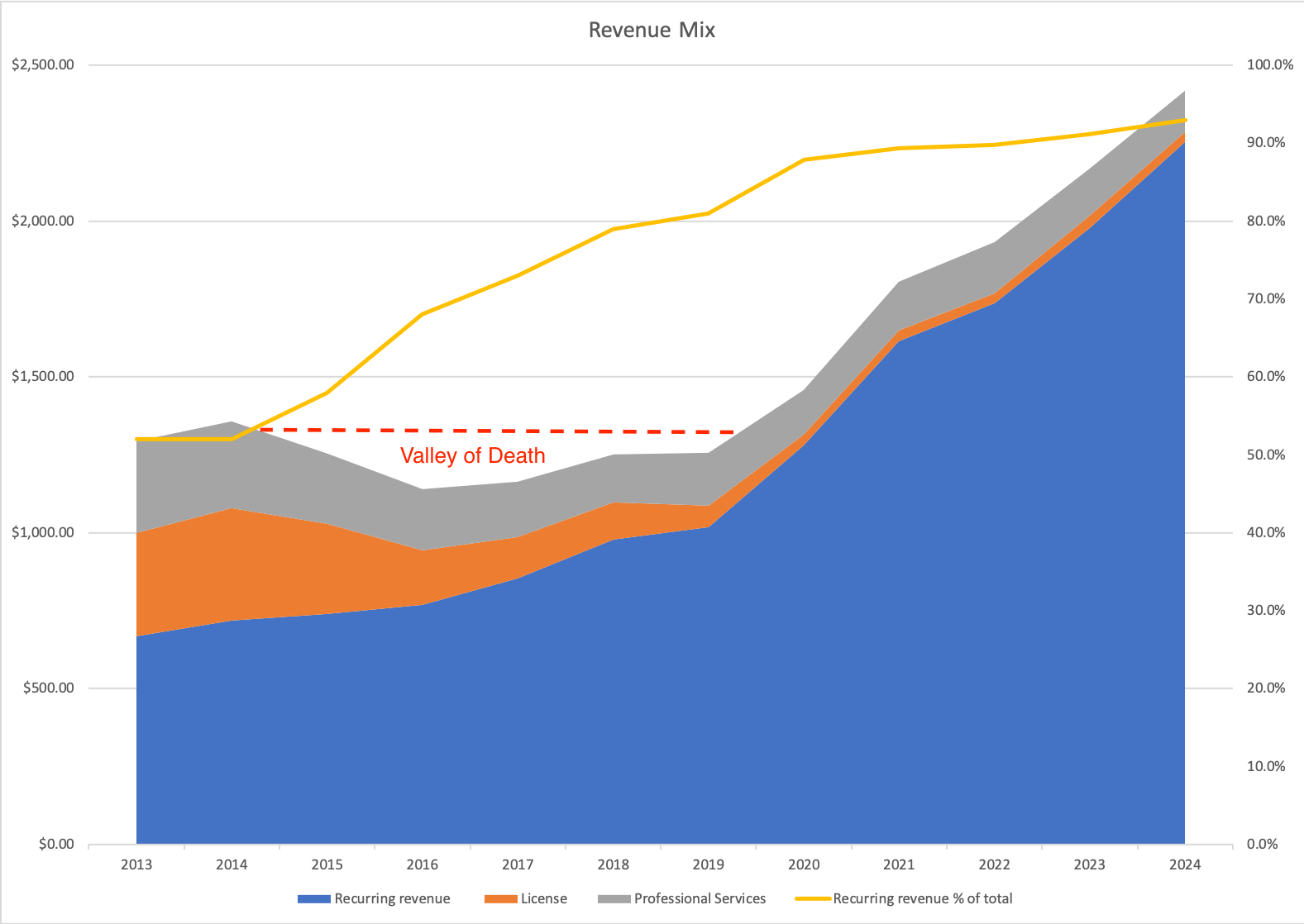
By FY2019 the transition was largely complete and PTC has been in growth mode ever since. Recurring revenue has grown from 52% in 2014 to 93% today. Additionally, the ‘net yield’ of transition to subscription turned out to be even greater than expected with customers taking the opportunity at the time of conversion to review their seats and opt-in for additional features - as a result PTC believe that $1.00 of revenue under the old model converted to around $1.45 under the new model. It’s difficult to overstate how much higher quality PTC is as a business today compared to 2014.
Digital Thread
Heppelman made a series of strategic acquisitions, which you can categorise into two buckets - the first being “Digital Thread”. The term itself, they started talking about around 2015. Here are the most important acquisitions to know about:
Servigistics (2012): Service Lifecycle Management (SLM), helping manufacturers optimise their post-sale service operations like service parts planning, field service management, warranty, returns/repair, and knowledge management
ThingWorx (2013): a software platform for quickly building and running Internet-of-Things (IoT) applications, allowing manufacturers to connect, monitor, analyse, and act on real-time data from smart, connected products
Vuforia (2015): an augmented reality (AR) platform that lets apps overlay digital content onto the physical world by recognising and tracking real-world images and objects in real time, enabling uses like remote guidance, training or maintenance
Codebeamer (2022): an Application Lifecycle Management (ALM) platform that offers integrated requirements, risk, and test management, supports agile and DevOps workflows, and helps regulated/safety-critical industries maintain traceability and compliance throughout software-driven product development
ServiceMax (2023): a cloud-native Field Service Management (FSM) platform that helps manufacturers track and service products in the field: managing work orders, dispatching technicians, parts inventory, product usage, service history, contracts & entitlements
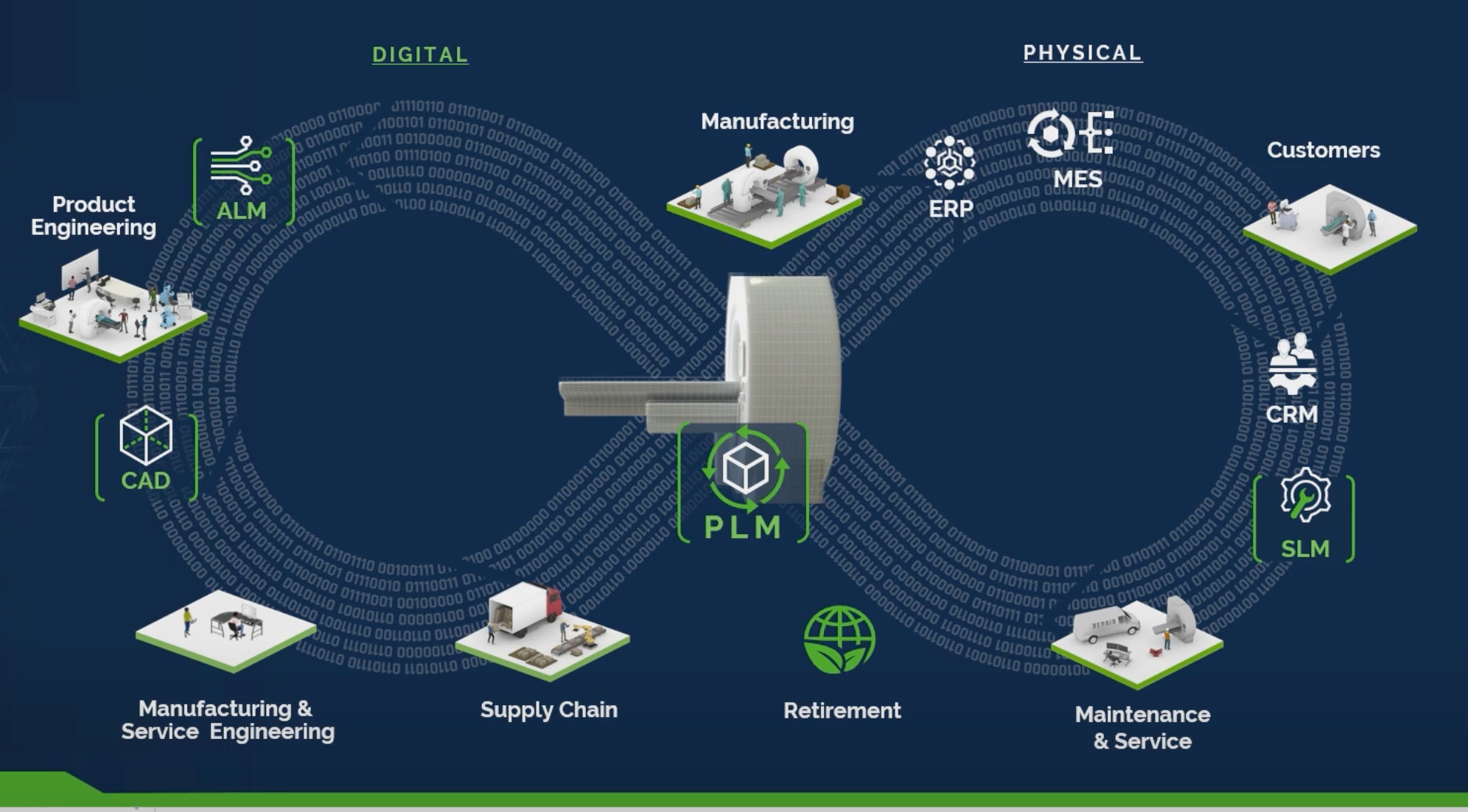
PTC has now installed the concept of Digital Thread at the very centre of its business model, with Windchill itself acting as the linchpin. Let’s spend a few moments on it. Here’s a pretty clear distillation of PTC’s philosophy here from the most recent 10K:
Given the breadth and openness of our portfolio, we can enable end-to-end digital thread initiatives, which leverage a connected flow of product data across design, manufacturing, service, and, ultimately, reuse. A digital thread enables product companies to break down silos, streamline workflows, and achieve interoperability across departments, functions and systems with a single version of truth. It also secures the quality, consistency and traceability of product-related data, ensuring that the data is up-to-date, accessible, reliable and actionable. With a digital thread, the right data is delivered to the right people at the right time and in the right context across the value chain.
With this in mind, PTC likes to use the metaphor of an ‘infinity’ or ‘closed’ loop to visualise the strategy and how it applies to product/manufacturing businesses. From this perspective, the acquisitions make a lot of sense and provide opportunity for cross-sell. For customers using Windchill already, it’s an easy decision to then chose Codebeamer for ALM or Servigistics/Servicemax for SLM. Or maybe you’re an existing ServiceMax customer and you’re looking into replacing your legacy PLM - Windchill could be an easy sell there. Some customers already use PTC for their CAD, PLM and SLM - the whole loop. But customers can pick and chose - PTC configures software with a view to 3rd party compatibility. You don’t have to use Windchill if you use Creo and vice versa - in contrast to, say, Dassault who are somewhat less technology-open in this respect and steer the customers towards packaged solutions (i.e. 3DXperience). Additionally, note that PTC has much more sophisticated and complete offerings in SLM and ALM compared to its main competitors - they’ve gone further in closing the loop. PTC is now much more than a CAD/PLM vendor. It’s a solid base to grow from, and I’ll come to that later.
[Note that currently PTC’s reporting segments are ‘CAD’ and ‘PLM’ - the CAD segment also includes Vuforia and Arbortext but everything else sits within PLM]
SaaS / Velocity
CAD and PLM are two of the last important enterprise software categories to transition to the cloud - even today they remain primarily on-premise or in some cases hybrid. The reasons are varied including technical issues such as the size and complexity of CAD files, infrastructure issues around things like latency, the complexity of PLM and its integration with other systems such as ERP (which also remain on-premise), security/IP concerns - the list goes on…
PTC remained relatively silent on the topic for years - stating the obvious, that customers weren’t in a hurry. Competitors began to introduce cloud-like offerings some years ago - some are hybrid using a desktop client app with cloud-based features. Others are cloud-based versions of older software, accessible through the browser. But none of these are cloud-native.
Then in late 2019 PTC announced the acquisition of Onshape, the first cloud native CAD system. Followed in early 2021 by the acquisition of Arena, a cloud-based PLM system. PTC would later go on to use Onshape’s cloud underpinnings (‘Atlas’) as a base for introducing cloud versions of Windchill (‘Windchill+’) Creo (‘Creo+’). We’ll talk more about the various products in Part II.
PTC believe that, conservatively, they get at least a 2X ARR uplift when converting on-prem subscription customers to SaaS5 albeit at lower gross margin, as you would expect. Heppelmann became very bullish on the prospects for converting on-prem customers, aiming for a maximum 70% conversion to take place over 10 years from PTC’s FY23 - here are some slides from the FY23 Investor Day:
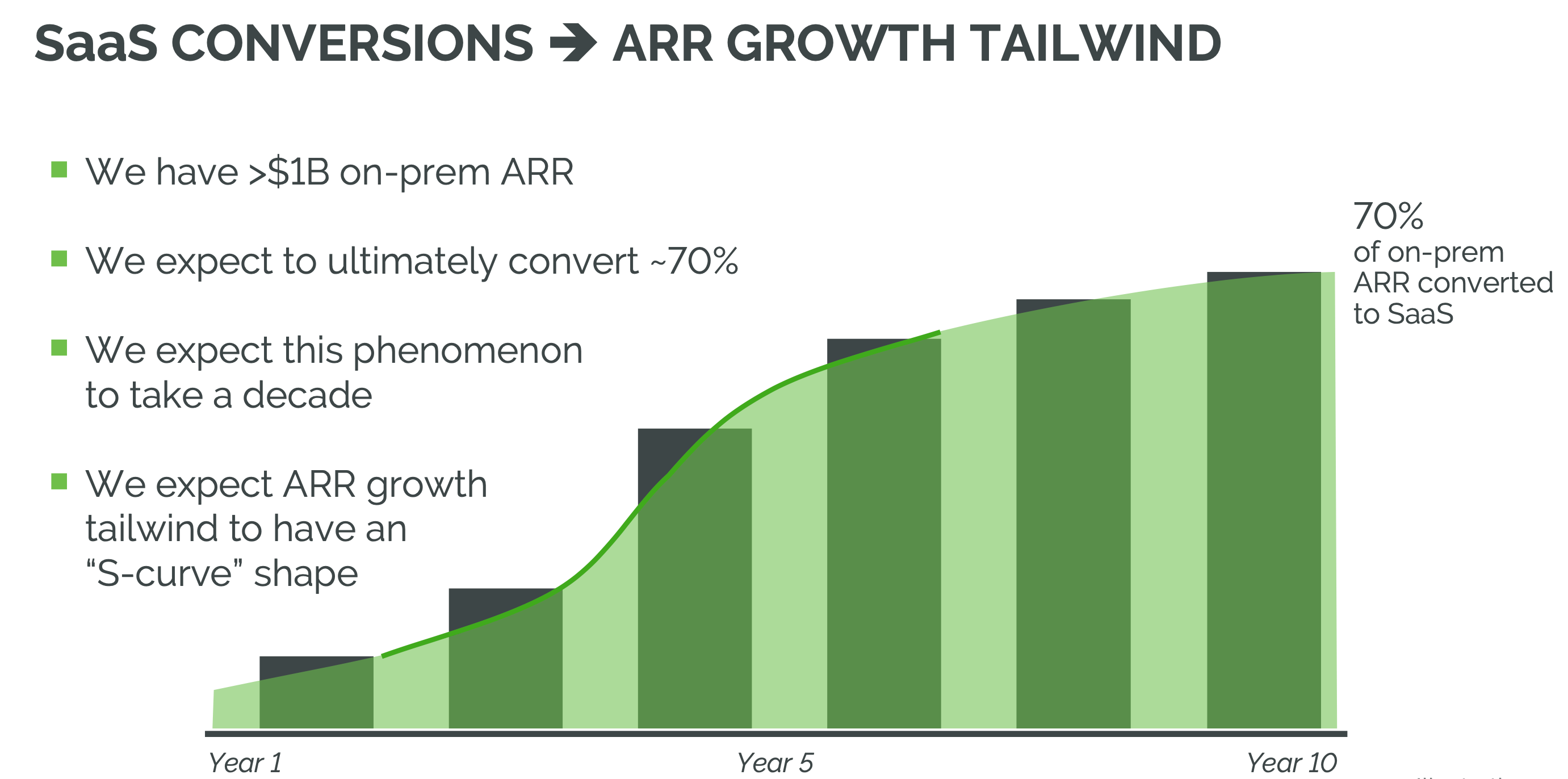
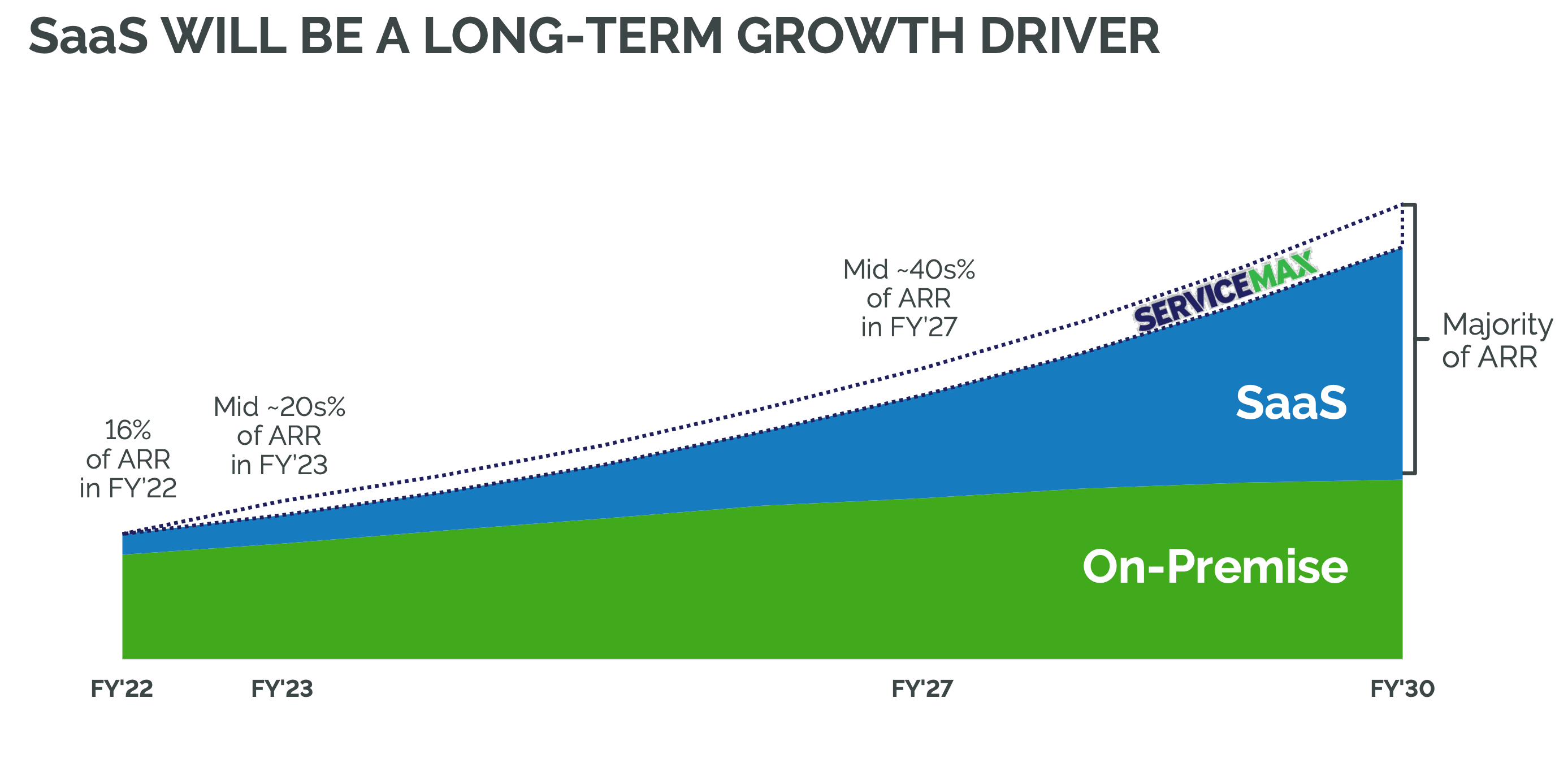
Within the context of an S-curve adoption framework, management at the time were targeting an average annual contribution of 400bps to ARR from conversion over a decade. At around the time of FY23 SaaS share was around 25%.
Note: PTC has two product groups, the results of which are no longer split out. The first is Digital Thread, which is the bulk of the company. The second is ‘Velocity’ which encompasses the higher growth cloud-native products Onshape and Arena. The Velocity products are positioned towards Agile product development. While operated separately (and managed by Onshape veteran David Katzman) there is pooled resource and technology sharing between the two groups.
Chapter 3: Neil Barua, The Present & The Future
When PTC acquired ServiceMax in 2023, the CEO of that business came along too - Neil Barua. To everyone’s great surprise, in July 2023, PTC announced a leadership succession plan with Barua to become CEO in February 2024.
Interestingly PTC and ServiceMax have a shared history. PTC originally set up a partnership with ServiceMax back in 2015 and took some equity. PTC was even considering buying the business outright, but then GE stepped in with a high bid in 2016, following which the PTC partnership was abandoned. GE then sold ServiceMax to Silver Lake a couple of years later. While the publicly available details are sparse, apparently ServiceMax was not well-run under GE ownership. Barua was installed by Silver Lake after they acquired the business from GE. When PTC acquired it, gross margins were 70% (in line with what you’d expect for a well-run SaaS business) and ARR was growing in the mid-teens.
Starting out as an investment banker, Barua spent 10 years as mentee to John Legere6 at Global Crossing where they took the business from bankruptcy to ultimate sale. Barua became a partner at Silver Lake, including a stint as CEO of Silver Lake investee IPC Systems. Prior to PTC, there’s no record of Barua as CEO of a public company, which makes him harder to assess - you can hear him speak about his background here. In many respects he’s very different to Heppelmann - here’s what the latter had to say in an interview shortly after retiring:
Neil is of course a different person than me. We have characteristics that are common and then we all have something that is unique. Neil is a great leader for the times and given where PTC is now. He has what PTC needs from its leader. He is a little less technical than me, but very great with customers, employees and financial acumen.
And from another interview shortly before he stepped down:
PTC no longer needs to keep technology expertise in the CEO position. We have taken care of that over the past five years by building a very strong leadership team. The CEO needs to be adept at leading the company.
One thing is clear, the succession process was well orchestrated and communicated and seems to have been driven by Heppelmann’s desire to retire from company management. In this context, Barua looks rather like a handpicked successor - in fact after the announcement the two went on a ‘world tour’ visiting PTC offices and customers together.
The Barua Playbook: Wood Behind the Arrow
I’ve been taking my time to make up my mind about Barua - the results of his strategy and execution will have to speak for themselves and I’m still not fully decided yet. But the thinking behind the appointment is becoming clearer, as is the strategy that’s now underway.
When Barua formally took over, he immediately announced his initial priorities. These include five areas of focus (which you’ll now hear a lot about in PTC’s investor communications):
PLM / Windchill
ALM / Codebeamer
SLM / ServiceMax
CAD / Creo
SaaS
These are together what Barua considers to be PTC’s core capabilities, future growth drivers and highest ROI, all within the context of Digital Thread. And it’s not without good reason - each of these is performing really well and I’ll go further into products in Part II. These are his most important ‘arrows’ that he wants to ‘put wood behind’. Renewed focus also mean re-prioritisation of R&D - so for example, no new standalone IoT or AR applications, i.e. only investment into those IoT and AR applications that support the Digital Thread.7 From early on Barua has been saying that he wants to focus PTC on organic growth opportunities and any M&A will be focussed on the Digital Thread strategy - he’s not interested in large deals lacking focus.
He also distanced himself from the previously more aggressive SaaS timeframe. While SaaS remains one of the strategic priorities (and his too previous leadership roles were in SaaS), Barua’s inclination is to step back from pushing customers too hard. So it’s merely a case of whether the transition is sooner or later. It might be safer, therefore, to assume a longer transition than the 10 years indicated at the FY23 Investor Day, so maybe that 400bps average annual contribution becomes 300bps - but then again maybe it’ll work out faster than that.
About a year ago, Barua began to introduce his new go-to-market strategy. Until recently PTC was organised to sell by product group, rather than industry. Given the strength of the products, PTC doesn’t appear to have been slowed down too much by selling this way. But PTC’s main competitors are set up to sell according to industry verticals, and depending who you ask are generally considered to be more customer friendly than PTC. It’s not difficult to see that from the customer perspective a less siloed approach makes sense. Imagine you’re an automaker with requirements in each of CAD, PLM and ALM - it’s better to deal with a single industry-proficient salesperson who can help you with the right solution for your requirements, rather than a handful of generalist reps who also sell to Medtech or aerospace customers, for example.
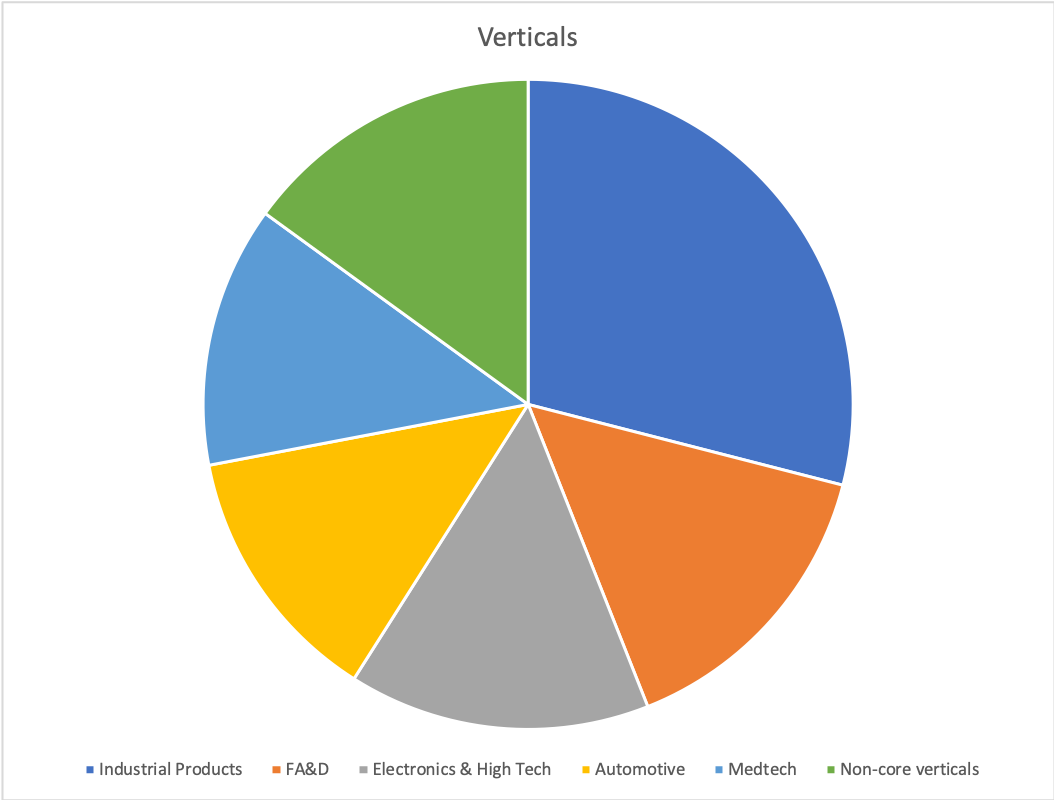
Central to the new strategy, PTC has re-organised into five core verticals from the customer perspective. These are:
Industrial Products
Federal, Aerospace & Defense
Electronics & High Tech
Automotive
Medical Technology & Life sciences
With the exception of Industrial Products (‘high 20s’) each represents a low- to mid-teens percentage of the business.
As part of the re-organisation, PTC also created a new executive leadership position and hired externally. The new position, Chief Revenue Officer (CRO), went to Rob Dahdah who joined in December 2024 and the strategy shift went full steam ahead. At Q4 FY2024 earnings (November 2024), PTC gave us advance notice of potential near-term headwinds from the re-organisation as well as related costs of $20m. There’s been a lot going on beneath the surface in sales, marketing, pre-sales, post-sales, implementation (i.e. “customer success”) - new hires, retirements, promotions etc.
The genesis of how and why this has all unfolded in the way it has, only occurred to me when I was speaking to one of you - an NFTBC reader. And ‘putting two and two together’, there is almost certainly a connection with one of PTC’s board members - Mark Benjamin. Benjamin was previously CEO of Nuance Communications, where he conducted a successful business transformation, re-orientating Nuance into higher-growth SaaS verticals while repositioning the company as an AI leader. As part of his transformation he brought in an old colleague of his, Rob Dahdah to execute a new go-to-market strategy. Here is their basic playbook that they outlined at the Nuance Investor Day in 2019:
Organised salesforce around industry vertical expertise so that reps understand customers workflows and KPIs deeply
Expansion, cross-sell, up-sell
customer success / selling outcomes rather than product. Compensation set accordingly
Nuance’s sales compensation and reporting (ARR, net retention) were retooled to make customer success the measure of success for the field, not just bookings
High performance sales culture
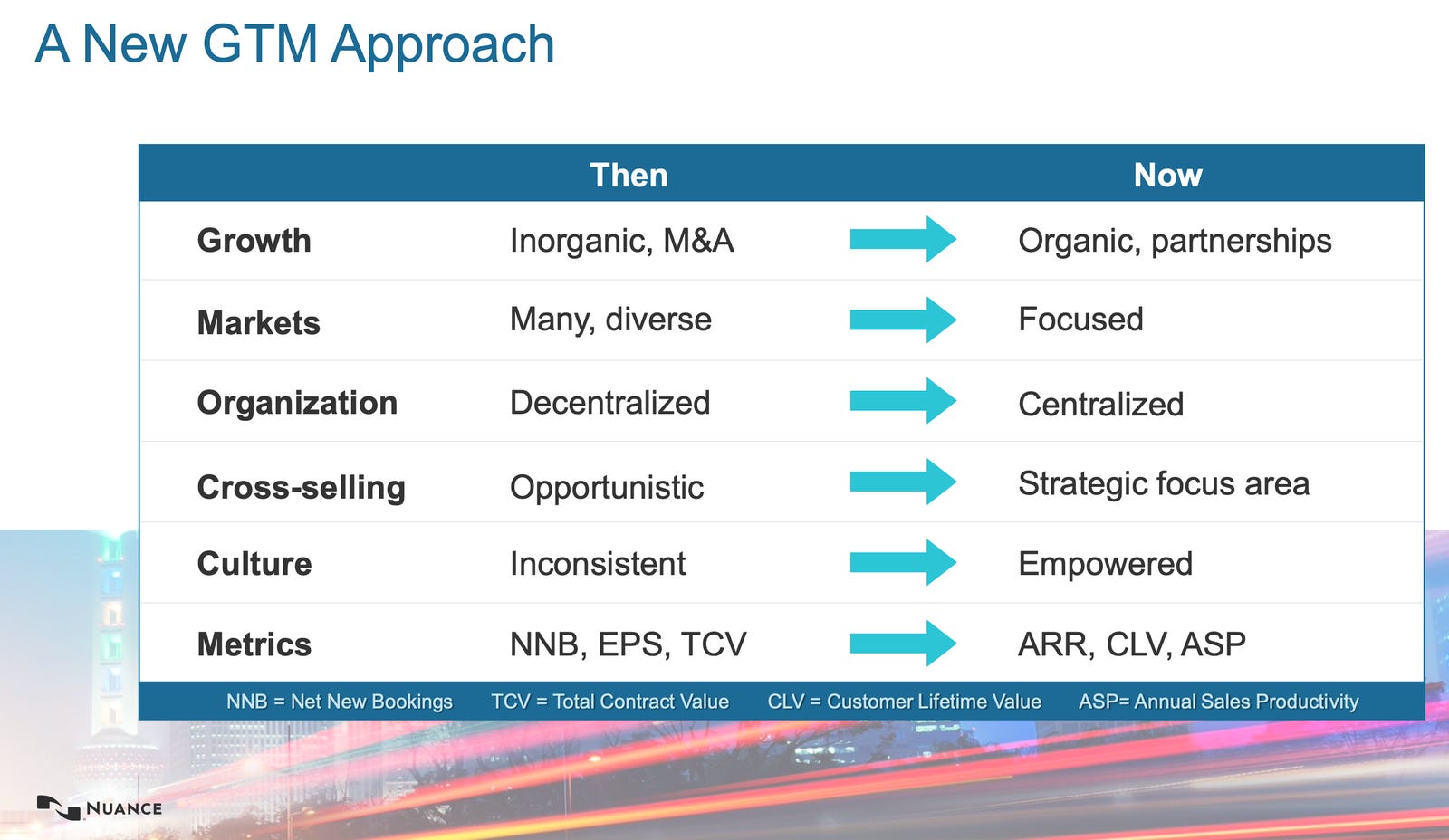
While PTC and Nuance aren’t in exactly the same position, there are key parallels:
Switch to verticals
Cross-sell / up-sell strategic focus
Renewed focus on organic growth
Switch in sales culture from bookings » alignment and customer success
Repositioning for AI?
And the strategy certainly seemed to be gaining traction at Nuance by the time Microsoft swooped and acquired it - although we’ll never know just how successful the strategy might have been if left to run its course.
It’s interesting - if you go and look at all the PTC transcripts since he signed up, the language of the Dahdah playbook is evident, including from the CEO and CFO: “alignment”, “accountability”, “customer success”. And Dahdah himself now shows up on the earnings calls - it’s clear as day how focussed on this strategy leadership is.
How close is it to showing results? This is what Dahdah said in July:
The results are the checkpoints along the way. First organizing the team, then developing the messaging, starting to deliver the messaging, having that resonate with the customers and then have that be part of their budgeting cycle. So you could expect to see that. And that’s what we’re pointing at. I mean we’re aiming at that for mid next year, mid to late next year.
Per Dahdah they’re in the message delivery phase currently, with foundational worked having been completed. “Mid next year” for PTC would be around March 2026 in PTC’s financial year, so make a mental note of that.
Last but not least: pricing. As you’ll see below, pricing has traditionally been lower down in the hierarchy of PTC’s growth algorithm and PTC has priced less aggressively than peers. While pricing is not part of the publicly announced go-to-market strategy, from recent conference calls it’s starting to become clear that it is part of it nevertheless - they probably don’t want to shout about it too much.
Here is Barua taking a question about pricing at Q3 2025 in July, if you’ll forgive the long quotes:
Philosophically, Rob, myself, Kristian and the leadership team have been working through commercial levers, far more than I think I’ve ever seen in the 2 years I’ve been been at PTC. So from a perspective of planning, thinking about options how it impacts customers, how might it flow through ARR, what are the impacts good and bad around certain ways in which we could think about commercial levers has been extreme detailed discussions over the last, call it, 90 days, as Rob has been getting the sea legs underneath them. So philosophically, we believe there is opportunity, and we believe there are distinct ways in which we could capture that opportunity.
That being said, I think Kristian said this in prior calls, and I think I’d like to give Rob a chance also to articulate that to show the alignment here, we also have to be very mindful that the customer needs to see value also. And so all of this commercial discussion needs to be interlocked with the innovation that I’m pressing really hard on the product team to deliver, whether it be the AI releases, whether it be the continuation of what we’re seeing some really good momentum on our SaaS product. So that when we actually execute some of these commercial levers, there is something that we give to our customers and say, “Okay, we’re going to take it and there’s something new that we actually can appreciate, why you’re asking for this.” And some cases, well, for the most part, we’ll start doing that. In other cases, there are opportunities to continue to optimize the commercial arrangement that we have with customers.
And Dahdah:
So Kristian, actually, did some really good analysis to help us at least size the opportunity. And even when I came in, it was one of the first things we had a chance to look at together. And then, as Neil very well said, delivering this in the form of the value to the customer is super important. And also making sure that the teams, the commercial teams know how to have that conversation, which historically, we just weren’t really that good at.
So there are a number of things that we’re going to bring together. But personally, I think it’s a great win, obviously, even for our customers. If you think about how they structure their contracts and how they plan with other major tech providers. This is not like a new motion for that. So it’s really more of a new motion for us.
We have an opportunity to bring it to them in a new way now in terms of the value we deliver. And it’s something that is an important part as we go forward to the strategy for the go-to-market teams.
I think it’s safe to say we should expect PTC to take more pricing than under Heppelmann. And, other than bringing extra value to the table, the best way to take pricing is to have very high switching costs.
CAD/PLM Switching Costs
Something Heppelmann said some years ago really stuck with me (no pun intended):
I do think the switching costs are unbearably high, and we don't actually even try to displace competitors unless the customer is begging us to engage in that discussion because it's too hard, at the end, to justify the switching cost. So I do think a lot of companies would say if I have something and it's working, that's what I'm staying with. And many times, that's good for PTC. And sometimes, it frustrates us because we think we have a better solution than somebody else.
But definitely, people have known that CAD software is very, very, very sticky. And I've always said, the only thing stickier is PLM software. It's just about impossible to rip out. It's a bit like ERP software. It's connected to so many things.
It's involved in so many processes. It may be customized a little bit or integrated into homegrown systems. You might have developed some applications on it. So it's just -- it's not something you can readily switch. So for us, that's a good platform to build on, add some growth, adds a ton of profit margin to our business
- Jim Heppelmann, at the Goldman Sachs Technology and Internet Conference 2019
Most investors probably already appreciate the stickiness of ERP and the business disruption that can arise from implementations. For manufacturing companies, the situation is as least as serious with CAD and PLM. You don’t change to a different system (or in some cases, even update to the next version) unless there’s a serious business case for it - it can be highly disruptive. Perhaps the most infamous example of CAD system business risk is Airbus, where French and German engineers were simply on different versions of the same software (Dassault’s CATIA), causing a two year delay and losses in the billions. I asked ChatGPT to come up with a list of CAD/PLM implementations at major industrial businesses where there were significant resulting negative impacts. Here are some of them:
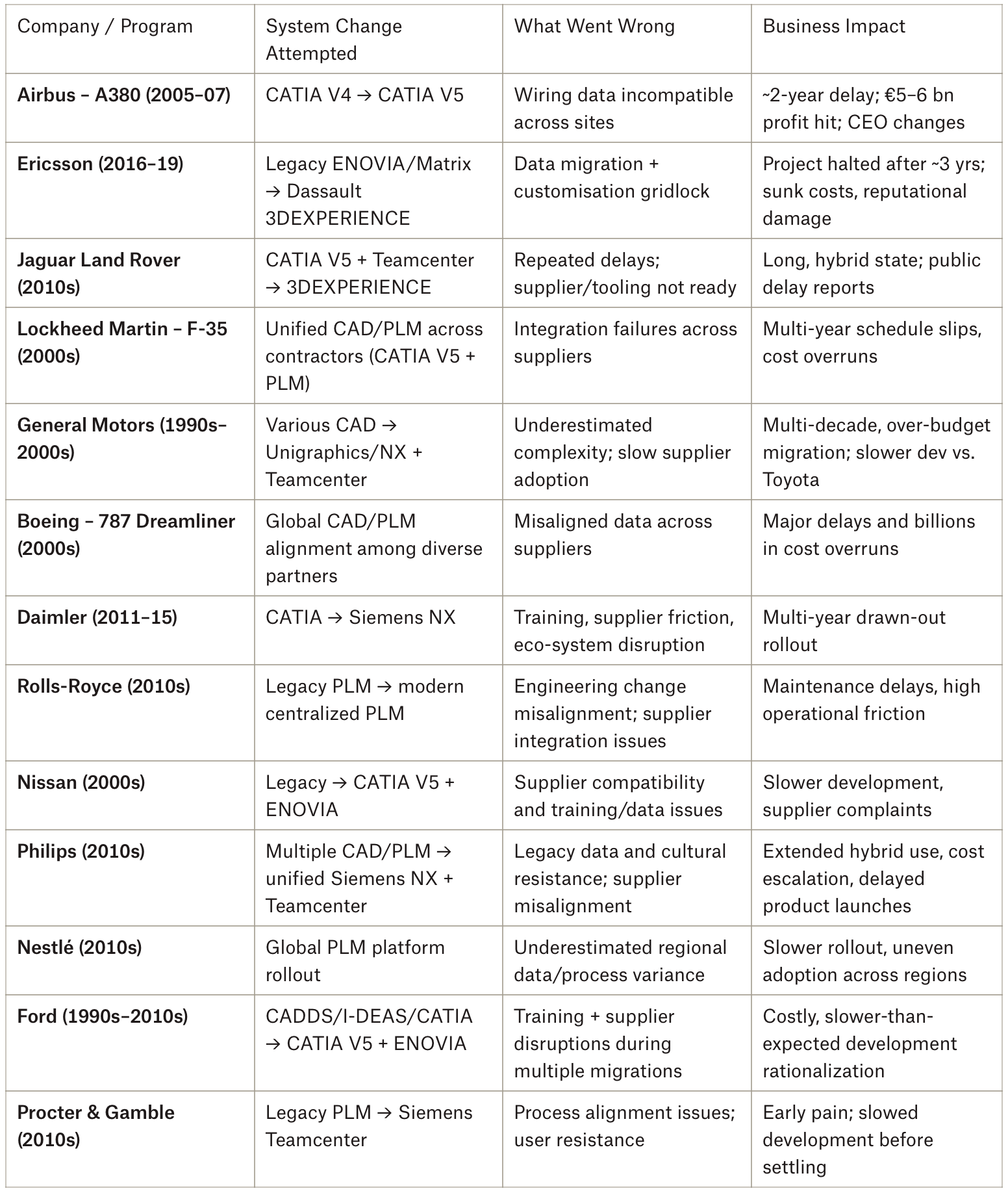
In most of the these examples the switch was typically one of the following: 1) from a legacy system to Dassault / Siemens, 2) a consolidation from multiple systems to one or 3) an upgrade with the existing vendor. The one that stands out is Daimler/Mercedes who decided to switch their CAD system from Dassault CATIA to Siemens NX. It’s difficult to overstate how much of a pain something like this is - there are case studies about it and even documentaries ( ⬅️ this one has 45,000 views on Youtube!). Why did Mercedes do it? Recall that Hepplemann remarked: “the only thing stickier than CAD is PLM.” Well, it turned out that if Mercedes wanted to stay with CATIA through the next upgrade cycle they would have to change their PLM system to be compatible with the next version of CATIA - the PLM system won!
The PTC Growth Algorithm
As Heppelmann noted, with one exception in particular (i.e. Onshape), PTC does not put great energy into outright displacements of competitor CAD and PLM systems - unless that’s what the customer specifically asks for, and that does happen, in particular when customers want to standardise from multiple systems. CAD being a fairly concentrated and mature market, Creo doesn’t depend much on new logo customers for growth. PLM is somewhat less mature and more fragmented, so new customer logos are more of a growth source there. But it’s notable how low down the growth hierarchy new customers are for PTC.
Here’s how CFO Kristian Talvitie put it at the JP Morgan Global Technology Conference in May this year:
if I were to stack rank the elements of growth, I think the largest component is really up-sell and expansion. The difference being expansion is I have whatever, 10 seats of Creo, and I want to add 5 more. Up-sell being I have 10 seats of this particular package of Creo, I need incremental functionality. So I still want 10 seats, but I want incremental functionality, which would be the upsell.
So that's probably the largest component of the growth followed by cross-sell.
I think it would drop down a fair bit from there and you would see the impact of pricing.
And then I think the fourth element, which comes after that would be new logos.
So we have (in order):
Up-sell and expansion: selling additional features and seats to existing customers within their existing applications
Cross-sell: selling additional applications to existing customers (e.g. customer has Windchill and they buy Codebeamer, ServiceMax or Creo etc)
Pricing
New customers
PTC generally operates in sectoral domains that are 1) still somewhat fragmented, 2) adjacent to exploitable niches, 3) under-served by legacy software or even 4) not yet sufficiently digitalised. And so the really intriguing thing about PTC is that there seems to be plenty of opportunity in these up-sell, expansion and cross-sell opportunities - and from a strategic standpoint the company has set its portfolio up beautifully to exploit this. It’s a strategy that has worked well for years:
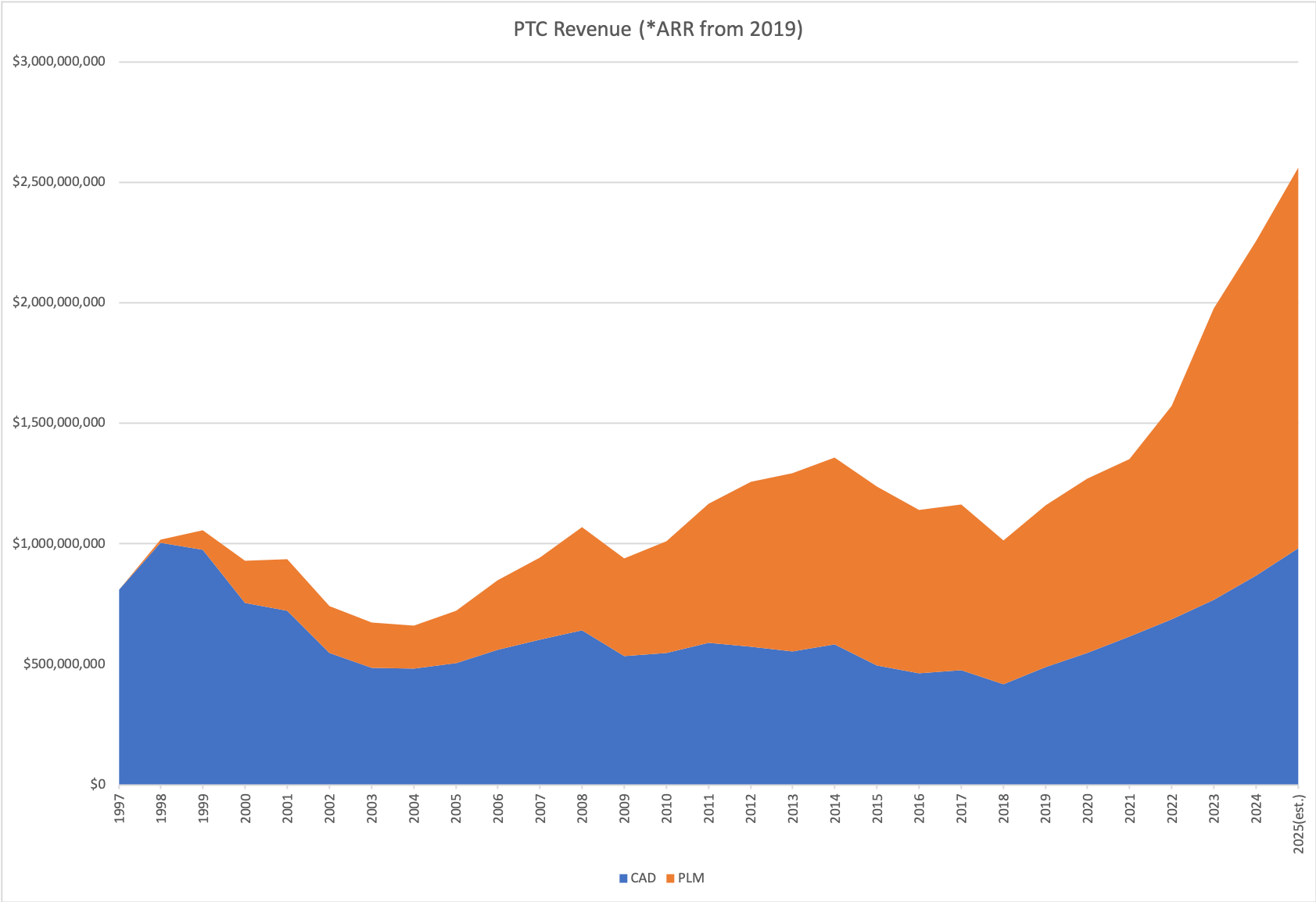
With PLM now at 60% of the business and the faster grower (>15% CAGR since 2019) it’s the main growth driver. We shall explore this further in Part II. In particular: Windchill is driving seat expansion outside of engineering departments to become an enterprise-level application, Codebeamer is in demand as hardware products become software defined and ServiceMax is driving cross-sell opportunities. CAD is doing well too with 2019-2025 CAGR of >12%.
As noted, pricing looks set for an upgrade in the hierarchy, while Talvitie didn’t even mention SaaS which has the potential to be a significant contributor once customers start moving up the adoption S-curve. Then there’s Onshape, which I believe will ultimately grow to be a $1bn ARR product over time compared to perhaps $30-50m currently (we’ll talk about that in Part II). Taken together, PTC has a reassuring number of levers to pull to maintain growth for the foreseeable future.
So ends Part I. In Part II we’ll take a closer look at products, AI and financials.
Thanks for reading. As always, get in touch if you have any comments or questions.
Further Reading
If you want to dive into the deep history of CAD and PLM, The Engineering Design Revolution by David Weisberg is unbeatable and a true labour of love. And it’s available for free. The only downside is that it ends around 2007. Sadly Weisberg passed away some years ago so there will never be an updated version.
Here’s one well-known short seller’s pitch from 2017.
Insofar as I talk about revenue, it’s to allow comparison to the pre-2019 period.
Parametric modelling (as opposed to direct modelling) is a design method where geometry is driven by parameters—dimensions, constraints, and relationships—so changes to one element automatically update related features. This allows designers to efficiently modify and control complex models with precision and consistency. In practise, the best systems these days use both.
The Engineering Design Revolution by David Weisberg
At the FY23 Investor Day they said Windchill+ was converting at 2.4 to more than 3X at that time.
Yes, the very same John Legere of T-Mobile turnaround fame
Here’s an interesting example of this - in early 2025 the leaders of PTC’s ‘Reality Lab’ AR unit spun out a new company, Datatimespace. What’s more they were seeded by PTC and Heppelmann now chairs their business.
Any thoughts on PTCs strategy to acquire the next generation of users? Discounted subscriptions for students etc. You discussed the stickiness of CAD software so seems to me that the largest risk of user attrition comes when the baton is passed to a generation where PTCs software isn’t their native choice.