


Friends of NFTBC.
This year, it seems, investors have collectively asked whether enterprise software is being rendered obsolete by new generative AI tools. It’s not a topic I’m keen to weigh in on or where I would have much of use to contribute - generally speaking. That said, there is currently one software stock that we talk about here at NFTBC - PTC. So let’s talk about it.
At present, there are two principal threats that software businesses are facing (as widely perceived). The first is from generative coding tools (“vibe coding”) - specifically, if software can now be written by anyone at low cost, why would businesses need to buy expensive enterprise applications anymore? The second is risk of displacement by “AI agents” - if an increasing proportion of traditional business functions can be carried out more efficiently by autonomous agents, won’t businesses require fewer software seats?
Notably, PTC stock doesn’t appear to be dropping as hard as many of the previously popular SaaS names. It seems abundantly clear that some species of software could be more at-risk than others and, I suspect, investors are in the process of trying to sniff out which ones these are - and rightly so. The questions involved are difficult ones to wrestle with and I wouldn’t be surprised if we’re still a good while away from greater clarity - possibly years in some cases. Equally, it seems to me that some software businesses are likely to prove quite robust or potentially emerge as beneficiaries in the wave of developments to come. I’m inclined to include PTC in this latter camp.
2026 should be an illuminating year for PTC followers as we get to hear progressively more about the AI strategy that is already well underway. The cadence of AI feature releases has been steady over the last 12+ months, with Codebeamer AI launching just last week (demo here).
I listened to a conversation with PTC’s AI Product Lead Ayora Berry in recent days, and so I thought I would share a few thoughts with those of you who follow the story. Berry was talking to one of the co-founders of Leo AI - an engineering design co-pilot that has officially partnered with PTC’s cloud CAD Onshape product. The title of this post (“Organising the Noise”) derives from the conversation. It’s certainly a bewildering time, and this makes it all the more important to present customers with a coherent strategy and roadmap - and PTC has been doing exactly that. In broad brush strokes this has entailed conveying to customers what to expect and on which approximate timeframes. Rather than overpromising and under-delivering, PTC is releasing AI tools into its existing products, as and when they are sufficiently robust and genuinely useful. As you might expect, this means simpler deliverables today, and more complex and challenging ones in the months and years to come. Simply being organised and dependable at a time like this, perhaps should not be under-estimated.
[NFTBC does not give advice - please do your own research. I currently own shares in PTC].
Just to kick things off, I don’t think there is any serious suggestion that businesses would ever seek to vibe code replacements for their CAD or PLM systems - you quickly get into a minefield of all sorts of different issues around complexity, compatibility, robustness etc. The idea is barely worth entertaining. Recall in the deep dive we looked at a long list of case studies where companies suffered negative consequences from switching CAD/PLM systems (or even versions). So rather than system replacement, the possibility of threats relates more to workflows - how users interact with the existing underlying systems and who captures the economics. For example, on the vibe side of things, there’s “prompt-to-CAD” or “vibe CADing” - where you use a (potentially third-party) interface to describe a part which is then executed by a CAD system.1 Then on the agent side, the threat is that a third party comes along and controls a new surface for interacting with the agents, while the PLM system is effectively relegated to an invisible layer and disappears from the user’s mind.
I have highlighted these risks for understanding and completeness. But it must be said that in the near- to medium-term AI looks to be highly complementary to PTC’s business and more opportunity than threat. For the medium- to longer-term PTC is starting from a particularly favourable position - I would argue AI is their game to lose even if success is yet to be secured. Let’s now start thinking about some of Ayora Berry’s recent comments (lightly edited):
it’s very clear for us: [the key to driving AI adoption is] to get your product data foundation in order, or your data house in order. In the enterprise or in any software system, AI is only as good as, the context from which it operates in. And so your data in your systems need to be quality, they need to be accessible, they need to be structured so that the AI has that substrate from which to deliver insights and automation. So in terms of being ready for AI, the clear message is that there’s good news: like you already have a good start. You’re using PDM, PLM, you’re using ALM—all these systems of records out there to manage your business processes. And you’ve been on those journeys for decades. Now you can tap into all that work you’ve been doing by embedding AI into those systems to deliver those insights and automation. So that’s foundational: is to get that product data established and continue your journey in using enterprise software.
From all the various signals we’ve seen (including PTC’s financial results), this is precisely the direction that customers are pushing in at the moment - more PLM and ALM implementations and seat expansion outside of engineering departments. And frequently, they’re not buying the software in isolation, but alongside CAD, SLM and other PTC applications. As Berry puts it, “context is king”. With PLM providing the product data foundation and CAD, SLM, ALM adding further enrichment to the contextual environment, the starting position for deployment of useful AI is a strong one:
I often share that in this AI world that we’re in, this wave of innovation, context is king. And it’s a riff on an earlier phrase from the early internet era of “content is king,” wherein if you have a website with say videos or music or whatever, the more content you have that’s your moat. But in the age of AI, context is king. You need to know who’s using that CAD model, when they’re using it, why they’re using it, how it’s being performed, where is it in the lifecycle. All that context is rich. So when you embed these systems like Leo and PTC’s AI systems into the CAD software into other tools, you’re going to have this contextually rich advisor.
And I think that’s a huge gain.
So how does PTC avoid fumbling this head start? It’s very clear that PTC is moving to absorb the vibe and agentic layers into their own ecosystem - with control of the user experience today, Windchill, Creo and other PTC apps are the natural choice for the user experience tomorrow as well. I’ll address a few of the other barriers to entry that a possible UX usurper might face, but let’s first zoom out with a brief reminder of PTC’s AI deployment philosophy (as discussed in Part II). PTC has a three-pronged strategy: Advise, Assist, Automate.
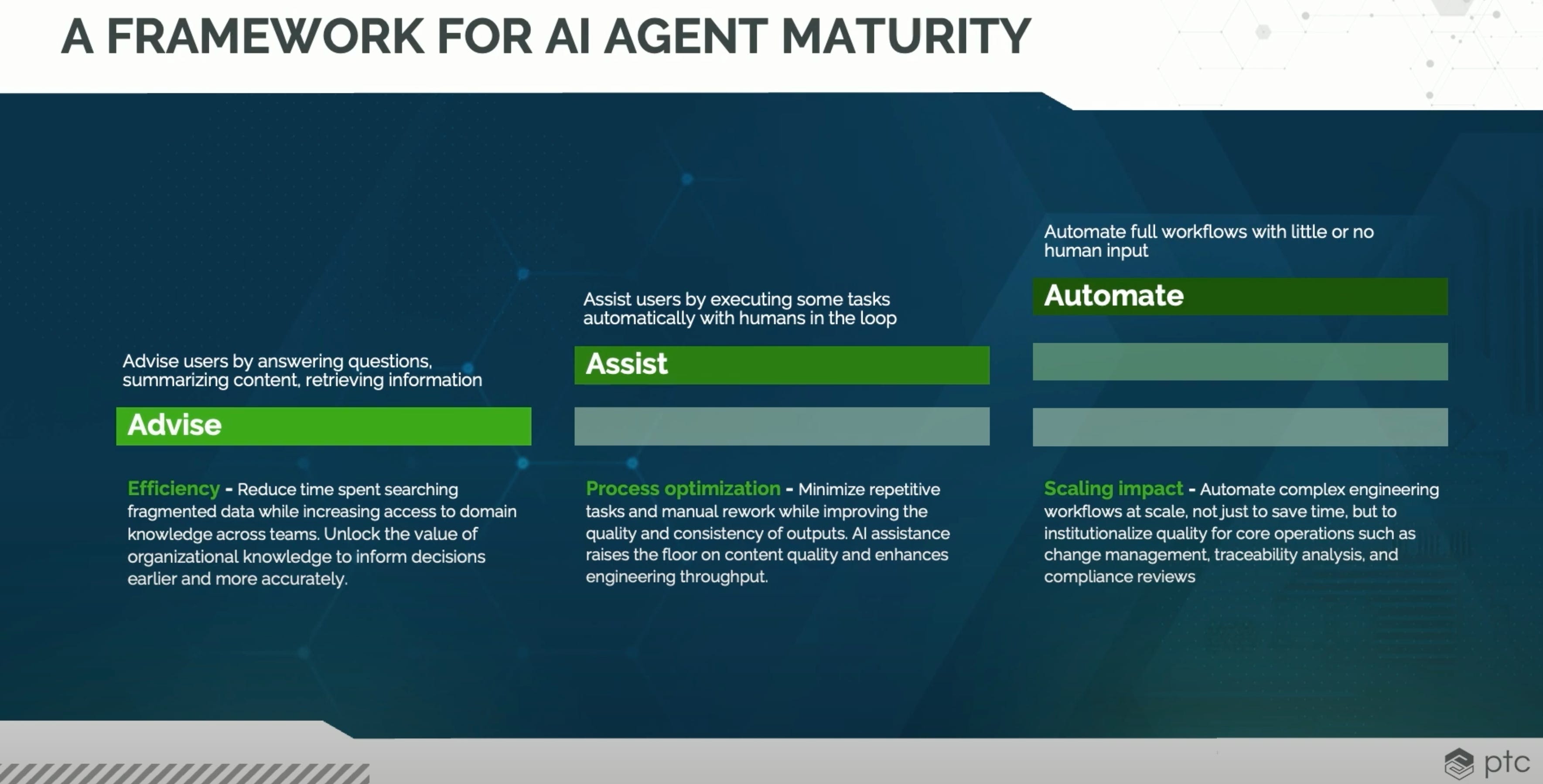
Berry noted that currently 80% of customer use cases are advisory, 15% in the Assist space and the remainder in Automate. While PTC has launched features in all three categories, it’s no surprise that most have been more tightly oriented around Advise capabilities so far - but these features and categories are not mutually exclusive. While the immediate focus is on making current workflows more efficient, Berry outlined the various timelines they envisage - most notably getting to a robust agentic deployment in the next three years (“breaking down silos”):
What’s shaping up is three time-based horizons that we’re seeing. So one is turbocharging workers—augmenting workers with capabilities from AI. The next level is elevating the enterprise IQ or intelligence—breaking down silos so that business units can work together to execute, you know, a cross-domain business process like a change execution. And then thirdly, more in the future, is we’re seeing the potential to reinvent how products will be built, where AI is either a companion or leading in developing products.
And within that framing of those three phases, right now, all the action is in the turbocharging worker space. That’s where a lot of the agents and AI systems are operating. In the next one to three years, we’re going to see actual value delivery in this enterprise intelligence space where we figured out how agents can talk to each other between systems in a way that’s authenticated and reliable and secure and robust. Now of course things are happening now—like there are solutions that people are building that connect ALM and PLM—but at scale in the enterprise, we see that more really taking substance in one to three years.
And that final phase of reinventing product development itself, that’s more in the 3 to 7-year timeline.
So why not move straight to the Automate phase? The answer relates to risk, and helps to highlight the barriers to entry:
One thing that’s new in use case selection in addition to thinking about value and effort is the risk. What’s the risk to my business if AI gets this wrong? Right? Like yeah, we don’t want AI GPT models to be looking at Reddit data of course, but even when we’re training it on millions of bibles and context data from the customer, we want to make sure we deliver the right answer at the right time. And there’s a lot of validation that companies like Leo and PTC do to ensure that you get a reliable answer. But when you evaluate these vendors and these use cases, what I would say is think about the risk—like that’s the third dimension of this evaluation criteria. And on the low risk side is if it’s just reading data, then you have lower risk. But if it’s modifying or creating data, then you’re at higher risk. So that’s an easy split. And then when you look at the create/modify space there’s nuances. But like for example if it’s just taking data and modifying it in a sense that it’s your own proprietary data—like for example PTC data, product support data, if you’re asking questions on how to use Creo and we modify that—like that’s a low risk space. But if you’re modifying say an RFP from an OEM because you’re a supplier and you change a requirement or you change a design and you change the intent of your customer, like you’re at a bigger risk. So there’s just that angle too when you’re making decisions with new use cases.
For PTC’s customers there are critical considerations concerning trust: traceability and compliance, IP protection, access and deterministic workflows (i.e. vs the probabilistic nature of LLMs). Granting read permissions to some other agent provider is one thing, but granting write permissions is at another level risk. For its part, PTC already sells into these requirements and can ship agents that are already natively permissioned and workflow-native - rather than bolt-on. But they still need to get it right, which will take a little time. Naturally, the longer they take the higher the risk that someone else can insert themselves into the workflow, but the barriers to entry are formidable and it would seem that PTC fortunately has time on its side.
One last thing I wanted to highlight from Berry’s conversation concerns PTC’s philosophy of technology openness - something that came up in both parts of the deep dive (lightly edited):
So the one thing that’s important to take into consideration here with this AI era that we’re in is that it’s clear to PTC that we’re going to build AI systems purpose-built for our products. We know our domains. We know the engineering space and how to build those systems for sure. And within that context though, we also know that we’re not going to build everything. Like our customers, our partners are going to build AI systems too. And so there’s a core pillar in our AI strategy which is an open ecosystem. And so I just want to put that out there: like it’s important that these companion agents, these external agents working in our enterprise software are critical to delivering value to our customers.
Done well, these partnerships have the potential to be mutually beneficial and drive the success of both partners. It looks like the Onshape/LeoAI partnership is driving in this direction (see demo here), for example. That said, I think we should fully expect to see PTC doing M&A in this space and bringing in outside capabilities (or potentially neutralising threats).
Concluding thoughts about economics
As noted, in the near- to medium-term, AI looks more likely to be a tailwind than headwind at PTC driven by PLM/ALM implementations and expansions - traditional seat-based growth. What’s less clear is the dynamic beyond that, when the shift to agentic automation and probably towards consumption-based pricing2 starts to bite. With higher workflow efficiency it’s certainly possible to envisage scenarios where fewer seats might be required. But I think what probably matters more is how strong the competitive position is overall, how irreplaceable PTC systems become and how much value customers are realising. With strong execution, PTC has the potential to strengthen its position in both cases, even if the nature of the economic model evolves - and a stronger position probably means better economics rather than worse. To be continued.
Thanks for reading.
Get in touch if you have any comments or questions.
mail@notesfromthebeautycontest.com
This approach has serious limitations and points of failure by the way (e.g. see here) and is currently limited to very simple parts.
PTC have said they expect to introduce consumption models in time.
Interesting and insightful, thanks NFTBC!