

Friends of NFTBC
It has been a particularly dramatic couple of weeks for software stocks since I wrote to you with my musings about PTC and AI. As I wrote at the time, with the rise of generative AI it’s clear that some species of software could be more at risk than others. No doubt the debates among investors will continue to rage on for quite some time. I have made the case that in the near- to medium-term AI is more complementary to PTC’s business model rather than threat. And then for the medium- to longer-term, PTC starts from a position of strength: “I would argue AI is their game to lose even if success is yet to be secured”.
Since the software-AI drama began this year, it feels as though PTC could be receiving some benefit of the doubt. But we’ll have to see how this evolves over time.

There will be further things to say on this topic in the months ahead, but this post will be more directly about the progress in PTC’s ongoing go-to-market transformation and the prospect of a durable business re-acceleration in the near future. PTC reported earnings this week and there are a few points worth noting for those of you with an interest in the stock. For those who are new to the story, feel free to check out my previous PTC posts here (behind paywall, but with previews).
[NFTBC does not give advice - please do your own research. I currently own shares in PTC]
Short version
Management’s key message is that they’re contracting sufficient new business to begin an acceleration from Q4 and lasting into 2027/2028 - you just can’t see it in the numbers yet. The GTM transformation appears to be progressing well with PTC continuing to add business to the deferred ARR balance. Following a big Q4 for bookings, this momentum continued into Q1 and they’re expecting it to continue into Q2.
Along with a step-up in share repurchases, PTC looks to be on track to grow free cash flow per share by 20%+ this year to $8.70+. Overall, things seem to be progressing well currently.
I have been adding incrementally to my PTC holding in the low-150s, having had only a relatively modest position at the start of the year. In the low 150s PTC is close to a 17x FCF multiple, which feels low if they can indeed continue to durably grow per-share FCF in the teens or perhaps higher - and that is, of course, the question.
Headlines
You can find PTC’s FY26 Q1 press release and presentation slides here. The main points to note are these:
ARR came in at the top end of guidance
Revenue came in well above the top end (more on this later)
Share repurchases in FY26 now to include the post-tax proceeds from the ThingWorx/Kepware divestment ($365m), so total repurchases for the year are expected to be between $1.115 billion to $1.315 billion - implying that PTC should be able to reduce share count by around 5% for the year (market cap depending).
Here are the full headlines:
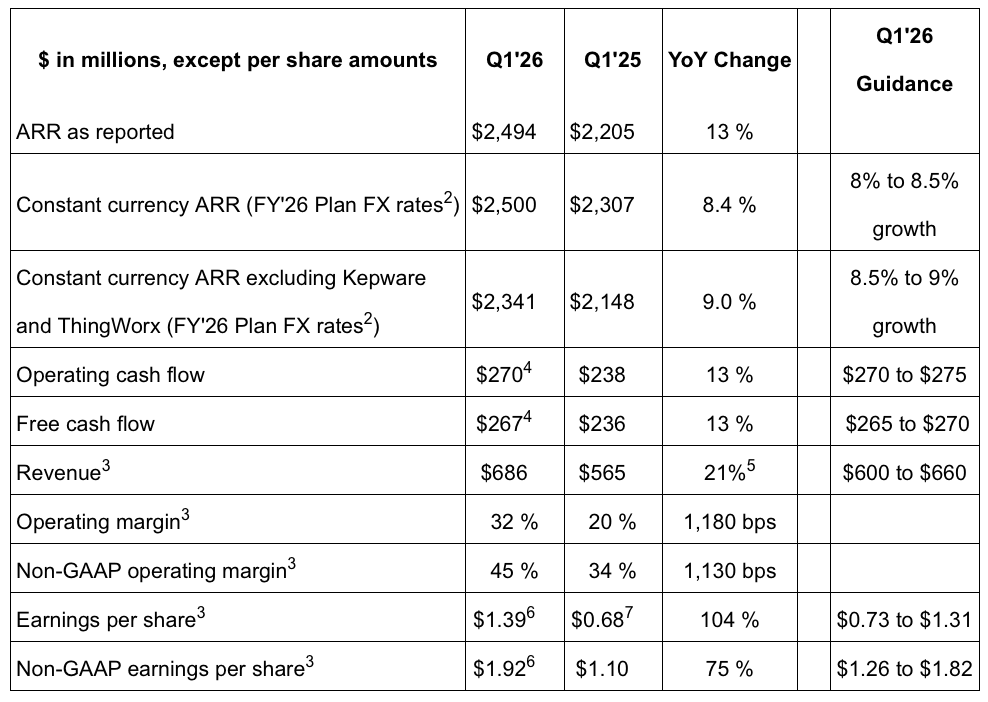
As well as updated FY26 guidance and Q2 guidance:
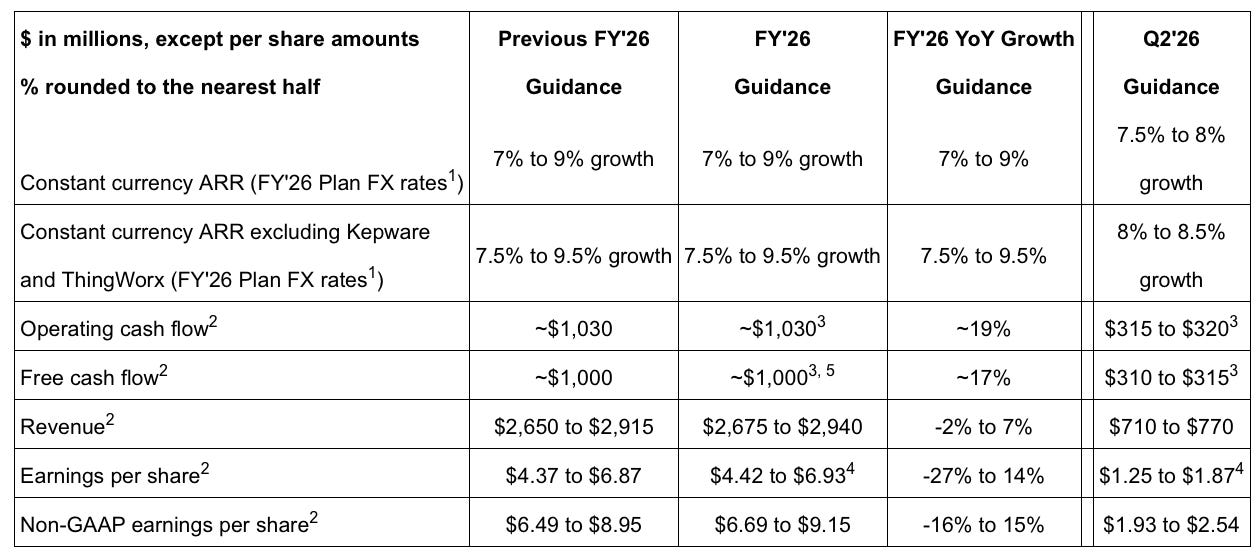
Diving Deeper
Revenue / deferred ARR
Weirdly, and despite what I’ve previously told you, revenue is starting to become the most interesting number to watch at PRC - for the time being at least. Recall that PTC had a massive revenue ramp in Q4 (+39% in constant currency). Q1 showed another strong revenue result of +19% in constant currency. Q2 is guided to be another +16.5% at the midpoint. Yet ARR growth isn’t anything like this high. It’s down to the quirks of accounting for on-premise subscription software, which I raised briefly in the deep dive. PTC held a workshop on this a few years ago, with some illustrations of how the revenue recognition can differ from SaaS and regular on-prem software support:
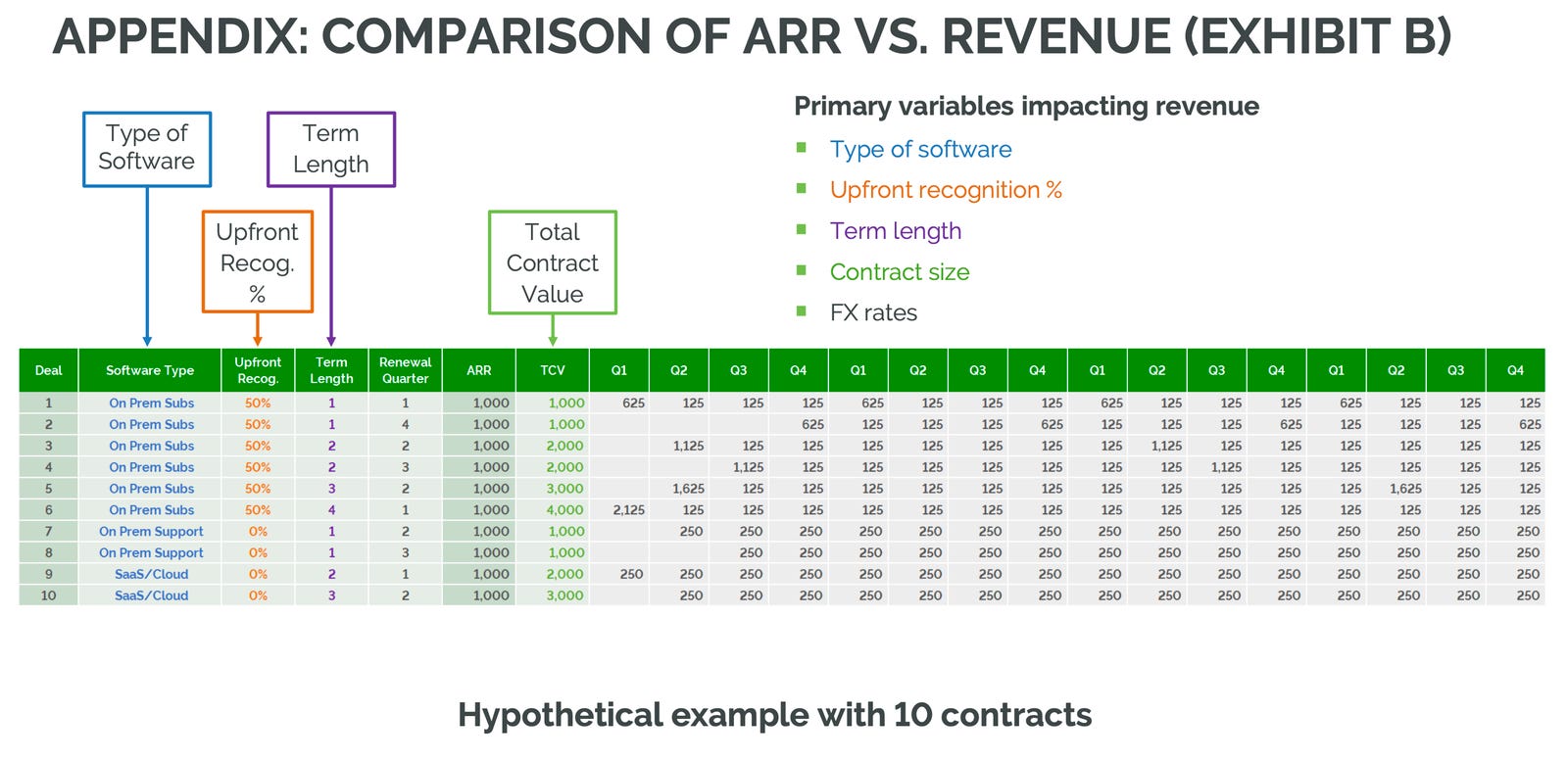
Since Q4 PTC have been telling us that they’ve been landing big contracts and, on the basis that many of these will be on-prem subscription, PTC is having to recognise significant amounts of revenue upfront - depending on size and length of contract. As a reminder, this revenue recognition does not reflect actual cash billings and receipts, which correlate much more strongly with ARR. Much of the revenue comes first, with ARR and cash coming later.
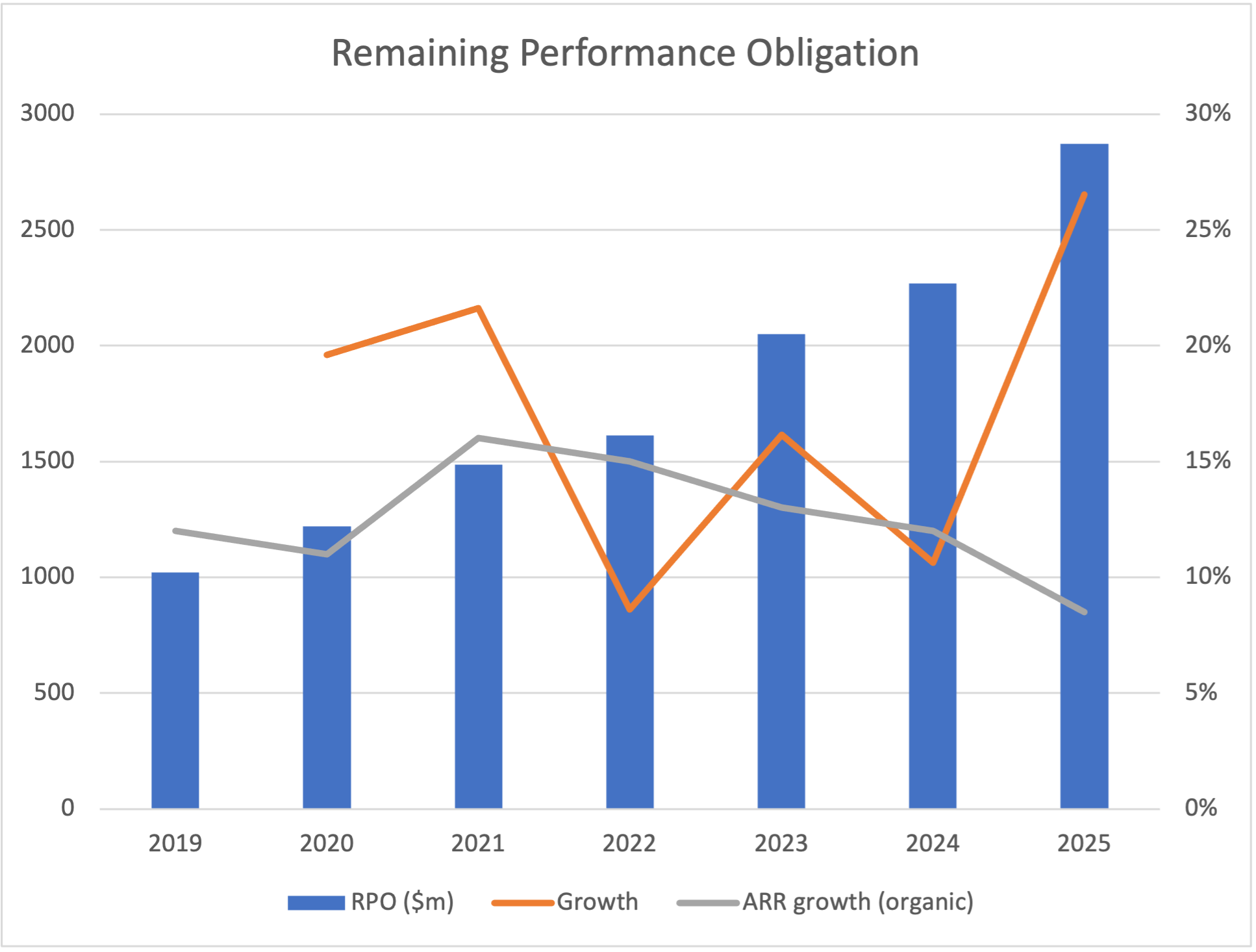
This recent period of bookings also includes a move to a higher proportion of 2-3 year contract lengths - some of this shows up in PTC’s remaining performance (RPO) disclosures in regulatory filings - for example, in FY23, 59% of RPO was expected to be recognised within 12 months, whereas in FY25 the 12-month figure was 55%. In Q4 ‘25, PTC disclosed that RPO had grown 27% year-on-year. While we need to be careful by avoiding any precise extrapolation (we don’t have all the details), let’s have a look at what has happened in the past when PTC has shown strong RPO and revenue growth. First revenue:
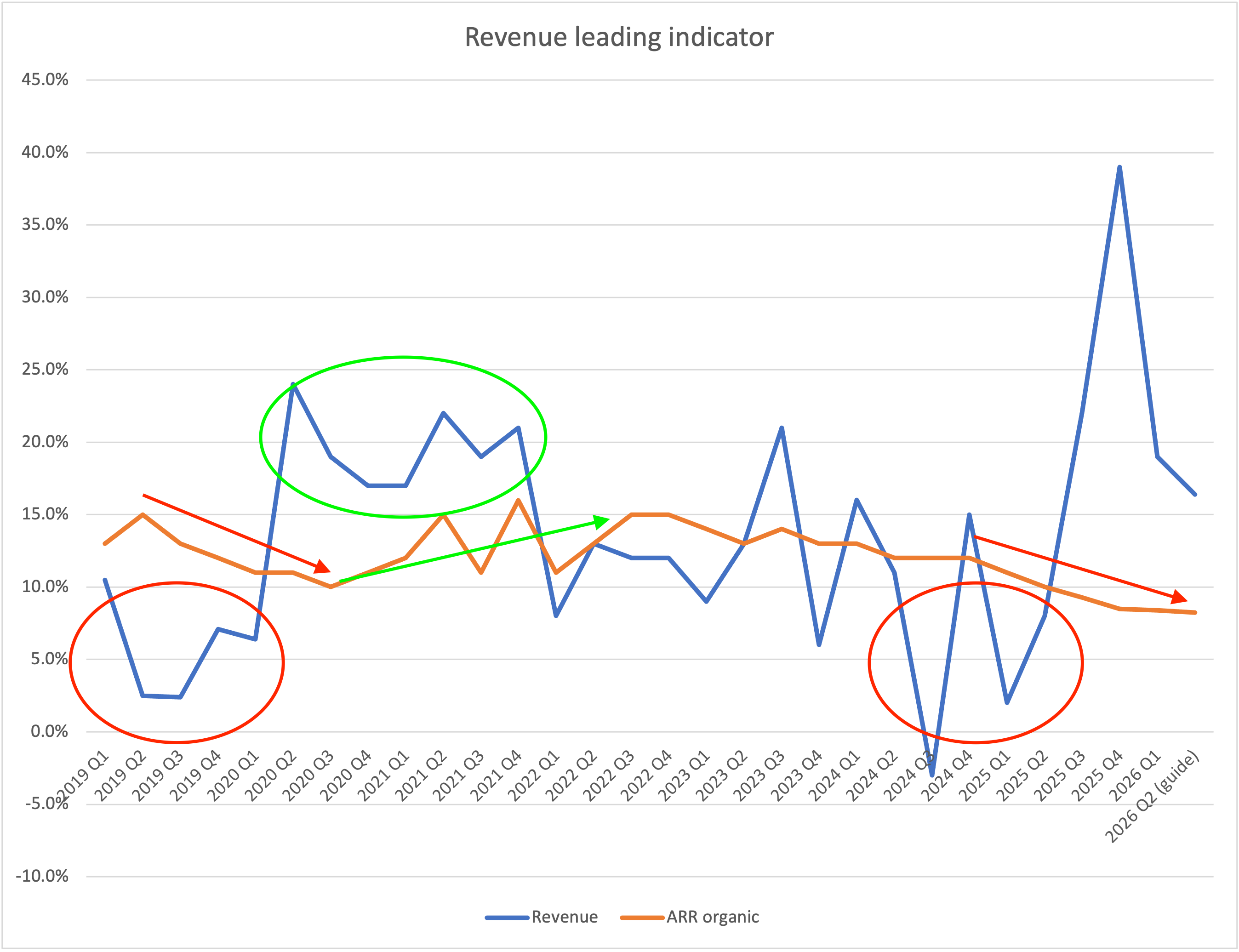
PTC suffered a weaker revenue period in 2019, with ARR growth slowing by 5pp right up to late 2020 - it’s no surprise that PTC investor sentiment was also weak around this time, including prior to the pandemic. This was followed by a strong period of bookings and revenue growth from 2020-2021, driven partly by larger and longer contracting, which then supported a 5pp ARR acceleration lasting until early 2023. From mid 2024 to mid 2025 you can see that revenue was much weaker - we have seen ARR growth taper from double-digits to high-single digits as a result. With the massive recent spike in revenue, we can only guess where ARR is heading from Q4, except to say that growth is likely to be higher than today. I’m optimistic they’ll regain 10%+ ARR growth but exactly where things go - who knows. RPO1 paints a similar picture - ARR growth generally follows RPO directionally on a lagged basis:
Onto some management commentary from the conference call.
Commentary
On Q1 performance:
The key driver of our strong Q1 ‘26 revenue and EPS was similar to last quarter. We did a great job contracting customer commitments. As a result, our revenue growth significantly outpaced our ARR growth for a second consecutive quarter. In Q1 ‘26, demand capture continued to outpace ARR growth, resulting in additional deferred ARR that will support durable growth in future periods. Importantly, this dynamic reflects the quality, duration and the structure of customer commitments we’re contracting, not a change in revenue recognition practices.
On progress so far and what to expect:
The work that we’ve done and undertaken around go-to-market transformation, the hard work that we did up front and the precision and process that we’ve undertaken over the last 12 months, and that we’re continuing on this year and into next: In addition to the product innovation that we’re talking about AI is around bringing PTC back to a consistent demand capture environment by which we’re winning and engaging in strategic cross-product deals across the core priorities that actually build towards this Intelligent Product Lifecycle and so fundamental to our customers.
And so that process that Rob and CK [Catherine Kniker - CMO] and the go-to-market team started off 12 months ago, is showing the fruits of all that process in demand capture that happened in Q4 and in Q1. And as we alluded to, we intend to continue that momentum into Q2. That is not showing up yet in net new ARR. And the way we showed you the guidance for Q1 was clearly not a surprise in which we gave you the range because we know that the whole game is build a durable, accelerating growth company.
And the way you do that is by capturing great demand in a quality deal that fills deferred ARR and allows churn to continue to stay low and keep building new ACV into the quarter that we’re playing in. And we believe in summary that, that inflection that turning the corner and the turn the corner starts becoming more apparent in Q4 of this year and substantially into 2027 and 2028. And that’s what we’re playing for.
On the deferred ARR:
the crux of the deferred ARR is due to the fact that we’re winning strategic cross-product and in some cases and in many cases, on some product lines, competitive displacements. And so we’re taking the commitment, which is committed dollars from the customer. I’m cognizant that it’s not showing up right now in the in-quarter ARR in Q1 and as we guide around Q2, but we’re very positive about how it’s starting to build into how it will impact Q4 in a more meaningful way than it did last year and also into the following year. And it’s all to do with the implementation cycles of our customers, and we feel good about it because the commitments there, it’s contracted and it’s set to come
On implementations and the nature of the delayed-start multi-year deals:
we believe that in addition to, obviously, the predictability, the benefit to the customer and the way we’ve contracted is that it’s allowing them time to ensure that they’re aligned to the cycle of the contract. And so why we’re also excited about how we’ve had these quarters and what we call demand capture is because in addition to timing them appropriately, we’ve done them on the proper commercial conditions, not in any way, try to strain the deal by pulling it forward just to hit a current quarter and it doesn’t match the implementation cycle or market conditions in those out years. And so these are contractually obligated. They’ll hit in these quarters. We are hoping and we’re planning to be fully aligned with their implementations.
And the reason why that’s important is customer success, i.e., if that team has the implementation expertise when a deal is underway, they’re the ones that actually advise the customer around here’s what we see as the way in which the technology can actually be implemented in addition to a third party. That linkage is tighter and because it’s tighter, we believe that in the contracting process, it’s eyes wide open around when the implementations should occur, when the customers should pay for it and what’s the right thing to do for the process of the actual project itself. And so we feel confident that we put the right diligence, number one, and there’s far tighter linkages now than there was 12 months ago.
Number 2 is, I think, Rob alluded to this, I want to just punctuate it, is we’re doing deals to build a durable, multiyear growth, sustainable business, not telling the customer, if you let us maximize ARR for this quarter, you’ll get these certain attributes. We’re doing the deals the way they should be to do the deals. And so the risk profile of a customer coming back and saying, the implementation schedule is different than what you said is low, lower than I’ve seen. And at the end of the day, Rob’s got a discipline that says, since we were transparent with you, it’s in contract you’re going to pay for it.
On AI:
Entering 2026, it became clear that customers don’t want AI as another stand-alone system or workflow. They want AI embedded directly into the systems of record they already trust for their enterprise workflow. That’s exactly where PTC is focused and customers are increasingly recognizing this as a point of differentiation.
We are confident in our AI position because our customers tell us universally that structured contextual product data is their top priority. In addition to embedding AI in our products, we are building a common AI infrastructure across our product portfolio. This will enable our users and AI agents to understand and use product data from CAD, PLM, ALM, SLM and third-party systems in the same way, all backed by data governance and security standards.
Our vision keeps our products and AI closely coupled together thereby encouraging broader adoption of PTC solutions over time.
Don’t forget about the SaaS story which is still in the relatively early phase in CAD/PLM:
The good news story is the following. And I’ve been saying this for 2 years consistently. SaaS starts working for Windchill+ and Creo+ when there’s scaled implementations with a great experience with a back-end experience that’s good and the customers are happy. We’re starting to see that. And we’re going to leverage that.
We’re going to continue to build on the momentum. And so we feel really strongly about our position on SaaS. We feel like that will continue to be a growth driver.
And to your last question around lift on pricing, yes, we are seeing the similar sort of lift that we’ve been saying around the 1.5 to 2.5x kind of lift in terms of on-prem to SaaS lift on ARR.
On Codebeamer and Windchill in automotive and beyond:
On automotive, I will say, right now, Codebeamer is the tip of the spear and that tip of the spear is very substantial for us. And there’s plenty more to go in terms of Codebeamer, displacements, not only manual processes, but also competitive solutions. As you see that product is really gaining scale. We’re adding Codebeamer AI functionality, which the market is really energized by. So we’re happy to get all of automotive onto Codebeamer and that’s we’re marching towards that end for what it’s worth.
Same on Windchill with automotive. We are continuing to see an ability for Windchill, while in some accounts in automotive, it is there, as you know, we’re seeing this theme of like, let’s consolidate on Windchill. Let’s take all the disparate PLM system and put it all into Windchill, and we’re going to continue to go down that path.
We are seeing it start to go into other industries. We actually have customers now exploring it and actually in places that you wouldn’t even imagine. So we’re pretty excited about the possibilities there, and there’s obviously a huge white space outside.
On competitive displacements as a new growth driver:
we get the majority [of growth] from expansion, but there is actual growth and accelerated growth in competitive displacements. And so we feel really good about that as a kind of a next step grower for us.
A couple of other thoughts in closing
Outlook for remainder of FY2026: From what they’re saying it looks like Q2 could be the ARR low watermark for FY 2026, with management indicating a step-up in Q3 and a larger step-up in Q4. If they end the year at the high-end of guidance (+9.5% ARR growth) that would mark a 1pp improvement on 2025, or really 0.5pp once you factor in the divestment.
AI strategy: I’ve noted previously that management haven’t gone into much detail about the AI strategy before on conference calls. On the call CEO Neil Barua starting bring up the advice, assist, automate philosophy as well as the upcoming agentic infrastructure they’re working on - things that we’ve been talking about at NFTBC before.
Thanks for reading. Get in touch if you have comments or questions.
I adjusted 2023’s growth figure down to account for the ServiceMax acquisition.