


Friends of NFTBC
I hadn’t been planning another REGN post any time soon, but then something quite interesting happened this week. You can consider this post an addendum to June’s post on partnerships. It won’t be very long so I’m making it generally available.
This week Nature published a study describing a massive genomic study led by the Regeneron Genetics Center (RGC). The study unearthed rare truncating variants of the FNIP1 gene that are strongly associated with unusually broad improvements in metabolic health. In basic terms, carriers of these variants have lower BMI, more favourable fat distribution, less liver fat, higher lean body-mass percentage, lower atherogenic blood lipids, healthier blood sugars and a 60% lower odds of cardiometabolic disease.
To quote the headline news article (and RGC’s own Luca Lotta):
“For millennia, humans lived in a calorie-deprived environment, where every calorie counted,” says Lotta. “Pathways like this one helped the body spare calories for a rainy day - a sort of metabolic brake telling the body, ‘Don’t burn too much fat, you might run out.’” But we now live in a calorie-rich environment. Our genomes haven’t changed much, but our environment has, he says. “So, there’s a mismatch.”
In effect, disabling one copy of FNIP1 appears to fix this mismatch by acting on cellular metabolism. The prospect of translating the discovery into a medicine is therefore exciting. From the patent record it’s clear that REGN has already been contemplating drugging FNIP1 for at least several years. As to how close they might be to advancing a clinical candidate remains to be seen. When Len Schleifer was asked recently which of REGN’s MASH programs he was most excited about, his answer: “the ones I haven’t told you about. Stay tuned.” It makes you wonder…
RGC
There are still likely to be important translational questions outstanding on FNIP1 (I won’t try to address those here), but the therapeutic signal is unusually intriguing. In any case, weighing up FNIP1 is not the purpose of this post. It’s more about strategy and terminal value, such as we talked about in June. Here’s something else I wrote in June (in The Digest):
Aris Baras, head of the RGC, appeared on a podcast. It’s a great overview of what RGC is up to and some of their ambitions. Notably he talks about how REGN is currently putting around 10 RGC-discovered targets into pipeline programs each year. And he also mentions that they’re seeing non-linear benefits to scale. Think about it this way - they’re looking for rare genetic ‘superpower’ variants. You can only find these through sequencing populations at scale. But that’s not enough - you need to find enough people carrying the same variant (or, more commonly, different damaging variants in the same gene) to be highly confident that the gene-level associations are real. And that takes massive scale. They’re currently around 3m people sequenced and he seems to be suggesting that the pace of discovery is picking up at this scale, say, versus 1 or 2m. They believe they already have a clear path to 10m, but their new official ambition is 50m+ and as far as they know, no one else is trying to go that big. I think it’s plausible that REGN has invested a couple of billion dollars in RGC over the last 10 years, perhaps with a current run-rate of $300m+. Yet they have little to show for it yet in terms of new targets making it to revenue. Who else behaves this way in pharma? It’s exciting to see where RGC goes in the years ahead and what the eventual economic contribution could start to look like - I think it’s going to be big.
Size Matters
Arguably the most exciting publicly disclosed targets to come out of RGC so far are as follows:
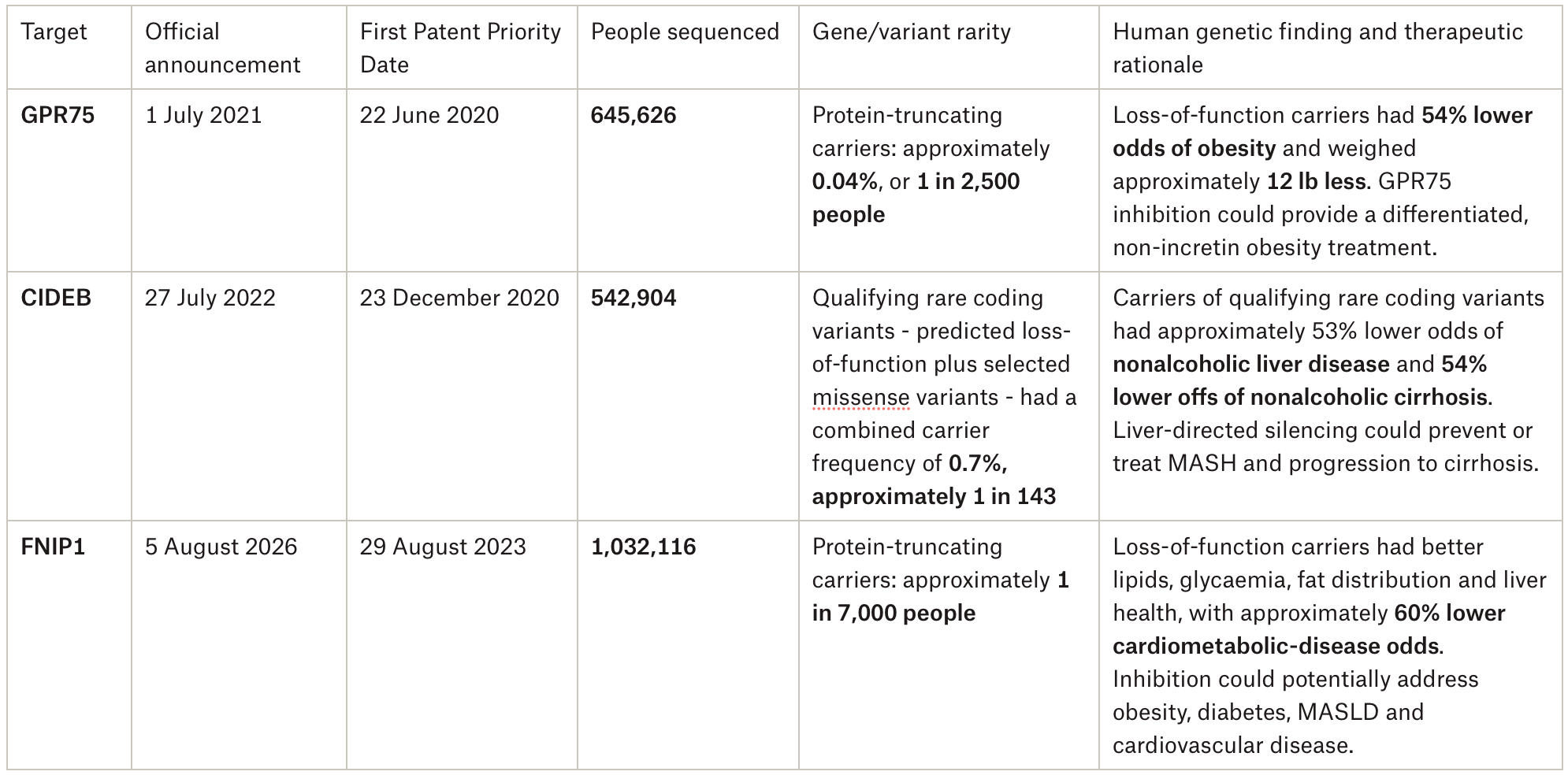
Of the publicly disclosed novel targets so far, these are right at the high-end in terms of dataset size (i.e. people sequenced). FNIP1 was discovered in a substantially larger analysis than GPR75 or CIDEB and is among the clearest illustrations yet of the returns from mega-scale sequencing. Homing in on Aris Baras’ non-linear benefits of scale point, it’s pretty interesting that the FNIP1 signal emerged from an analysis of over 1m people, and is arguably the most compelling novel target so far. They found ‘ultra-rare protein-truncating variants in FNIP1’ that were only present in 1 in 7,000 people - this is what Baras was talking about by the need to go big.
Bearing in mind that these disclosures only take place at a significant delay to the underlying work (directionally patent filings give us an extra clue here), we can only imagine what RGC is currently cooking with a dataset that exceeds 3m and is on its way to 10m+ and perhaps eventually 50m. I think it’s pretty exciting.
I’ve seen numerous murmurings in the last 12 months to the effect that REGN is past its best and should now step aside on R&D in favour of smaller, more nimble, more innovative biotechs (that’s the general argument). But show me the small biotech (or even large pharma for that matter) that is willing and able to assemble all the required infrastructure and partnerships and put into effect and analyse a database of 10m+ people’s exomes/genomes (and increasingly, proteomes) linked to de-identified patient health records. It’s a massive undertaking and costly in both dollar terms and years. Over the last 12 years RGC has built a vertically integrated population-scale sequencing factory. Frankly, it is hard to imagine anyone recreating the same integrated system quickly or easily. So far as I can ascertain (and in line with Baras’ comments), no competitor has publicly committed to building a comparably integrated, 10 million-person sequencing resource for its own R&D purposes - the nearest disclosed pharma program I can find is materially smaller. In this context, RGC scientists have led or materially contributed to many (actually, I believe, most) of the largest exome-wide association analyses published yet.
Getting a Head Start
Now, if RGC’s discoveries were to remain effectively secret, the IP advantage would be inarguable. But in practice, RGC has certain data disclosure commitments - to partners and to its own researchers (REGN has always encouraged its scientists to publish, in the spirit of the original Genentech model). Moreover disclosing major discoveries in the name of science is, no doubt, the right thing to do in REGN’s own terms (‘doing well by doing good’). But that’s not to say that all important insights leak out - I’m sure they don’t. Nevertheless, major discoveries do not remain internal secrets - they enter the public domain through eventual publication in scientific journals or might be inferred from disclosures made in patent filings. So I think the bigger questions here are something like:
How big of a head start can REGN get before actionable insights enter the public domain?
How quickly can they act on that head start?
Both Len and George have talked recently about the increasing difficulty of getting a head start before someone follows. But it also looks like they’re adapting and acting a little differently to how they used to.
With HSD17B13 in MASH, REGN filed initial target IP and then around a year later told the world about the discovery at the same time they announced the Alnylam partnership to find and develop an RNAi drug - in practice they didn’t have much of a head start. And indeed, Arrowhead caught up very quickly. By GPR75 and especially CIDEB, REGN seems to have learned to feed RGC discoveries into a standing therapeutic-development machine privately, file both target-level and molecule-level IP, and only then publish the target. FNIP1 potentially takes this one step further, with almost three years between the earliest patent filing and the full scientific publication. Importantly, the patent itself became public in March 2025, so the target was not secret for that entire period. Nevertheless, REGN had approximately 18 months in which the target and therapeutic hypothesis were not public, followed by another 17 months during which competitors (if they went looking) could see the patent but not the complete evidence eventually published in Nature. I could be reading too much into it, but one plausible interpretation is that they’re allowing themselves valuable additional time for translational work, discovery and pre-clinical development before potential competitors get a first peek at the science behind the target. And if you think about it, the larger the dataset underlying the discovery, the less likely someone else is to have arrived at the same independently. FNIP1 took a million people vs 47,000 for HSD17B13. I suspect, at 3m+ people, REGN could have increasingly more headroom to act in the absence of competition.
And the same goes for target validation. Patents become public around 18 months after filing. And in these patents REGN leaves a trail of breadcrumbs around the target in question. At the very least patents can point competitors in the right direction and they can try to validate the target independently. But when variants become increasingly rare, independent validation becomes impractical in the absence of access to a massive dataset. The informational asymmetry grows as the variants get rarer. Taking it to the next extreme, suppose that RGC discovers a spectacular protective gene that’s 10X rarer than with FNIP1. The approximate carrier numbers become (illustratively):
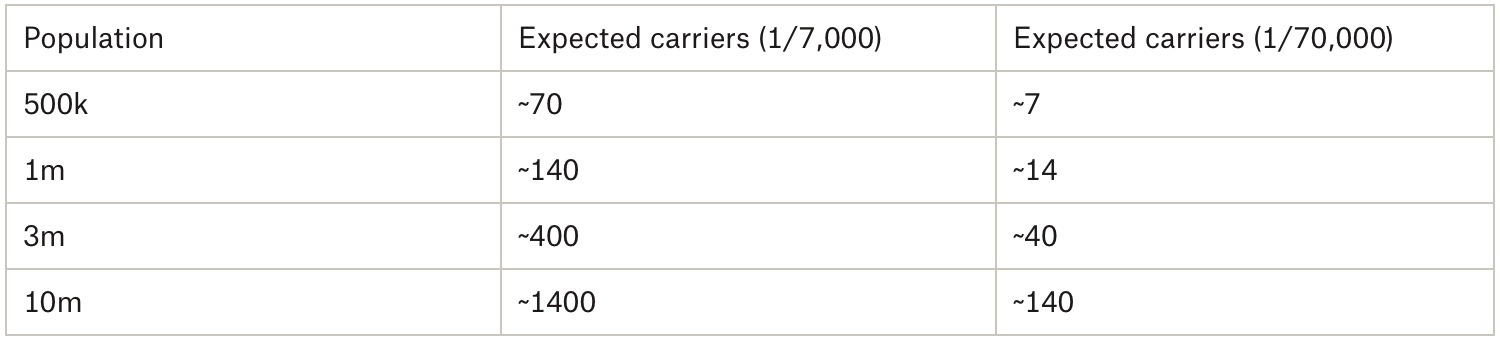
Carrier numbers themselves increase linearly with cohort size, but the practical discovery benefit can be non-linear: an additional increment of scale can move a gene from statistically invisible to convincingly associated. At sufficient scale, RGC may have a significant window where it is the only group able to observe an ultra-rare association with persuasive statistical confidence (effectively a temporary monopoly on human-genetic insight). Until the complete evidence is published, competitors may be unable to reproduce the human genetic case - even if they can begin investigating the target through patents, public datasets and their own experiments.
Certainly once the translational work is sufficiently advanced we can assume that REGN can act expeditiously with their own VelociSuite antibodies, should the target in question be amenable to that approach. I think this is also the case with RNAi now via the Alnylam partnership - e.g. unlike HSD17B13 REGN appears to have a substantial head start on CIDEB, with their Alnylam-partnered molecule now in phase 2 (and no competitors in phase 1 yet, so far as I can see). In a similar vein, you can see REGN pushing the partnership strategy into further novel modalities to ensure they always have ready access to the appropriate technology (I find the new Parabilis partnership particularly intriguing in this regard).
Final Thoughts
Per Baras’ recent comments, RGC/REGN have put 50 RGC-discovered targets into actual pipeline programs (that’s +20 in the last two years, by the way). But in the clinical pipeline we can see only a small handful of these - the tip of the iceberg. There’s a lot that they just haven’t told us yet. Separately, my review of the public patent record identified at least 13 additional novel, genetics-derived targets around which REGN has filed patents, but for which it has not published detailed scientific evidence. That is a floor rather than a complete count - applications filed since February 2025 (give or take) will generally not yet be public. Patent filings do not, of course, prove that every target remains part of an active pipeline program however.
RGC practically never comes up in the general investment discourse on REGN - even for those who know about it it’s much too jam tomorrow to be considered relevant in a market environment that operates from quarter to quarter. But it is highly relevant in my view: a unique hard-to-replicate asset that 1) regularly turns out compelling novel drug targets and 2) whose capability and informational advantage only compound further over time through scale. In practical terms for investors, if RGC/REGN can in the coming years demonstrate 1) a consistent pipeline of compelling novel RGC-derived programs converting to the clinic and 2) a consistent ability to exploit their head start, then I think RGC will be difficult not to notice. I suspect that RGC’s increasing scale as well as the facilitating platform partnership approach make this more likely than not. So my contention is that if/when RGC does eventually enter the discourse as an obvious durable advantage, investors may have to revisit conventional thinking around terminal value.
But let’s not forget the sceptics: scale alone does not make medicines. Rare-variant associations may ultimately prove undruggable or intractable, target-level patents might be designed around, most pharma development programs fail and RGC has not yet contributed much revenue. Those caveats might explain why investors discount RGC - but not, in my view, why they should largely ignore it.
Thanks for reading.