

Welcome friends of NFTBC.
For newcomers, please check out our introduction for more context about this substack.
To borrow loosely from an old Buffetism, we’re going to be kissing a few corporate toads at NFTBC - some of them are going to turn into princes, but some sadly won’t. Like everyone else, obviously I want to own stocks that are going to go up at some stage. But the reason I set out to take NFTBC in this particular direction is simply because I find it fun and interesting and I’m hoping you will too. Who wants to read the umpteenth write-up on Ferrari? Everyone and their grandma knows it’s a great business, so to hear it over and over gets tiresome.
Now, the next toad I’ve decided to kiss is BMW. I know, I know, legacy automotive is about the most toad-infested swamp to fish in at present - we’ve got trade wars galore, recessions here (US?), weak consumption there (China), state-sponsored competition (China), generational disruption from the transition to BEV. You name it. But for better or worse, I believe that BMW is a grotesquely under-appreciated business with bright long-term prospects. And while I’m not going to give you the full thesis today, I will give you part of it: Rolls-Royce Motor Cars, a wholly-owned BMW subsidiary. In fact, dare I say it - I believe Rolls to be of comparably regal qualities to Ferrari.
Roll-Royce Motor Cars
Comparison with Ferrari
We’re not doing a deep dive here, so I’ll get right to it. Here’s Ferrari’s actual annual shipments in the last 10 years, shown against Rolls’ actual shipments. Additionally, we have Ferrari’s actual reported revenue against my estimate for Rolls:
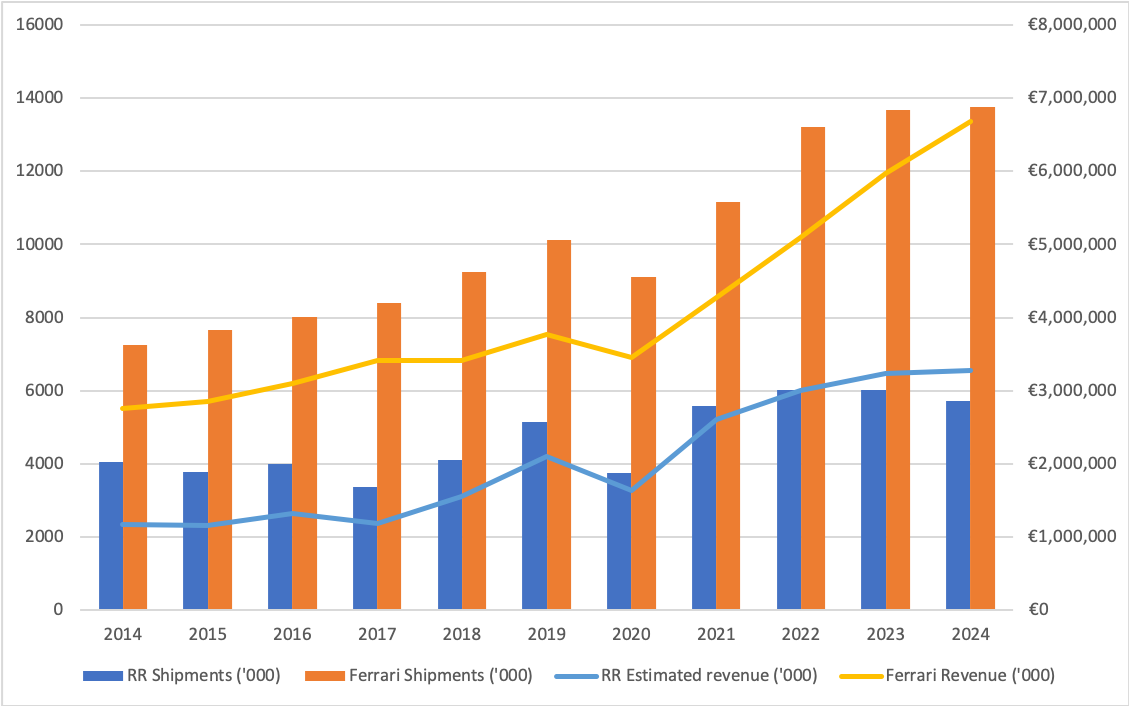
Next a little context. We don’t actually know how much revenue Rolls-Royce produces for the BMW Group, we only know the shipment numbers. However, Rolls’ previous CEO did tell us that in 2022 the average selling price for a Rolls was €500,000 compared to €250,000 in 2012. So what I have done above is simply multiply 2022’s shipments by the ASP and worked it out from there. It won’t be 100% precise, but it definitely can give us a good sense of underlying trends. Also note that Ferrari’s revenue figure includes things like sponsorship and spare parts, but Rolls’ does not. Let’s look at some of the data another way:
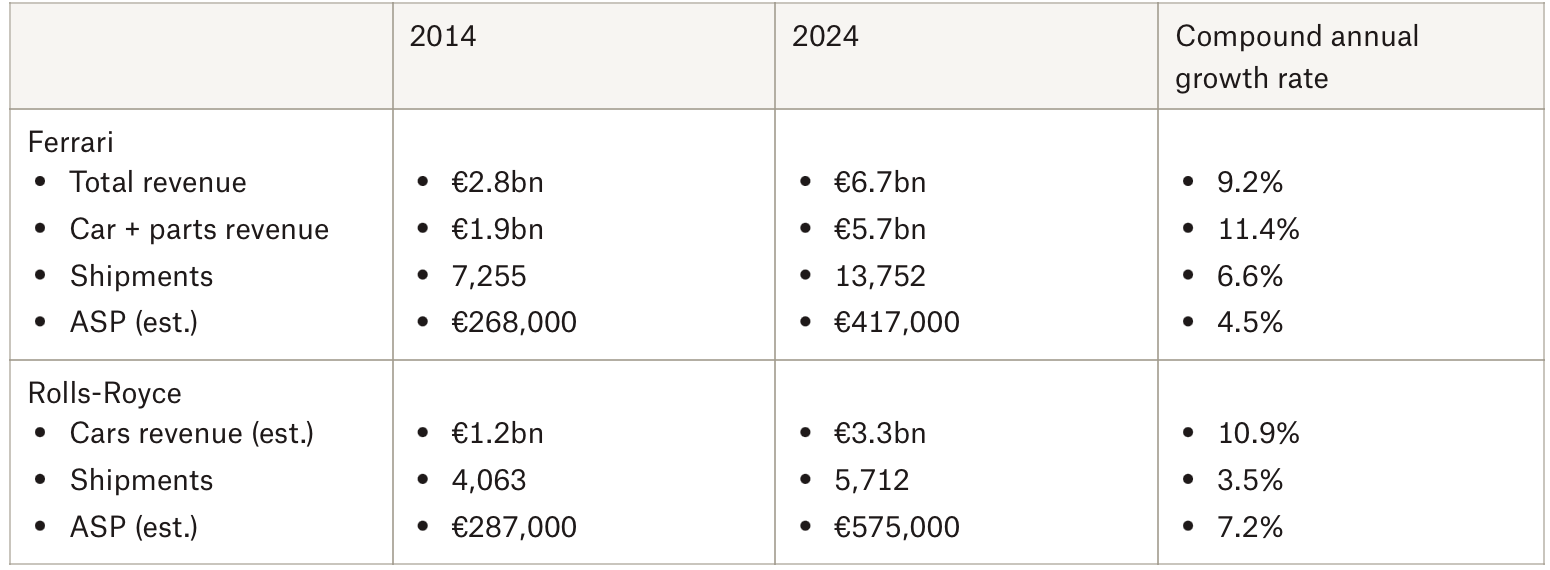
It seems as though Ferrari and Rolls have grown their top lines at pretty similar rates over the last decade. The main contrast is that for Ferrari, volume has done a bit more of the heavy lifting, whereas at Rolls ASP has done more of the work. Both volumes and ASP are legitimate levers to pull, except that one has to be extra careful not to pull the volume lever too hard such as to risk reducing “scarcity”. And there’s no question that both brands have arrived where they are through scarcity. Other things being equal, ASP is the better level to pull. Yes, you can achieve economies of scale through volumes, but higher pricing can be remarkably profitable while keeping volumes lower preserves scarcity. Needless to say, to realise extraordinarily high ASPs, you need to offer your clientele something they find extraordinarily desirable. Like Ferrari, Rolls maintains scarcity value through tactics such as invitation-only products and services. And while Ferrari’s unique identity is wrapped up in the “Prancing Horse” and the brand’s racing heritage, the name “Rolls-Royce” is itself synonymous around the world with the “very finest” or the “absolute pinnacle”.
Some might ask if Bentley is the better comparator for Rolls-Royce, given their similar luxury British heritage. I would argue no. Bentley actually disclose a lot more information than Rolls and we know that while they have similar volumes to Ferrari, their revenue is no higher than Rolls’ - i.e. their ASP is only in the low €200,000s. It’s still enough to make Bentley a very nicely profitable business with operating margins of around 20%, but it’s not Ferrari-style profitable with 30% operating margins. We don’t know how profitable Rolls is, but we can guess.
Profitability
Here is the 2022 income statement for Rolls-Royce Motor Cars Limited, BMW’s UK-based subsidiary that actually hand-builds the cars in Goodwood (accounts obtained through UK Companies House):
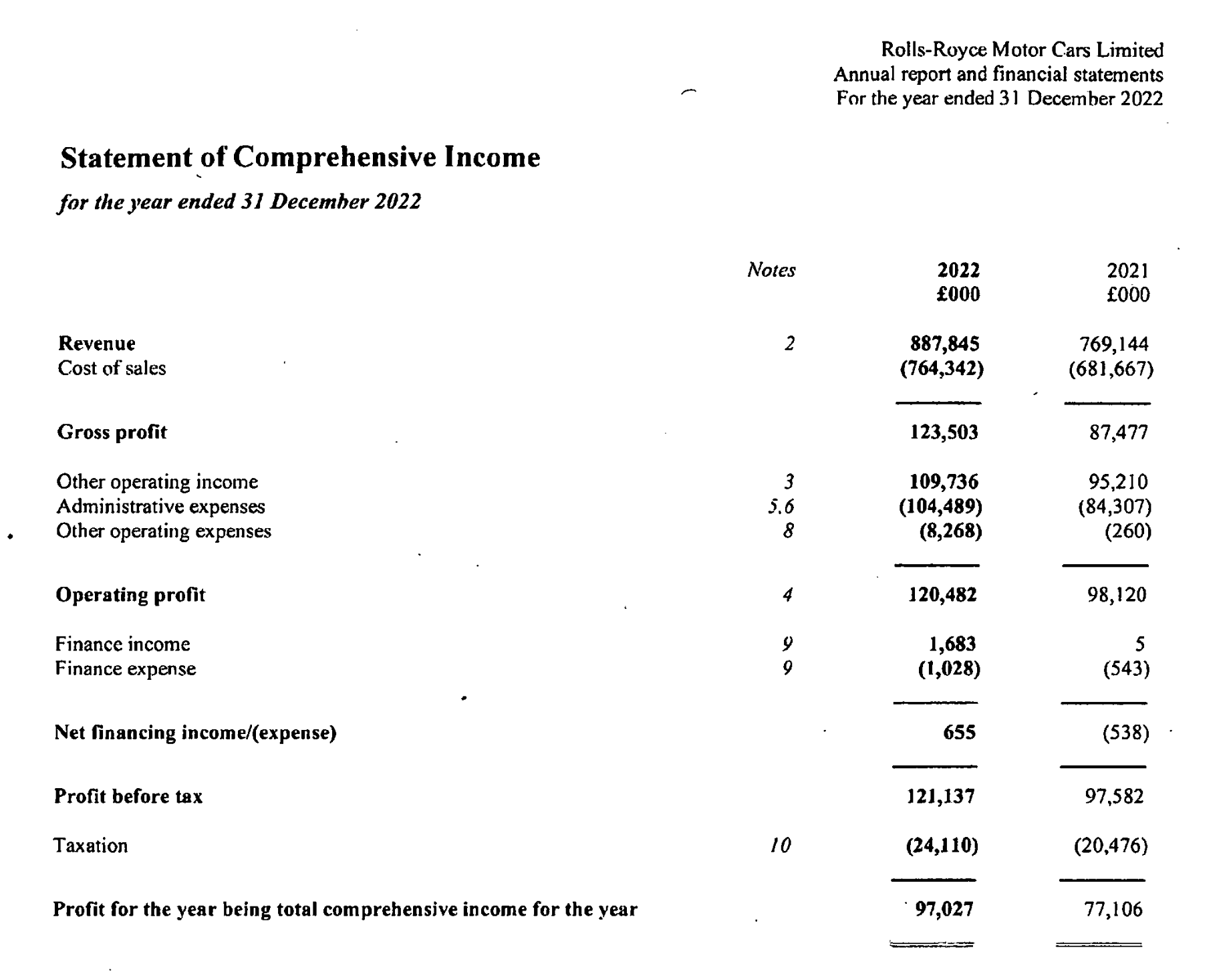
First of all, don’t be led astray by that revenue number - this subsidiary has, by its own admission, essentially one customer and there are no prizes for guessing who that is. Neither will there be any prizes for guessing that the revenue figure here does not include the final markup. What I’m more interested in is that “cost of sales” figure. That £764m includes £100-odd million of payroll, plus materials, parts and various other costs of business and production. And if you work it out, it puts the gross margin on Rolls’ car sales at around 70% - which is as high as über luxury house Hermès! 70% is most likely too high though. For example, a sizeable chunk of the cost of sales is certainly BMW-manufactured components without any markup applied. We can’t ultimately know what Rolls’ gross margin is, but Ferrari does 50% and I bet you it’s higher than that. Here’s why: 1) Rolls’ ASP is significantly higher and 2) shared economies of scale with BMW. For example, petrol-powered Rolls-Royce cars use engines from higher-end BMWs, while the electric Spectre shares technology with the BMW iX and other electric variants. Moreover, BMW’s architecture strategy allows for a high degree of component sharing among its products from high-end to lower-end. In other words, Rolls-Royces are likely to contain many components that are mass-produced for or by a company making 2.5m cars per year. But that’s not to say that everything in a Rolls is mass-produced - far from it…
Bespoke
A “standard” Rolls is a huge upgrade from even BMW’s own opulent high-end offering in terms of materials and comforts. Customers can choose from an enormous array of configurations both external and internal to make their car their own - for example, do you want your “Spirit of Ecstasy” made of silver, gold, carbon fibre? No problem!
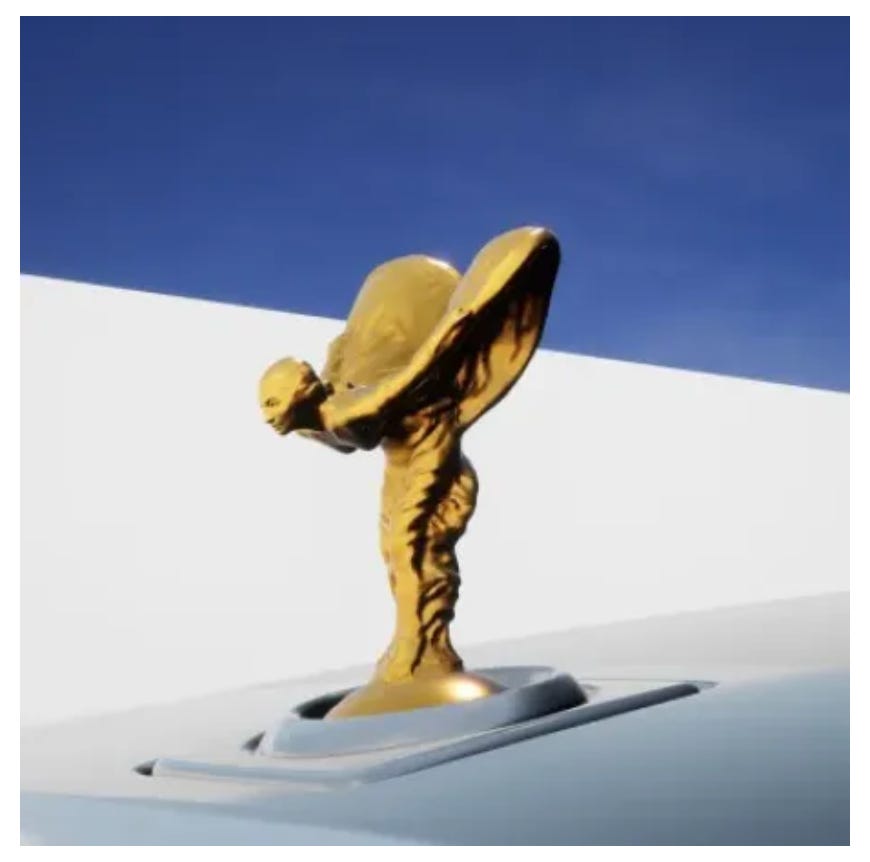
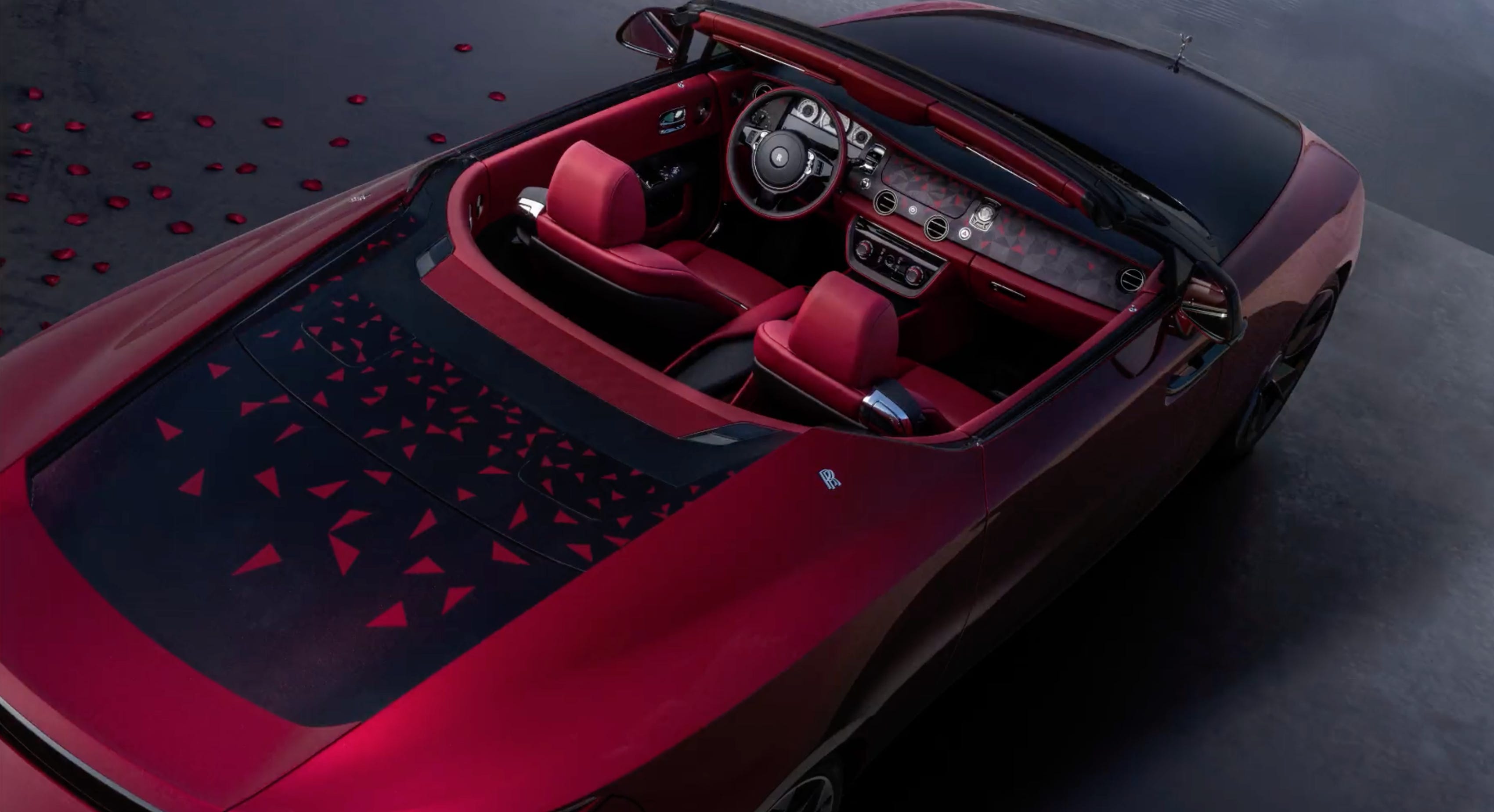
You can have a go at configuring your own Rolls here. And we haven’t even talked about “Bespoke” yet. You can go into a Rolls Royce Private Office and talk them through exactly what you want done to your Phantom or Spectre - hand-stitched this? Wood-carved that? Spirit of Ecstasy encrusted with diamonds? They’ll happily do it for you - at a price, of course. And then there’s the ultimate - “Coachbuild”. By invitation only, Rolls-Royce will craft a unique car just for you, under your full supervision. One of these is reportedly around $30m, for example:
The Future
In 2021 Rolls announced its intention to go fully electric by 2030. Even BMW has been sceptical of those pushing too fast in transitioning to electric, and rightly so. But at Rolls, it actually sounds like a great idea. Here’s what the press release said:
A PROPHECY FULFILLED
The use of electric motors is not a new concept for Rolls-Royce. Sir Henry Royce was fascinated by all things electrified, and his first venture, named F. H. Royce and Company, created dynamos, electric crane motors and patented the bayonet-style light bulb fitting.
However, it was Charles Rolls who truly prophesied an electrified future for automobiles. In April 1900 he experienced an early electric motor car named the Columbia and declared its electric drive to be ideal.
Rolls said, ‘The electric car is perfectly noiseless and clean. There is no smell or vibration, and they should become very useful when fixed charging stations can be arranged. But for now, I do not anticipate that they will be very serviceable – at least for many years to come.’
Charles Rolls’ prophecy has been the subject of constant consideration during the marque’s Goodwood era. But we have not been satisfied that available technology could support the Rolls-Royce experience. Until now.
Now is the time to change the course of the future of luxury.
And so, near the end of 2023 Rolls-Royce began shipping the Spectre, the first electric model. So successful has the launch been that by the end of 2024, the Spectre accounted for 1/3 of Rolls’ entire shipments! For some context here, among other manufacturers BMW is a BEV leader, having launched its first (the i3) in 2012 - and it’s taken them 14 years to get to 17.4% electric sales, although admittedly the transition has accelerated lately. But Rolls’ electric transition is remarkable and by all accounts they are delivering on the promise. Per Harry Metcalfe, one of the most widely-watched automotive Youtubers:
I think it’s the first electric car that I’ve driven, from a manufacturer, that actually enhances the experience; what I expect from that brand. So for Rolls-Royce, I think electric is going to offer them a wonderful future. It absolutely suits the car. It’s the first car I’ve driven that is improved by being electric
Harry is a renowned critic of electric cars, so coming from him - I was genuinely surprised to hear praise so high. And by all accounts Harry is not alone - the Spectre’s reception has been incredibly positive. As Doug Demuro aptly puts it, the Spectre is “the Rolls-Royce of electric cars”. It’s pretty easy, therefore, to view Rolls-Royce’s electric future as a very bright one.
Not coincidentally, Rolls recently announced a £300m investment in its Goodwood production facility, the largest since BMW opened it in 2003 - in part to expand Bespoke and Coachbuild capabilities and in part to ready Goodwood for the ongoing electric transition. It will be instructive to see how volumes evolve in the coming years. We already know that Rolls’ maximum production capacity is roughly 6,000 cars per year and they’ve been producing at or near this ceiling for several years. Admittedly, 2024 was a little lower but, by their own admission, this was primarily due to planned product transitions.
Circling Back
So it looks like Rolls-Royce is a business growing revenue at a comparable rate to Ferrari, it’s probably more profitable and it may even be increasing its profit margins at a greater clip due to ASPs. Moreover, Rolls has now emphatically confirmed its relevance in the world of electric. I assume Ferrari will too, but it’s perhaps more of a risk for them at this stage given the tight association between the brand and its engines - they launch their first BEV this year.
So I ask: why shouldn’t Rolls-Royce be valued in a similar way to Ferrari? It’s a theoretical question, given that BMW is unlikely ever to divest the brand, but interesting to ponder nevertheless. And with Ferrari trading in the region of 10x revenue, that would put Rolls-Royce in the region of €33bn, representing about 2/3 of BMW’s market value 👀.