


You can complain because roses have thorns, or you can rejoice because thorns have roses
- Jean-Baptiste Alphonse Karr
WPP has been a persistent thorn in my side since I first wrote about it in February. It had looked to me at the end of 2024 as though financial performance was turning a corner, but events this year have proven otherwise - no question. At the start of the year I had been expecting like-for-like revenue growth somewhere in low-single digits, along with continued operating margin expansion. Instead they’re now guiding for -3 to -5% on the revenue side and a 50 to 175 bps contraction on the margin side - and at this stage, we don’t even know if they’ll meet this fresh hurdle. Part of this is due to the ‘macro.’ Uncertainty around tariffs is a real thing that impacts client spending. But WPP has also continued to lose net media business to Publicis - more than had been anticipated.
As far as stocks go, WPP has been a pretty disastrous one - I shan’t dress it up any other way. I do intend to keep writing about it occasionally though. It’s not a major exposure for me or a higher conviction, but as a case study on the current AI-driven upheaval unfolding round the world, it’s of great interest in my view. The general assumption is that WPP is cooked. The game is up. Short of a miraculous turnaround probably entailing a swift pivot to the same data strategy of arch rival Publicis, WPP should be broken up for parts and sold. This is the current narrative.
My view is somewhat different. In the deep dive I described how WPP’s approach was to be a disruptor rather than the disrupted, through its differentiated internally developed WPP Open suite:
WPP has built a single ‘marketing operating system’ software stack that powers all of WPP’s businesses - it’s called ‘WPP Open’. Moreover WPP Open is customisable and available for use by clients as well, effectively as their own ‘white label’ workspace. Open is comprised of core ‘Studios’ - Creative, Production, Media, Experience, Commerce and PR, designed to support the end-to-end workflows of WPP and its clients in a way that allows for integrated ways of working across the company and its functions.
And:
As you can imagine, they’ve built a lot of automation into WPP Open in order to make workflows more efficient, while users also have access to the best LLMs (across providers). But one area where WPP has really set itself apart is through the creation of proprietary ‘brains’ Per CTO Stephan Pretorius:
We sat down together and understood that marketing is effectively a four- part algorithm. You're connecting consumers to brands through content and channels. And so by encoding those four concepts into custom AI agents or Brains as we call them, we are now able to bring the power of AI to the entire marketing supply chain in a very structured way.
And it’s not just AI window dressing - they’ve actually built this and it’s in full deployment. It’s impressive:
More recently in May, I talked about WPP’s differentiated data strategy which has only really come together in the last several months. I also talked about how CEO Mark Read’s window of opportunity was closing rapidly before he would be likely to be deposed.
In the event, and several weeks after my May post, WPP announced that Mark Read would retire at the end of the year and that the search was on for his successor. Speculation about candidates began immediately and even the bookies started taking bets. But then, the day after the disastrous trading update, WPP announced the successor, to start on 1 September: Cindy Rose, a wildcard no-one had been expecting.
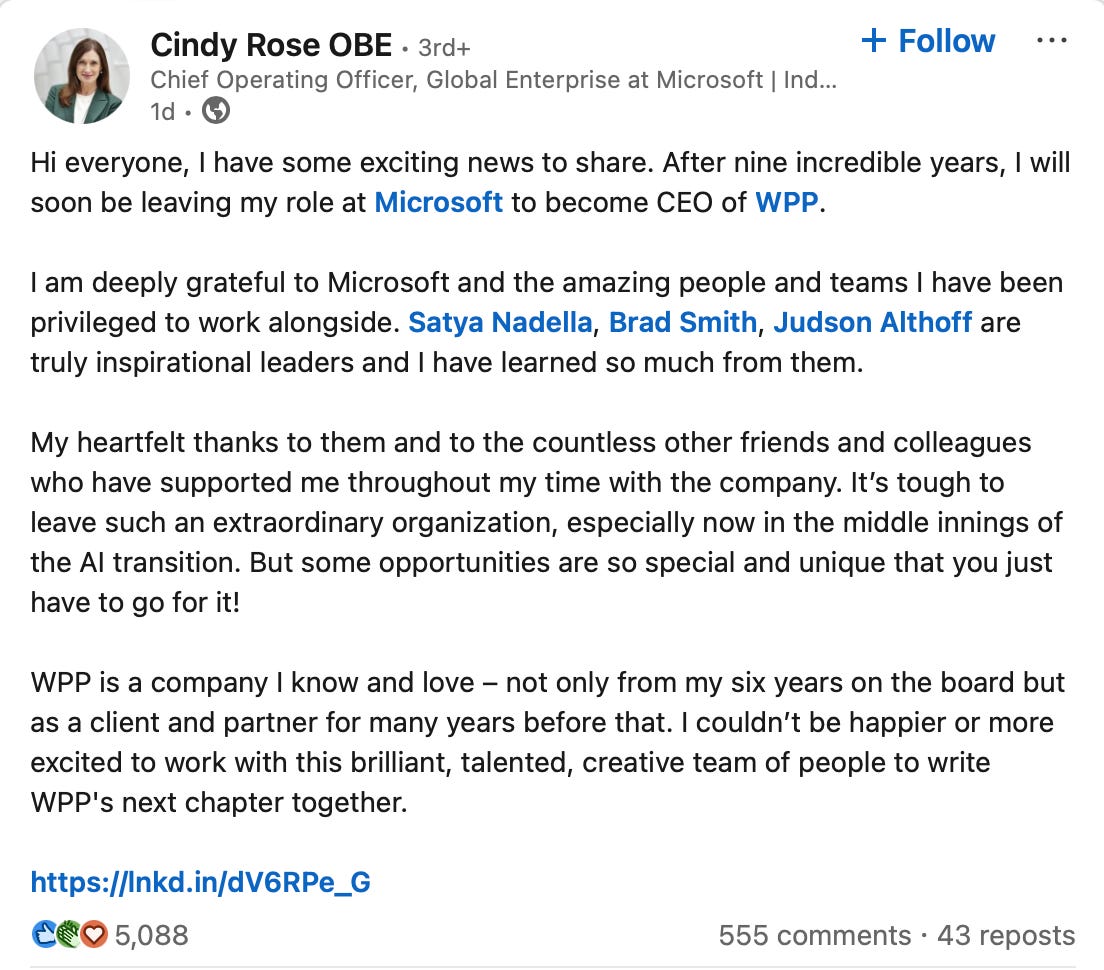
Rose, has spent the last nine years at Microsoft, most recently as COO of Global Enterprise Sales, but she has also been on WPP’s board since 2019. While I don’t know a great deal about Rose at this stage (please let me know if you have anything notable to share) - I am intrigued by the choice. WPP is, in effect, trying to reposition itself as a software and technology solutions provider, albeit alongside its more traditional creative services offering. So there’s certainly some kind of sense in having someone with deep experience in enterprise software sales and getting traction with the relevant budget people in C-suite. Moreover, having been on the board for six years, Rose has been party to all the discussions and decisions that have carried the WPP Open strategy this far. In other words, it’s looking unlikely to me that we’re going to see a pivot to the Publicis strategy or a breakup. Some version of a continuation of the WPP Open strategy, but presumably with adaptations looks like the stronger bet. I’m really curious to see where it goes.
Despite the positive indicators towards the end of 2024, the WPP Open strategy is clearly not working. But is that because it will never work? I don’t yet know the answer to that question, but what WPP is attempting makes a great deal of sense in theory. If they can get it right, then the company’s fortunes could change quite dramatically - client retention, revenue models, economics.
Here’s Rob Reilly, WPP’s Chief Creative Officer speaking after Cannes last month:
We’ve won the Creative Company of the Year title three out of the four years I’ve been here. So yes, it matters. Especially when it serves as a reminder that Mark Read was a CEO who believed in creativity as a growth driver. He invested in people, in creativity, and in AI. Looking back, despite the stock price, I think he will be recognised as a visionary in modern marketing. It’s disappointing that he’s leaving, though it was his choice. He fought the good fight and, in many ways, won.
As always, get in touch if you have any comments or quesions.