

Friends of NFTBC.
A very happy new year to all and wishing you the best for 2026! To mark Notes From The Beauty Contest approaching its first year, and to bring in 2026, you can get 20% off the usual NFTBC annual subscription during the month of January.
In this review, the plan is to provide a rundown of the various stocks I wrote about in 2025. We’ll briefly cover what has happened so far, take a quick look at the thesis and then go over a few thoughts for 2026. In the second part of the review, full NFTBC subscribers can see my current portfolio weightings of these names as well as my 10-year track record from looking at stocks in this particular way.
Before we get to that I thought it might be interesting to begin with a discussion of NFTBC itself - some of the learnings so far and thoughts about future direction. In early 2025 I found myself suddenly out of work, having previously been an analyst with a global large cap fund for many years. Perhaps a story for another time. But rather than looking for another job, I decided to start Notes From the Beauty Contest, named after Keynes’ analogy of the newspaper beauty contest - which I took to be the central dynamic at play in equity markets at that time. You can read what I wrote here, but the basic point is captured in these words:
It matters not what a company’s prospects offer for the years ahead, but instead what investors think that other investors think are the key datapoints and considerations from one quarter to the next.
It becomes easier to explain (if not fully comprehend) the increasingly wild volatility around earnings and other events once you consider the third and fourth orders of second-guessing. This beauty contest dynamic seems equally true today as it was a year ago.
One option, of course, is to throw yourself headfirst into the game. Some investors appear to be particularly adept at it, although I suspect perhaps not all that many. Another, is the approach ultimately adopted by Keynes himself - one of fidelity to a relatively small number of well-understood stocks (his ‘pets’) as a practical means of dealing with uncertainty. I find myself temperamentally suited to some version of the same. Where a business is doing something compelling and differentiated, and run by capable people, things frequently turn out better than expected (or not as bad as feared). I like to hang onto these sorts of names and let them work themselves out rather than trade them a lot. But I don’t shy away from changing the position size as things evolve - sometimes quite aggressively. If the risk/reward looks strong I like to own more, and vice versa. It’s also worth remembering that uncertainty applies to the upside just as much as the downside. I’m quite comfortable living with the uncertainty of not really knowing how things are going to work out. Conversely, for many, uncertainty seems to be the investment equivalent of Kryptonite - low visibility in the near-term is often not well tolerated. Tolerance for the uncertain combined with patience are two of my favoured tools therefore - and I have aimed to instil these into my research at NFTBC. But when stepping into the uncertain, it certainly pays to be in the hands of the right company management. Here is what I have written previously:
If investing is inherently uncertain, who is better placed to know what lies ahead than those most involved. So I believe that if you can find competent and credible management teams, you should take them seriously - especially when others do not.
The approach has worked relatively well for me over time, and we’ll get into some of that later on. I’m no preacher however - there are many ways in which to invest. This is merely what I do and I can only hope that others might be interested.
NFTBC started as an experiment. I didn’t know what to expect or if anyone would be interested. The success of some posts really surprised me - I had no idea that so many people would be curious about Regeneron, for example. Same goes for Bruker. I think those two, along with the recent Merck KGaA post, hopefully represent the best of NFTBC, so far. With the long BMW and PTC multi-part series, I think I went a bit off-piste and self-indulgent. While I enjoyed writing both, I think the appetite for that depth of research is more limited - particularly in a deeply unfashionable sector such as automakers. In both cases I think the first part was probably sufficient for most NFTBC readers. My main regret is the WPP post - or at least putting it out as my second post and in the way I did. The basic intention was to make a bold call, and to be right about it quickly in an ill-conceived attempt to gain some attention early on when I had very few readers (the WPP email had only 15 recipients) - that call proved to be hopelessly wrong. Moreover, making bold calls in quite this way has never been my modus operandi. I think it’s worth restating what I wrote in July some months later about what I wanted NFTBC to be:
A buy-side version of a sell-side note.
I’ll explain. It’s not a concise pitch of a ready-to-eat single-use investment idea. But neither is it unbiased long-form research with a near-term target price. It’s long-form research, but wearing a buy-side hat - and the hat of someone who considers himself a business owner, rather than someone jumping from one thing to the next. It’s the tortoise rather than the hare. I want it to be food for thought, to help you in your own research - perhaps today, perhaps next quarter, maybe even next year.
While it might look a bit like a pitch, it’s not really intended that way - I am spelling out the various ways in which I think the business can ultimately add value. But I’m not trying to persuade anyone about anything - you can use my research in whatever way is most helpful to you. In practice I may often own the shares myself, and I’ll always tell you if I do.
The approach will typically be more qualitative than quantitative. And while I’ll talk about valuation and some of the key considerations, there will be no sophisticated models and such things. I’ll also talk about timelines, roadmaps and turning points, but I won’t make firm predictions on shorter-term price moves or advise on entry points. I’ll be honest with you, I’m not much of a timing specialist and tend to be a bit early. From my conversations with you, I can see that you’re sophisticated investors - you have your own approaches to valuation and timing. While I’m happy to talk about such things in separate conversations, it won’t be emphasised in my research.
Next, a few other thoughts about future direction. Out of the professional habits of my last decade more than anything else, I’m still somewhat biased towards large caps and healthcare - thus far 50% of the stocks I have written about have been in the broader healthcare domain while the average market cap has been $40bn. I envisage exploring some more opportunities outside of healthcare and further down the market cap spectrum in future. I previously set a floor of $5bn, but I would like to reset this to the low single digit billions - merely to expand the opportunity set a bit further. I still want NFTBC to be relevant to professional investors managing meaningful amounts of capital, so I won’t push further into the world of small caps and beyond (and there are plenty of excellent writers working in that arena anyway).
Beyond this, I’m still experimenting and open to feedback (get in touch) - NFTBC will continue to evolve. One such evolution is The NFTBC Digest, a semi-regular email that goes to full subscribers only.
One other thing that’s going to change is disclosure around my own portfolio weightings to NFTBC stocks - for full NFTBC subscribers only. While I write about numerous stocks, I don’t necessary have equal excitement about each. I think the easiest way to convey the distinction, is simply to show you what I’m up to. If I was in your shoes, I’d probably want to know the same - it’s a reasonable expectation. I was somewhat reluctant to do this at first, for two reasons. First, I didn’t want disclosure to change the way I invest. I think that one of the available means to doing well over time, is to have the luxury of not caring what other people think - and this is particularly applicable to personal accounts. Second, I didn’t want to run any risk of NFTBC turning (even unwittingly) into some kind of portfolio service, as opposed to a research service. These two issues are still on my mind, and I haven’t come up with the right resolution yet. But I’m thinking disclosure will be relatively infrequent and periodic, rather than live trade-by-trade updates. I will tell you if I’m adding or reducing though - which I have started doing anyway.
Beyond that, I just want to say thanks to all NFTBC readers, both free and paying. Thanks for reading and sticking around. I hope to produce some interesting content for you in the months to come.
Stocks
Let us now talk about stocks - in the order that I first wrote about them. I’ll do a quick recap of 2025, provide a brief thesis (follow the links to go deeper) and set out a few thoughts for 2026.
[NFTBC does not give advice - please do your own research. I currently own shares in each of these names]
Regeneron
Reflections on 2025
When I published the deep dive at the start of February, I was excited about REGN’s valuation and future prospects, but uncertain about what might transpire in 2025 with the entry of Eylea biosimilars. I mused that REGN shares could drop another 25% before reaching the bottom - just like they did during the last Great Eylea Scare of 2019. In the event, they dropped 28%, although not entirely due to events I had foreseen - instead, persistent delays to important supplemental approvals of Eylea HD in the US due to regulatory issues with REGN’s third party filler (Catalent). REGN’s market cap plunged close to $50bn in June - making for an absurdly low enterprise value once you include net cash of approximately $15bn.
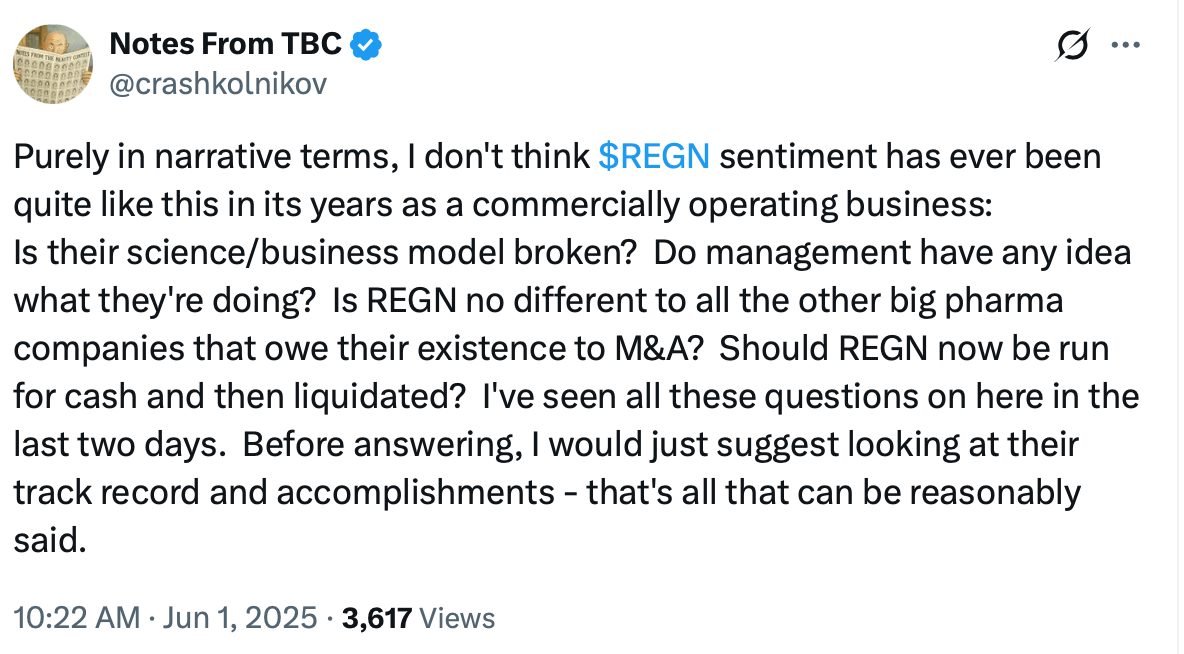
But Eylea aside, REGN actually accomplished quite a lot in 2025 including breakthrough data in adjuvant CSCC, highly differentiated data in gMG, Proof of concept in preserving lean muscle in GLP-1 induced weight loss, phase III wins with novel allergy therapies in areas of high unmet need - I could go on. Additionally and for the first time, REGN started to host investor round tables and we learnt more about the scale of their ambitions in Factor XI and multiple myeloma.
In the end the shares closed the year up around 15% from where I published.
Thesis
REGN has arguably the most productive drug R&D engine in the industry - over the course of the last 15 years, REGN-invented and developed drugs have grown from effectively nil revenue to almost $30bn annualised. I think they’ll do better than that in the next 15 years, and keep more of the economics than in the past. Combined with a low valuation (2026 consensus unlevered P/E of ~12.5x), this gives the shares high optionality. While it’s impossible to predict precisely how well REGN will do in future, if you can live with the uncertainty it’s quite compelling in my view. Read more here (paywall).
Thoughts for 2026
I’m now a lot more positive on REGN than I was a year ago - the Eylea bogey will be easier to beat this year and after much delay the missing Eylea HD approvals are finally coming into view. This gives Dupixent, Libtayo and lower Sanofi reimbursement payments (from Q3 onwards) the opportunity to contribute meaningfully and for earnings to grow faster than currently forecast (i.e. consensus is probably too low). There will be plenty to look out for in the pipeline too - most notably the late-stage fianlimab readout. Last, the outlook for 2027 is highly favourable and I assume investors will start to discount it at some stage this year.
WPP
Reflections on 2025
WPP is certainly one of my worst stocks in all my years of investing. The shares are down 50%+ since I published the post at the end of February 2025. The gist of what happened is that WPP lost a whole series of client retention pitches to rival Publicis - and certainly in a way that was wholly unexpected at the start of the year. And this all coincided with ramping investment in WPP’s internally-developed marketing tech platform ‘WPP Open’. The result has been a collapse in operating profit in a year it was supposed to be flat and on a path to acceleration.
I remain highly suspicious of the common narrative going round that WPP has been rapidly disrupted by AI. I think the explanation, for now, is more prosaic. Specifically, Publicis has had a much more compelling pitch to make to clients in 2025 - especially in media due to its data assets. It also helps that Publicis has a much more client-obsessed CEO than WPP’s former head Mark Read. Business Insider sums it up well with this anecdote:
During the pitch process this year for Mars’ $1.7 billion media business — before Rose was in-post as WPP CEO — the confectionery giant summoned all the agencies involved to meet on a cold January morning at the M&M’s Store in central London.
Sadoun [Publicis CEO] turned up about an hour earlier than the scheduled time. The Mars clients hadn’t arrived yet, and the doors to the store were locked shut. He waited outside on Leicester Square. Once Mars’ marketing team arrived, Sadoun greeted them, and they duly invited him in for coffee — much to the chagrin of the competing agencies, who weren’t able to take advantage of the opportunity to get extra face time with the clients. Mars this summer moved its media account from WPP to Publicis.
While it would have been impossible for anyone to predict the scale of the client losses, I could have been more on top of the general industry perception around the WPP/Publicis media dynamic. In effect, WPP is proposing to change industry practise with a new data strategy altogether - through inertia, clients have remained sceptical until they’ve taken the plunge and tried it, and until then Publicis remains king. What I still don’t know is whether I’m simply flat out wrong or just much too early. In any case, what I took to be signal initially, turned out not to be. But I’ll be honest with you - for all the ongoing risk of appearing like an imbecile, I’ve still got a hunch it might work. I remain intrigued, or curious at the very least. But mere hunches, of course, should be sized appropriately. Over the years I can think of at least a couple of situations where a minus 50-60% ultimately worked out quite well for me in a relatively short timeframe (in each case via acquisition) - but this is most likely the exception rather than the rule. We’ll see…
If there’s an investing lesson here, it’s something like this: the greater the departure envisaged from a company’s recent trajectory, the greater the confidence you need in management to pull it off. I placed more confidence in former CEO Mark Read than the evidence justified. Perhaps Read’s strategy will prove the critics wrong in the end but he was too optimistic or naive on the timeframe (as was I).
Thesis
While there’s little question that WPP gives off vibes of a raging dumpster fire, if you look more closely it’s also the most forward-thinking of the agency holdcos, having reinvented its business around an internally developed end-to-end marketing automation platform - a platform available both as self-serve or as a hybrid managed service alongside creative talent. So the bull case is that WPP will emerge from the AI revolution as an unexpected winner, by taking advantage of the paradigm shift to upgrade its business model away from billable hours and more towards technology fees and outcomes. If WPP can return merely to 2024’s levels of profitability it would be trading at ~4x earnings. Currently >80% of analysts have WPP rated at sell or hold. Perhaps that’s for good reason, but if WPP does anything other than shrink, the shares could do quite well. To learn more (or just have a laugh at my comically bad timing) my WPP posts are free to read here.
Thoughts for 2026
My working assumption is that WPP will be acquired before long, given the distressed price tag - probably by private equity. While I’d prefer this not to happen (so we can see things play out), it potentially puts a floor under the shares as there will come a time when private equity simply cannot resist. Come what may 2026 should be fun to observe and I expect we’ll gain greater clarity on the direction of travel after new CEO Cindy Rose outlines her strategy. If WPP remains independent, I plan to write an update in the coming months and I have some thoughts percolating about that.
Bruker
Reflections on 2025
The Bruker deep dive went out in mid-April. At the time, and much like REGN, I was very constructive long-term but highlighted the nearer-term reservations and potential headwinds - specifically around NIH funding and US border tariffs. What I hadn’t anticipated was the sudden severity of the funding crunch or, for example, 40% tariffs on Switzerland 🤨 (where BRKR has much of its manufacturing capacity). Neither did I foresee the second-order consequences of the delays to release of China life science stimulus funds as a precaution in response to US tariffs - all of this put BRKR’s margins in a tough spot for a couple of quarters, resulting in a dilutive equity raise in order to prevent debt covenant breaches. Things escalated pretty quickly and we saw reflexivity at work - BRKR is now worth slightly less as a result of having a weak share price at the time of the share issue. Nevertheless shares ultimately closed the year up 24% from where I published in mid-April.
Thesis
BRKR is massively under-earning on operating margins - about 13% in 2025 against a credible ambition of mid-20s in the mid- to long-term. This is on top of mid- to high-single digit organic growth supported by leading positions in important growth markets: multi-omics, spatial biology, structural biology, specialist diagnostics, semiconductor metrology, superconducting materials etc. Mid- to high- teens EPS growth is likely to be sustained for an extended period, quite a bit ahead of consensus. Read more here (paywall).
Thoughts for 2026
With management committed to 300bps of margin expansion this year, things are looking much more constructive than 2025. The unknown is the revenue part of the equation but there are already some positives lining up including: 1) a series of major customer orders came in towards the end of 2025, 2) recent management comments around strong launches of new mass spectrometry instruments and 3) a possible thawing of the research funding environment in the US.
BMW
Reflections on 2025
My originally announced intention was to start publishing about BMW in mid-April - in the end I chickened out and waited until July. April was around the time of ‘Liberation Day’ - peak tariff uncertainty. I found it difficult to imagine anyone would be interested, but with hindsight it would have been the best time in terms of share price performance. By July, the trade situation was starting to settle down a bit and by the end of the month a US-EU truce was agreed.
In any case, BMW preferred shares were the best performing NFTBC stock from point of publishing in 2025 - closing the year up 30%. Other than tariffs the main 2025 events were the ongoing struggles in China and, more importantly, the initial launch of Neue Klasse - which went about as well as I could have hoped for.
Thesis
I believe BMW to be a much better business than almost all other legacy automakers. After major multi-year investments they’re about to launch 40 models in 2 years, with important differentiated technology advances (Neue Klasse) and significantly lower BEV cost base. I expect BMW to resume volume growth in the coming years and with lower fixed costs in 2028 vs 2022. Combined with share repurchases, BMW is perhaps a 7% EPS CAGR story from here relative to a single digit P/E. You can read more here for free.
Thoughts for 2026
While I’m excited on, say, a 3-year view, I think 2026 is hard to predict. My main reservation is China, which I expect to be an ongoing profitability headwind at least until Neue Klasse starts to ramp there in H2. It’s also unclear what impact new launches will have on the sales and profitability of older models during the ramp phase. On the positive side of the ledger, BMW will continue to ramp down investment levels in 2026 - positive for both margins and cash flow. Moreover, as the year progresses we’ll get more visibility into Neue Klasse launches, uptake and the pipeline - there’s a possibility this starts to snowball and informs investor expectations around valuation before the fact. For example, we heard recently that the first Neue Klasse model is already sold out in Europe for 2026. Then there’s the tariff situation - the EU Parliament is yet to ratify zero tariffs on US imports (important for BMW) as well as the looming Supreme Court decision. Should be a fun year.
PTC
Reflections on 2025
Having posted 3 months ago, I think this one needs time to play out some more. From the time of posting to the end of the year, the shares were down 14% and I indicated at the time that I was keen to do some averaging down if the shares were to suffer a setback. We haven’t got to that stage yet - but it could happen and I would actually like it to (other things being equal). As many readers will already be aware, we’re heading into 2026 with weak sentiment around software - to be continued.
Thesis
PTC has successfully evolved from a legacy CAD provider into an architect of the ‘digital thread’ with a market-leading portfolio in CAD and PLM that is now 95% recurring. The core thesis rests on a pivot from the portfolio assembly phase to sales execution: under new CEO Neil Barua, PTC is optimising its go-to-market strategy to unlock double-digit ARR growth through cross-sell, upsell, seat expansion, SaaS conversions and untapped pricing power. Further optionality rests in Onshape (think “the Figma of CAD” and you’re leaning in the right direction) and a structural advantage in AI deployment, where PTC’s Windchill serves as the incumbent system of record for many manufacturing businesses. With ARR growing ahead of costs as well as commitment to share count reduction, I think PTC is good for per-share free cash flow compounding in the teens as against a multiple of 20-21x. You can read more here (paywall).
Thoughts for 2026
The main thing I’ll be looking out for this year is progress in the go-to-market transformation from around the Springtime onwards - accelerating bookings. And the other thing to watch will be the ongoing rollout of AI features and more announcements around the AI strategy which will continue to evolve.
Merck KGaA
I’ll be brief on Merck seeing as it was only posted a month ago. The shares are up around 15% since the post but, much like PTC, I’d prefer them to go down so I can buy more (other things being equal).
Thesis
Merck is primarily a collection of ‘wonderful’ and ‘good’ businesses among Life Science, Healthcare and Semiconductor Solutions. As we head into 2026 only 2/3 cylinders are likely to be firing - investors are currently getting paid to take on some uncertainty risk around the Healthcare business which is perceived as the weak link. The good news is that Merck has a pretty solid strategy underway for fixing the Healthcare business. I see Merck as roughly a 7% EPS grower with an earnings multiple below history. Read more here (paywall).
Thoughts for 2026
2026 is a transitional year with group performance likely below potential while the company cycles increased investment levels in the Healthcare business, along with loss of exclusivity for one of its drugs. I’m actually more excited about 2027 - and one year is practically an eternity in the markets of today. We’ll see how things evolve, but any sudden loss in investor patience this year could provide a useful opportunity.