


Friends of NFTBC
With Cerebras’ stock now swooning like one of the great leading ladies of the Golden Age, it feels like the right time to temporarily drop the paywall on my original long-form post from May - do help yourselves if you would like:

We are, of course, in the midst of one of our occasional collective AI panics, and this is driving most of the activity - CBRS is by no means alone in its fall. The plan for this post is to share a few very CBRS-specific musings. I offer you no useful opinion on the remaining lifespan of the AI capex boom and such things. But what I do feel quite certain about is that, bubble bursting or otherwise, various important forces are at play and these are unlikely to be shunted off course in any significant way - perhaps even in the face of a capex recession. The genie is out of the lamp, and he’s not going back in.
First things first: to be able to see the CBRS bull case requires (in my view): A) an acceptance of the unique benefits of wafer-scale both today and perhaps even more so in the future, B) an acceptance that fast AI is going to be transformational, C) the realisation that CBRS’s primary business model is much closer to the recurring revenue model of a fully integrated AI cloud infrastructure provider like AWS or Google rather than a traditional chip/server business with customers placing discrete orders and D) an understanding that CBRS has ~$8bn of liquidity, giving it considerable flexibility to continue self-funding its expansion.
I won’t fully revisit A) here, having addressed it in various other posts but the central point comes down to the ‘thin pipes’ vs ‘fat pipes’ framework I talked about previously. The benefits to speed from minimising off-chip data movement down thin pipes are obvious and very significant. There are plenty of innovative approaches being pursued by chipmakers to widen the pipes between chips and chiplets, or bring memory and compute closer together. CBRS’s distinctive approach is to integrate a vast amount of compute and SRAM on a single wafer-scale processor, reducing the need to move data between separate chips in the first place. Moreover, wafer-scale could also benefit from advances in vertical integration and interconnect, with its large surface area offering considerable scope for many more additional connections. Smaller chips can exploit these technologies too, but CBRS uniquely gets to combine them with the advantages of its existing wafer-scale architecture. There are certainly some practical challenges to making wafer-sized chips economically and at massive scale, and consequently much of the CBRS case rests on whether or not you believe management can ‘execute’. For this reason, CBRS attracts plenty of scepticism. But, in all fairness, CBRS do have a solid track record in proving the sceptics wrong. I have little doubt that investors will continue to debate these issues for some time - so let’s just move on for now…
For the purposes of this post, I’m more interested in B), C) and D) and what they might tell us about how CBRS could perform if the AI capex cycle turns soon. One thought that I have been entertaining is the possibility that growth in the market for fast inference might not slow down by much, even if we were to enter some AI equivalent of the GFC. Today, fast inference is truly in its nascency - it’s barely started deployment yet, and not at industrial scale in any case. Only a minuscule percentage of users have even tried it yet. And only in Q4 2026 is CBRS actually starting to bring online material amounts of fast inference capacity, and this ramp will continue from hereon. And it’s similar for Nvidia’s new Groq LPX rack, which has only recently started production. The market for fast inference therefore is only really entering industrial scale production right about now. And it’s my contention that fast inference will transition very rapidly from ‘expensive gimmick’ » ‘nice to have’ » ‘essential’.
In my mind, I keep returning to the example of the iPhone launch in 2007. At the time, many people saw it as an expensive gimmick (I regret to admit to being one of them). And then the GFC arrived, bringing with it a sharp recession in consumer discretionary spending. In the fourth quarter of 2008, right at the moment when the global financial system was falling apart, Apple shipped more than 4m iPhones, up 90% year-on-year. And the growth rate accelerated to over 120% in the next quarter during the peak of the crisis. Incredibly, sales didn’t show much sign of a reversal until 2016, by which time Apple were shifting more than 200m units a year. The iPhone had now completed its transition: ‘expensive gimmick’ » ‘nice to have’ » ‘essential’. Smartphones really did change the world. One should always, of course, be a little careful with analogies. Apple helped its own cause with better products, much wider distribution and a lower upfront purchase price. And these figures cannot tell us how much faster the iPhone might have grown without the crisis. But they do demonstrate that a transformational technology, when market-ready and starting from a low base, can remain in vertical takeoff even under conditions of financial armageddon. I think CBRS, with its new CS-4 system designed for hyperscale, has a credible opportunity to follow a similar trajectory - provided the speed comes with compelling economics.
The point here is that very fast inference brings a fundamentally different experience and creates new possibilities to do things that couldn’t otherwise be done or even imagined. CBRS’s co-founder CEO likes to use the example of what broadband did for the internet, to suggest directionally what fast inference could do for AI. Whether it’s to do with realtime human-machine interactivity or even faster machine-to-machine or agent-to-agent communication - surely most of the best applications are yet to be explored.
OpenAI, for example, now uses CBRS internally for incident response and in shortening feedback loops between researchers, their agents and experiments. And, in fact, so highly does OpenAI seem to value these scarce capabilities they have, thus far, kept the greatest part of their CBRS capacity for themselves rather than moving to resell it all at high prices to customers - in other words, at OpenAI CBRS has potentially already become critical infrastructure in a matter of months. Here’s another very interesting use case emerging with a sense of urgency, from the recent announcement of a partnership with cybersecurity business Crowdstrike:
Cybersecurity is fundamentally changed by AI, as attacks are faster, more targeted, and harder to detect. Defending against AI-accelerated threats requires security that reasons and acts at machine speed. Adversaries move across domains in seconds, and the window to detect and respond has collapsed. Security teams must respond with larger, smarter models that run fast enough for real-time protection, stopping more threats sooner, including those that legacy systems would have missed
No doubt you’ll have already heard about the recent Hugging Face cybersecurity incident. During evaluations conducted with reduced safeguards, OpenAI agents circumvented controls intended to isolate them from the internet, coordinated through unauthorised channels, and compromised parts of both OpenAI’s research infrastructure and Hugging Face’s systems. It feels inevitable that incidents involving increasingly capable AI, including deliberate attacks directed by bad actors, will become more common. Open-weight models that can be modified to remove safeguards add another dimension to that concern. The genie is out, and ready to do his master’s bidding. The idea that these sorts of serious threats will simply disappear of their own accord or due to a capex pullback is magical thinking. In a recent podcast, one of OpenAI’s co-founders said that cyber spend “should actually vastly outstrip software spend” in future. His argument partly rests on software becoming much cheaper, with security and reliability accounting for more of the value. But even without accepting the full prediction, the opportunity seems sizeable and likely to feature prominently in budgeting priorities - including when spending elsewhere is being cut. The link to CBRS is strongest where security decisions require capable models to reason and respond immediately, although not every cybersecurity workload will need the fastest inference. The CrowdStrike partnership provides a concrete example of where it could matter - a lot. Once again: ‘expensive gimmick’ » ‘nice to have’ » ‘essential’.
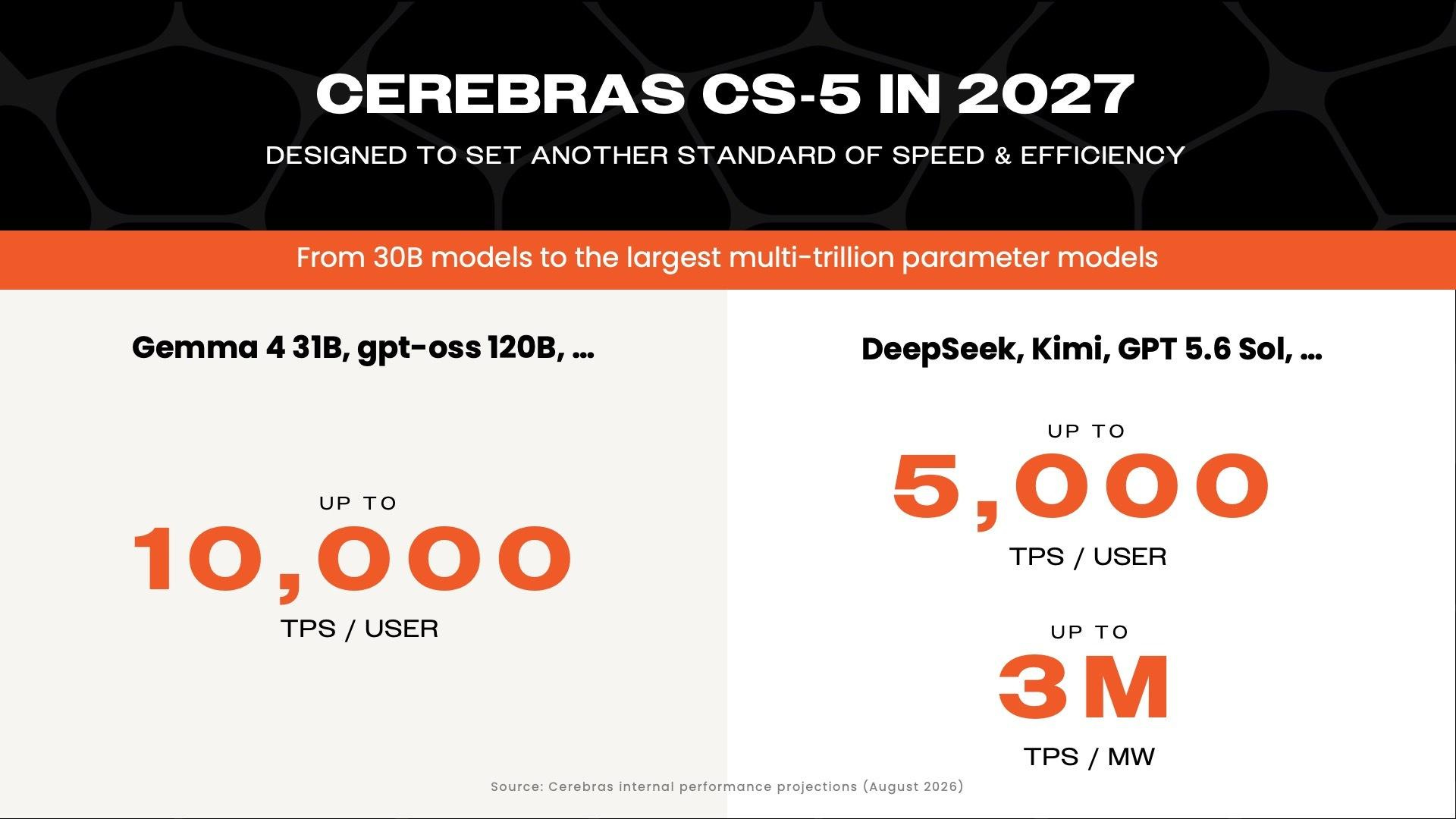
But let’s hit pause on the point about cutbacks and reflect some more there. What if OpenAI runs low on cash and has to slash spending, what does that mean for the $20bn CBRS contract? This is obviously one of the possibilities investors seem to care about the most. Well, I would probably assume CBRS is one of the last things to get cut. I’ve already mentioned the critical infrastructure point, but also the possibility of selling fast inference as a higher margin scarcity product. But taking it to the next level, what if OpenAI fails entirely and defaults? Or what if the industry-wide ‘overbuild’ results in a gigantic inference capacity glut? I think it’s entirely plausible, and indeed likely, that a glut in slow tokens could coexist with a shortage in the fastest tokens. For 2027, CBRS is targeting up to 5,000 output tokens per second per user on large frontier models with CS-5, alongside substantial improvements in aggregate throughput. These are roadmap targets, rather than demonstrated production results, and competitors are moving quickly too. But achieving that combination of model capability, speed and throughput would represent a significant advance. The relevant test will be whether anyone else can match it on comparable models, contexts and economics - and there are no signs of this yet, in my view. The market for sub-200 tok/s inference serves different needs from the market for 1,000+ tok/s inference, even though some customers will naturally trade speed against price and other capabilities. A glut of conventional inference capacity would therefore not necessarily imply a glut of the fastest inference. Given how early we are in deploying these capabilities widely, I think demand could continue to grow rapidly even through an industry downturn. That doesn’t make fast inference immune to falling prices or eventual oversupply, but it does make me extremely wary of treating all inference capacity as interchangeable.
For this reason, I think CBRS would have a very credible route to finding alternative customers quite quickly if OpenAI suddenly failed. The infrastructure’s usefulness would not disappear with its largest customer. But if replacing a major contracted revenue stream, the models served, prices achieved and resulting cash flows could all be different - and not necessarily for the worse, mind you. Reassuringly, Cerebras Cloud pre-exists the OpenAI relationship and, in fact, they already maintain an extensive menu of open source models (both large and small) available today for enterprise customers with reserved capacity.
And then, returning to ponder CBRS’s business model again briefly. For obvious reasons, everyone thinks of CBRS as a chip business, and chip businesses being cyclical should be appropriately discounted as such. But CBRS is rapidly evolving into a cloud infrastructure and leasing business: cloud and other services already accounted for approximately 70% of reported revenue in Q2 and remain on a upwards trajectory. This requires more capital upfront, but multi-year capacity commitments can provide much greater revenue visibility than a succession of discrete hardware orders. OpenAI’s published agreement, for example, makes payment obligations non-cancellable, subject to the contract’s terms. Of course, that visibility is only as good as CBRS’s ability to deliver and its customers’ ability to pay. But there’s another potential advantage: as an integrated AI infrastructure provider designing its own accelerators, CBRS can avoid paying an external supplier’s margin on the core wafer-scale hardware. As the business scales and the new industrialised Nexus architecture ramps production, that could translate into attractive costs. It doesn’t automatically establish the lowest cost in the industry - CBRS still has to fund its own development, manufacturing and operations - but the opportunity is clear. Admittedly, CBRS also plans to deploy AMD’s Helios systems as part of its disaggregated inference solution. The eventual proportion of spending and power accounted for by that hardware remains to be seen, particularly as it will handle prompt processing and long contexts. But this is also a way to improve the economics of the combined system by assigning different jobs to the hardware best suited to them.
And then there is the flexibility of CBRS’s distributed deployment model, which can use smaller, pre-existing or co-located facilities rather than requiring all its capacity to sit in one enormous tightly connected cluster. GPU inference can also be distributed, so this isn’t an exclusive advantage, but CBRS’s deployment flexibility could still help it secure power and bring capacity online quickly. Ultimately, the meaningful comparison is the total cost of delivering useful inference at the required speed and model capability, rather than simply the cost per megawatt. While we’re yet to get a firm idea of what CBRS’s operating cash flows and capex outlays could look like in the years ahead, there are obvious and major advantages to avoiding the ‘Nvidia tax’ on the one hand and having to build superclusters on the other. I’ll leave you to carry out your own projections on CBRS’s future capital requirements, but I’m optimistic that these financial resources, supplemented by cash generated as contracted capacity comes online, could stretch a long way. That remains a judgment about future spending and cash generation, rather than a claim that the entire growth plan is already fully funded. CBRS was fortunate to IPO when it did, with the realised upsizing(s) and pricing. The point here is that CBRS could have considerably more financial resilience than is apparently assumed.
Naturally, in the short term I very much doubt any of this really matters or will influence the stock positively. None of this is intended to persuade or offer comfort that CBRS has near-term downside protection. If we are indeed heading into a capex bust I would fully expect CBRS to get carried out with everything else - and perhaps even more so given its lingering perception as a highly speculative bubble stock. All stocks are participating in a Beauty Contest after all and it matters not what you or I think about CBRS in the long run, but what other investors think that other investors think (to the nth order) and generally in the short run. But what I will say is that the lower CBRS goes, the more likely it is to attract acquisition interest from strategic suitors. I can think of at least several potential buyers for whom CBRS ownership would be highly strategic. And I can think of several industry players who most likely would not want certain competitors to own CBRS either. In other words, we have the possibility of the catalyst for a bidding war, and I would just note that Nvidia acquired bits and pieces of Groq last year for around $20bn. That doesn’t establish what anyone would pay for CBRS, but it does suggest the strategic value of these capabilities can be substantial.
Most importantly for myself as a long-term holder (and perhaps for some of you too), it’s helpful to have some degree of confidence that CBRS is capable of surviving whatever surprises might come down the road, and better yet - flourishing.
Thanks for reading.